If you bought your e-bike with a lead-acid battery, you already know the routine. It was heavy from day one. After six months, the range started shrinking. After a year, you are charging twice as often and going half as far. By year two, you are shopping for a replacement — again.
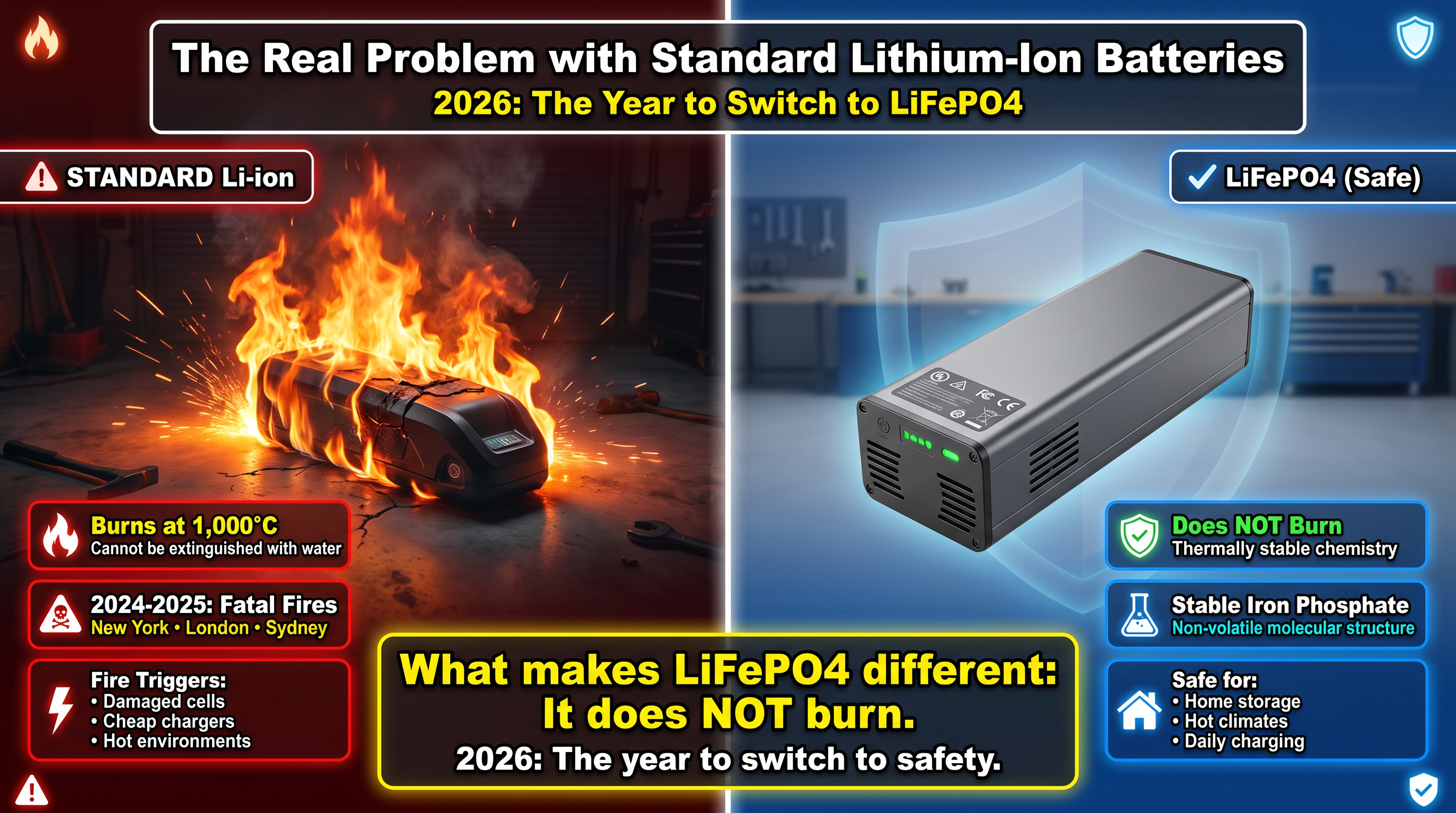
Even standard lithium-ion packs, the kind most mid-range e-bikes ship with, have a real problem. They are lighter than lead-acid, sure. But the chemistry is volatile. A damaged cell, a cheap charger, one hot afternoon in a parked garage — and you have a fire that burns at 1,000 degrees and cannot be put out with water. In 2024 and 2025, e-bike battery fires killed people in New York, London, and Sydney. Not hypothetical. Real.
This is why LiFePO4 exists. And this is why 2026 is the year to switch.
What makes LiFePO4 different
The short answer: it does not burn.
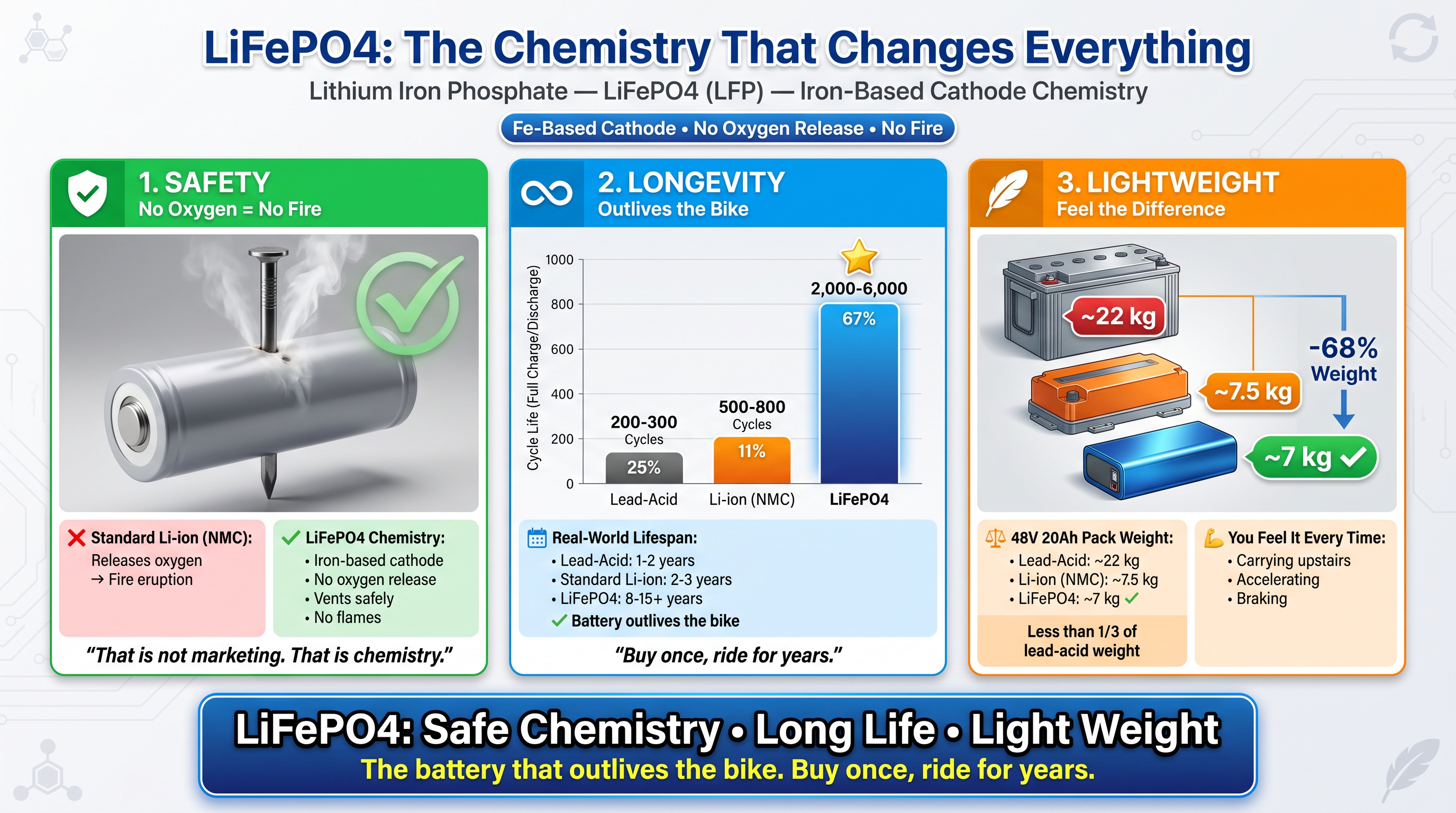
Lithium Iron Phosphate — LiFePO4, or just LFP — uses an iron-based cathode. Unlike the nickel-manganese-cobalt chemistry in standard lithium packs, LFP does not release oxygen when it fails. No oxygen means no fire. You can drive a nail through a fully charged LiFePO4 cell and it will vent, maybe smoke, but it will not erupt into flames. That is not marketing. That is chemistry.
The other thing: these batteries last. A lead-acid battery gives you 200 to 300 full cycles before it is toast — about one to two years of real riding. A standard lithium pack, maybe 500 to 800 cycles. A well-made LiFePO4 pack is rated for 2,000 cycles at minimum. Premium packs built with quality BMS protection hit 4,000, even 6,000 cycles. For most riders, that means the battery outlives the bike. Buy once, ride for years.
And yes, they are light. A 48V 20Ah LiFePO4 pack weighs about 7 kilograms, roughly the same as an NMC pack and less than a third of the lead-acid brick it replaces. You feel that difference every time you carry the battery upstairs, every time you accelerate, every time you brake.
Three reasons this matters more in 2026
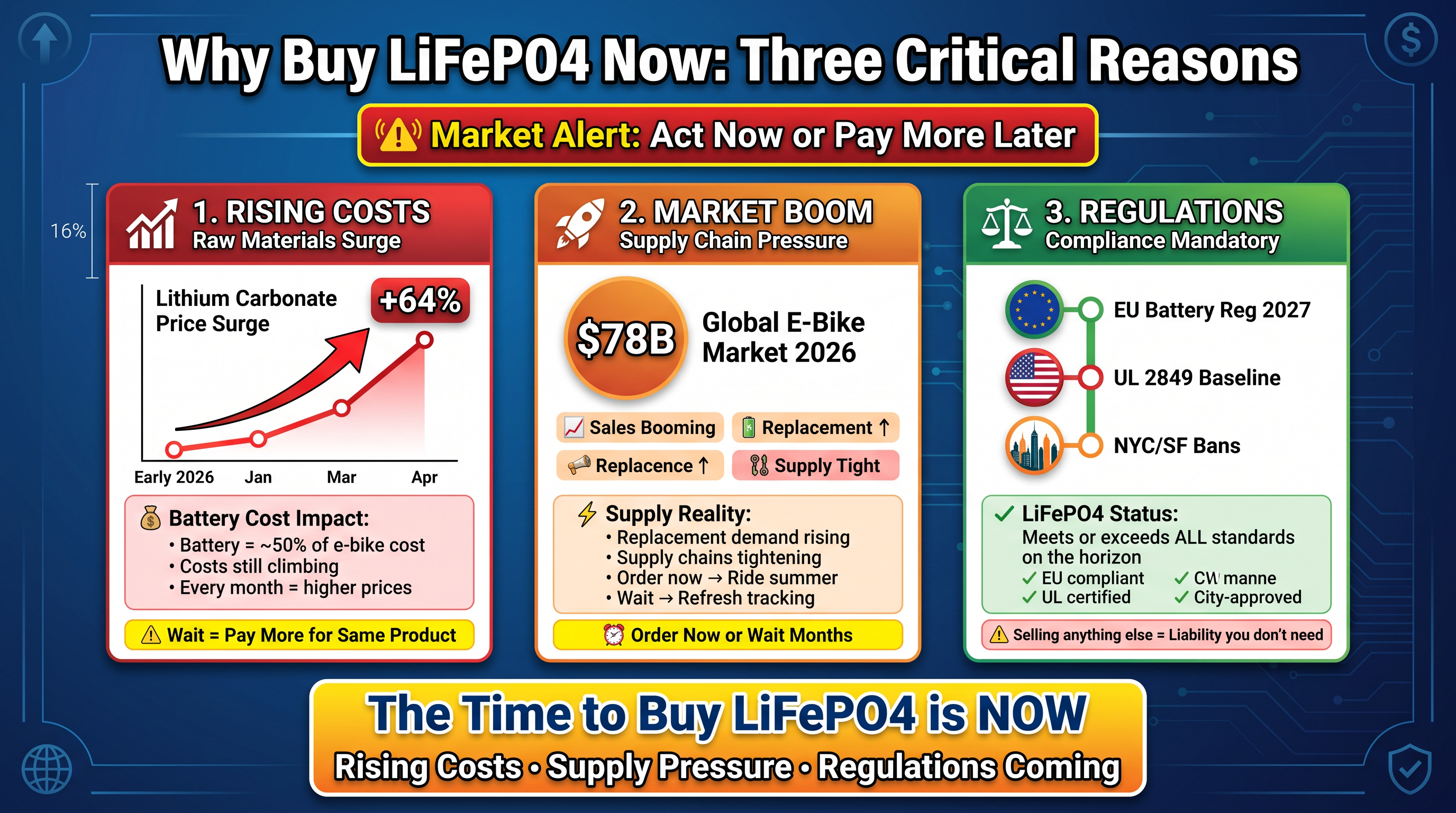
First, raw materials are getting expensive. Lithium carbonate prices jumped 64 percent in the first few months of 2026 alone. Battery costs already make up nearly half of what an e-bike costs to build, and those costs are still climbing. Every month you wait, you pay more for the same product.
Second, e-bike sales are booming. The global market hit nearly 78 billion dollars this year. Replacement battery demand is rising with it, and supply chains are tightening. The riders who order their LiFePO4 pack now will be riding through the summer. The rest will be refreshing tracking numbers.
Third, regulations are coming. The European Union’s new battery regulation takes full effect in 2027. UL 2849 certification is becoming the baseline expectation in the American market. Cities from New York to San Francisco are writing laws against uncertified e-bike batteries. LiFePO4 already meets or exceeds every standard on the horizon. If you are selling e-bikes or batteries, selling anything else is a liability you do not need.
What to look for when you buy
Voltage first. 48V is the industry standard now — it replaced 36V as the default about two years ago and gives you noticeably more torque on hills. If you are building a high-performance bike, 52V is worth considering, but 48V is the safe bet for 90 percent of riders.
Capacity depends on how you ride. A 20Ah pack will get a commuter through a full week on a single charge. Delivery riders and long-distance tourers should look at 30Ah.
The BMS — Battery Management System — is the part you never see but absolutely cannot cheap out on. A good BMS protects against overcharging, deep discharge, short circuits, and temperature extremes. It is the difference between a battery that lasts 6,000 cycles and one that dies in 600.
Our e-bike packs
We are UPOWER, a battery manufacturer based in Dongguan, China. We have been building LFP packs for 15 years — not just e-bike batteries, but solar storage systems, marine packs, and industrial power banks. The same 18650 cylindrical LFP cells and protective BMS technology that runs a 10 kWh home solar backup also runs our e-bike line. We offer custom packs in 36V, 48V, 52V, and 72V, with capacities from 20Ah to 30Ah and beyond. Every pack ships with multi-protection BMS and full certification. You can add your own branding, packaging, and spec sheet — we handle the engineering.
If you are a distributor, a fleet operator, or a rider who wants a battery that lasts longer than the bike it powers, get in touch.
Email: info@uli-power.com
Phone: +86 18565703627
Web: www.uli-power.com
Post time: Jul-21-2026