If you fly a drone for a living, you do not ask about cycle life. You do not ask about cost per kilowatt-hour. You ask one question: how much energy can this battery carry per gram? Everything else is secondary. Because in the air, weight is not a spec. It is gravity working against you the entire time.
That is why NMC owns the sky.
The math is brutal and simple
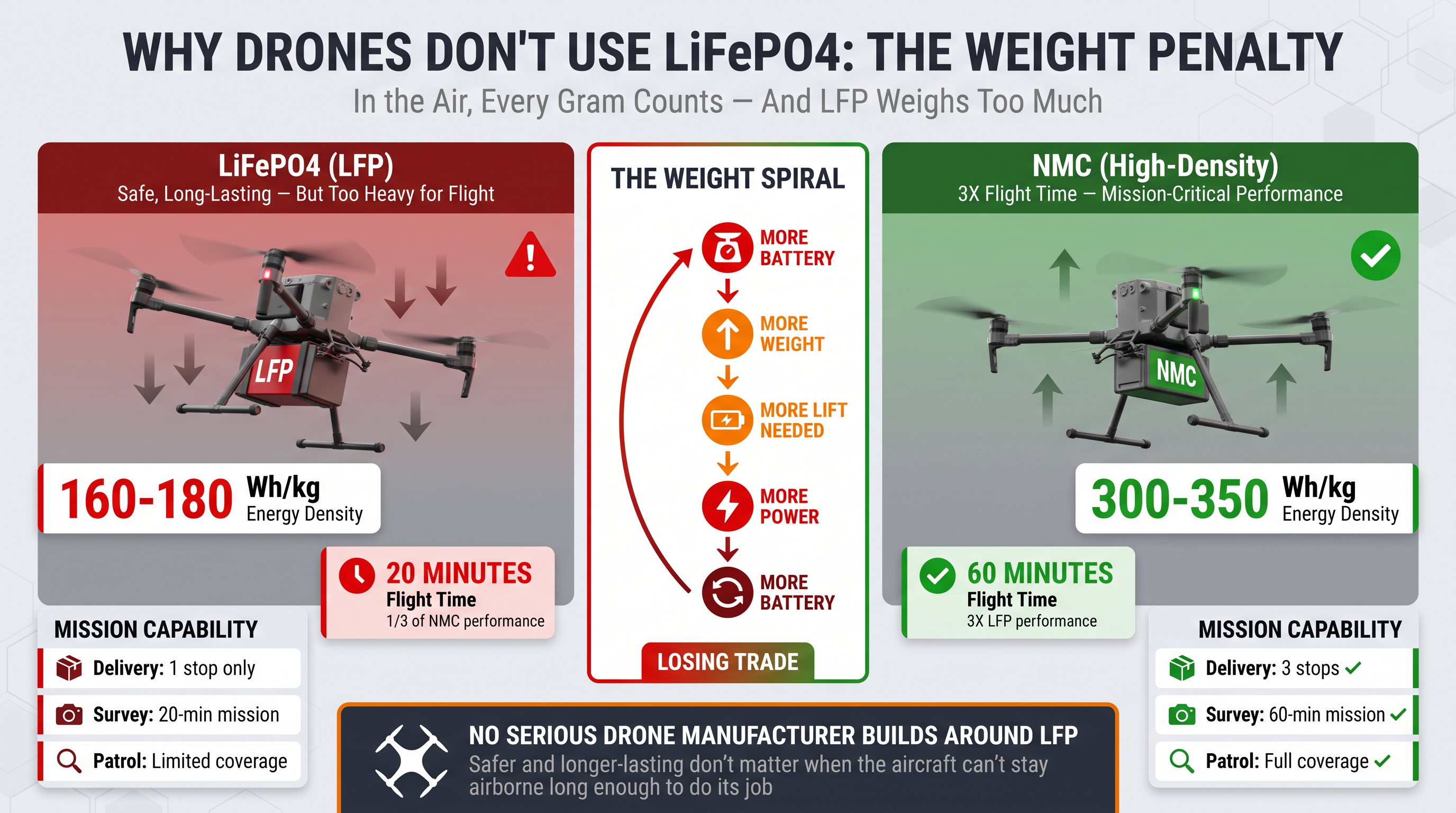
A standard LiFePO4 cell delivers about 160 to 180 watt-hours per kilogram. That is perfectly fine on the ground. In an e-bike, in a solar cabinet, in the back of an RV, weight is manageable. Add more cells if you need more range. The ground holds you up.
In the air, adding more cells is a losing trade. Every extra gram of battery requires more lift, which requires more power, which requires more battery, which adds more weight. A drone carrying LFP cells gets roughly one-third the flight time of the same drone carrying high-density NMC. That is not an estimate. It is the difference between a 20-minute survey mission and a one-hour patrol. Between a delivery drone that makes one stop and one that makes three. Between a reconnaissance UAV that returns with data and one that runs out of power somewhere over the target.
This is why no serious drone manufacturer builds around LFP. The chemistry is safer and lasts longer, and none of that matters when the aircraft cannot stay in the air long enough to do its job.
What NMC actually delivers at altitude
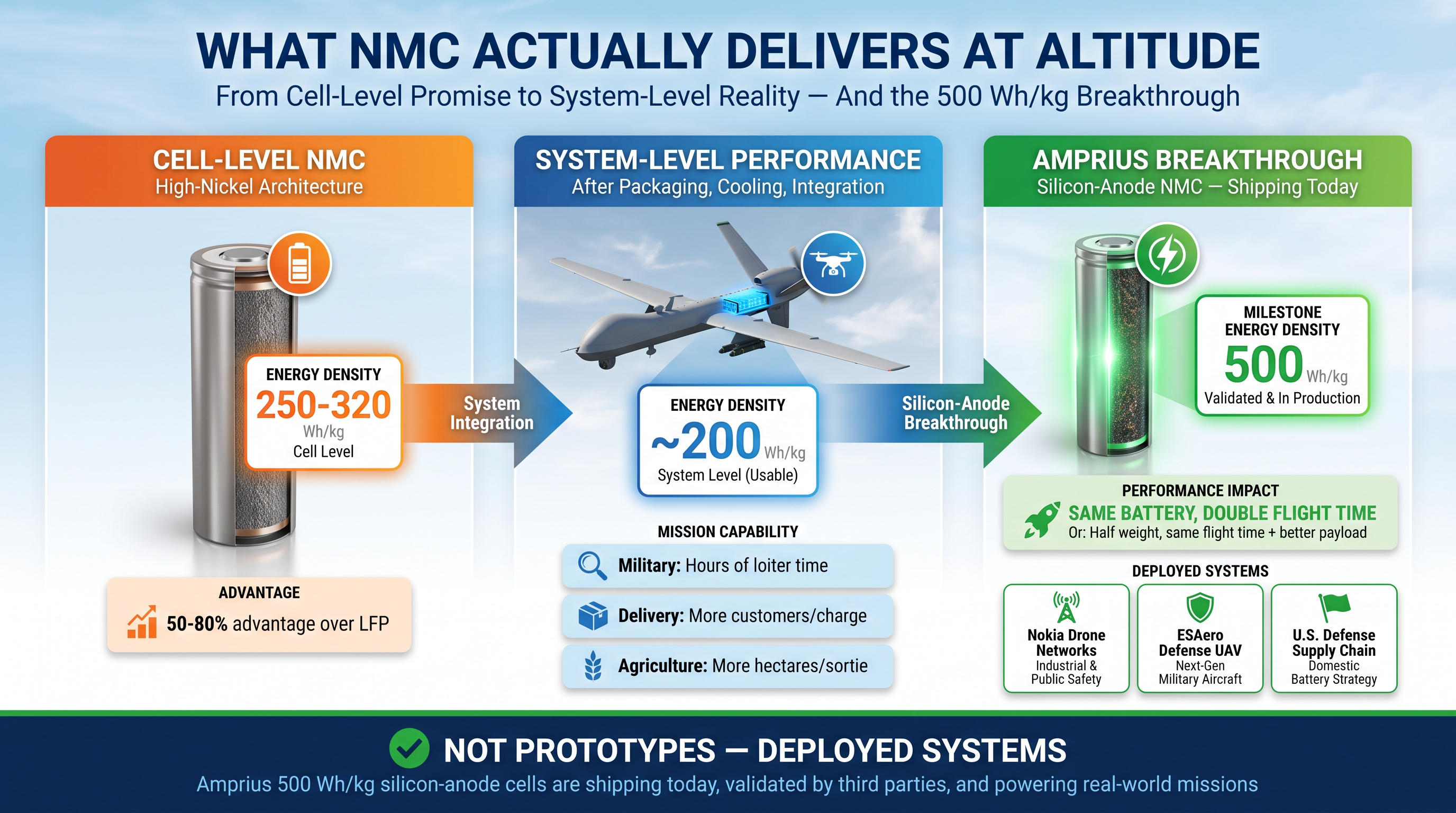
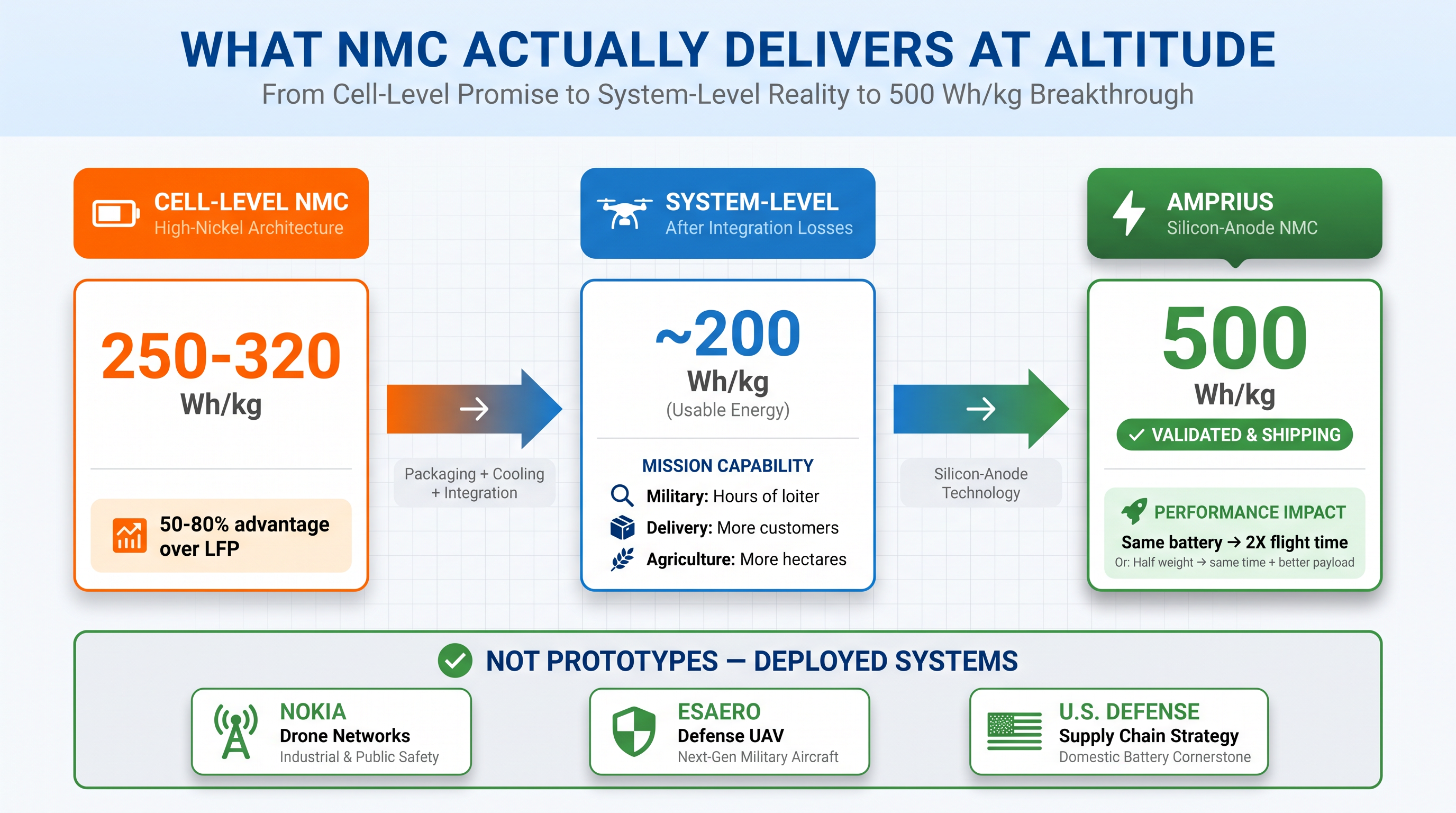
At the cell level, high-nickel NMC architectures consistently achieve 250 to 320 watt-hours per kilogram. That is already a 50 to 80 percent advantage over LFP. But the numbers that matter for aviation are not at the cell level. They are at the system level, where packaging, cooling, and structural integration eat into usable density.
Even after those losses, an NMC-powered UAV carries roughly twice the usable energy per kilogram of an LFP equivalent. That translates directly into mission capability. A military surveillance drone with NMC can loiter for hours instead of minutes. A commercial delivery drone can serve more customers per charge. An agricultural spray drone can cover more hectares per sortie.
And then there is the Amprius story, which pushes the math even further.
Amprius and the 500 Wh/kg milestone
Amprius Technologies, a California-based manufacturer, has done something that rewrites the drone industry’s assumptions. Its silicon-anode lithium-ion cells — which use an NMC-type cathode paired with a nanostructured silicon anode instead of conventional graphite — ship today at 450 watt-hours per kilogram. The 500 Wh/kg version has been validated by independent third parties and is entering production.
What does 500 Wh/kg mean in practice? It means a drone that previously carried a 1-kilogram battery and flew for 30 minutes now carries the same battery and flies for an hour. Or it carries a 500-gram battery, flies the same 30 minutes, and uses the saved weight for a better camera, a heavier payload, or additional sensors.
Amprius batteries are already in the field. Nokia has integrated them into its Drone Networks platform for industrial and public safety operations. ESAero, a defense UAV manufacturer, selected Amprius silicon cells to power its next-generation unmanned aircraft. The U.S. defense sector has made Amprius a cornerstone of its domestic battery supply chain strategy. These are not prototypes. These are deployed systems.
The aviation ceiling: how far NMC still has to go
Here is the humbling number that puts everything in perspective: jet fuel has an energy density of about 12,000 watt-hours per kilogram. The best batteries humanity has ever built — the Amprius 500 Wh/kg cells — are at 4 percent of that.
Commercial electric aviation — passenger eVTOLs, regional electric aircraft — needs battery energy density in the 400 to 600 Wh/kg range to be economically viable, and 800 to 1,000 Wh/kg to compete with turboprops on range. NMC with silicon anodes is the only lithium chemistry within striking distance of that threshold. Solid-state may eventually surpass it, but solid-state is still learning to walk. NMC with advanced anodes is already running.
This is why the entire electric aviation industry is betting on NMC. Every eVTOL startup from Joby to Archer, every hybrid-electric regional aircraft program, every high-altitude pseudo-satellite platform — they all depend on continuous improvement in NMC energy density. If NMC hits 600 Wh/kg by 2030, electric aviation becomes real. If it stalls at 400, the industry stalls with it. There is no fallback chemistry. LFP cannot do this job.
What this means on the ground
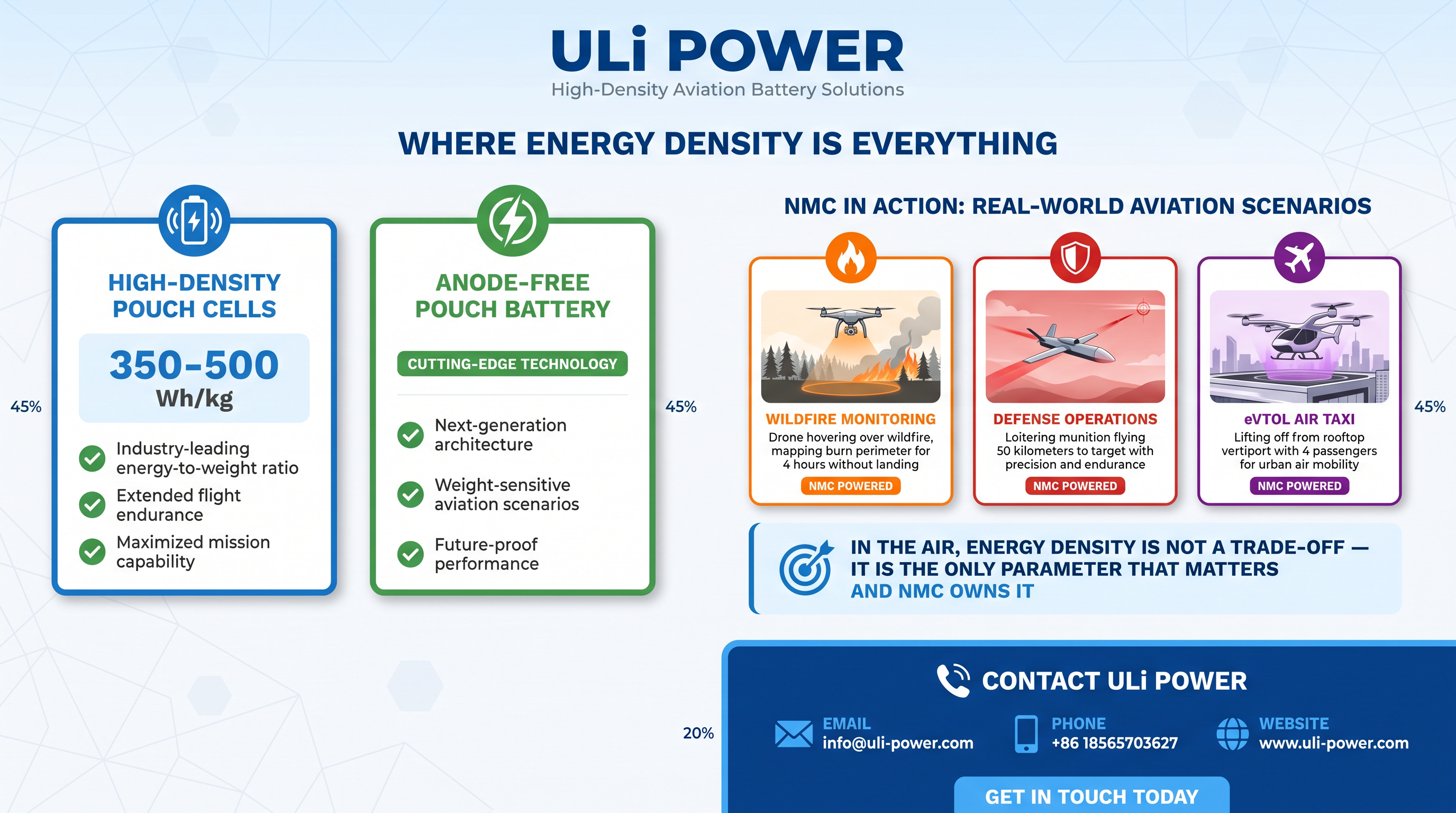
At ULi Power, we provide high-density pouch cells with energy density ranging from 350 Wh/kg to 500 Wh/kg, as well as cutting-edge anode-free pouch battery solutions. Built for weight-sensitive aviation scenarios, they deliver industry-leading energy-to-weight performance to extend flight endurance and maximize mission capability.
But when you see a drone hovering over a wildfire, mapping the burn perimeter for four hours without landing, that is NMC. When a defense contractor specs a loitering munition that needs to fly 50 kilometers to its target, that is NMC. When an eVTOL air taxi lifts off from a rooftop vertiport with four passengers, that is NMC.
In the air, energy density is not a trade-off. It is the only parameter that matters. And NMC owns it.
Email: info@uli-power.com
Phone: +86 18565703627
Web: www.uli-power.com
Post time: Aug-03-2026