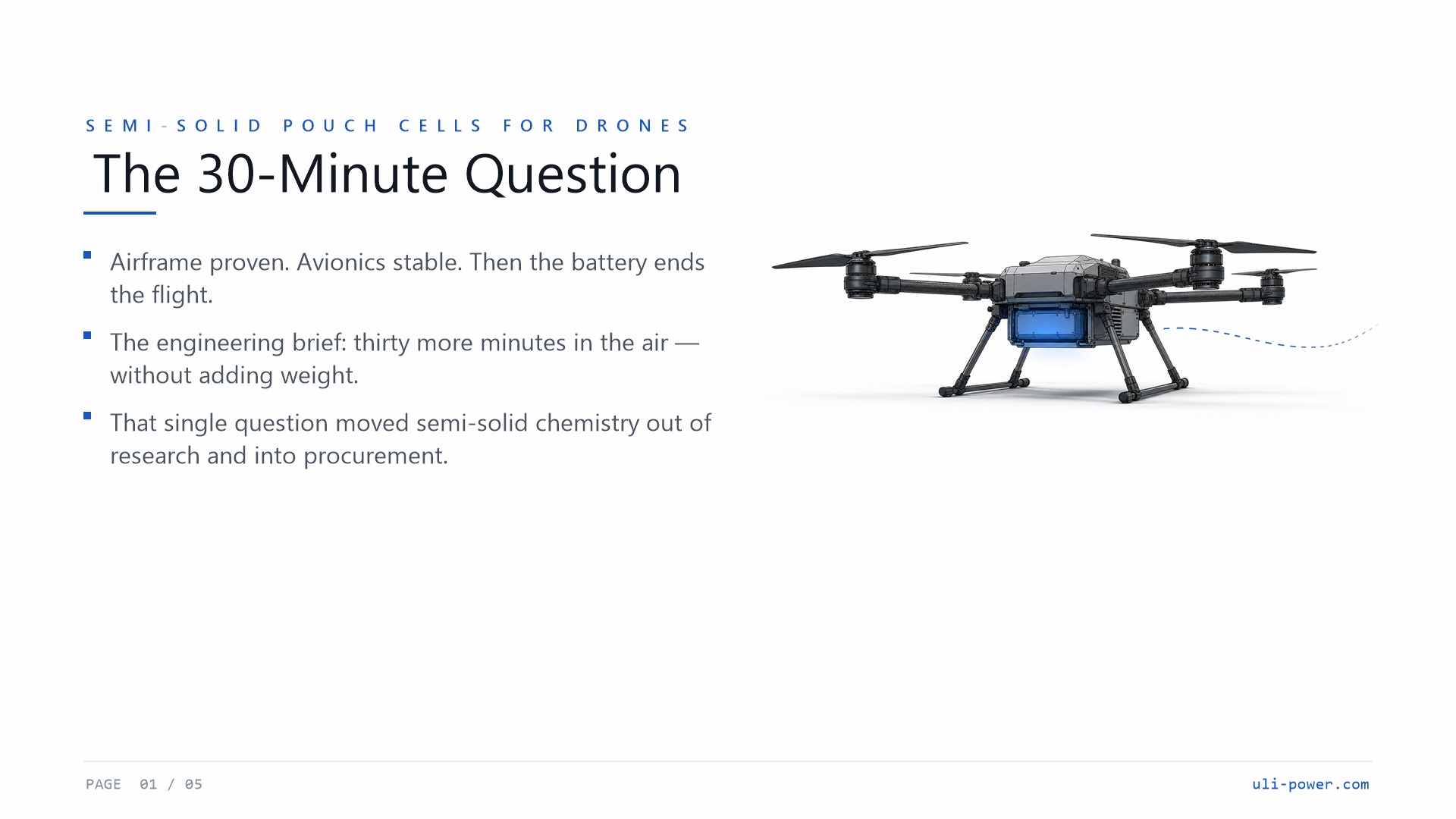
Every drone maker runs into the same wall eventually. The aircraft works. The airframe is proven. The avionics are stable. And then the battery runs out, and the flight ends, and someone in the engineering meeting asks the question that defines the next two years of the product: how do we get thirty more minutes in the air without adding weight?
That question is why the semi solid state battery has moved from a research topic toward a real procurement option. Industrial, agricultural, and long-endurance programs are evaluating semi-solid chemistry, but product maturity, test evidence, and commercial availability vary widely. This article explains what a semi solid state battery cell actually is, why the pouch format is attractive for aircraft, which chemistries matter, and how to read the specifications when you are ready to buy.
What “semi-solid” actually means
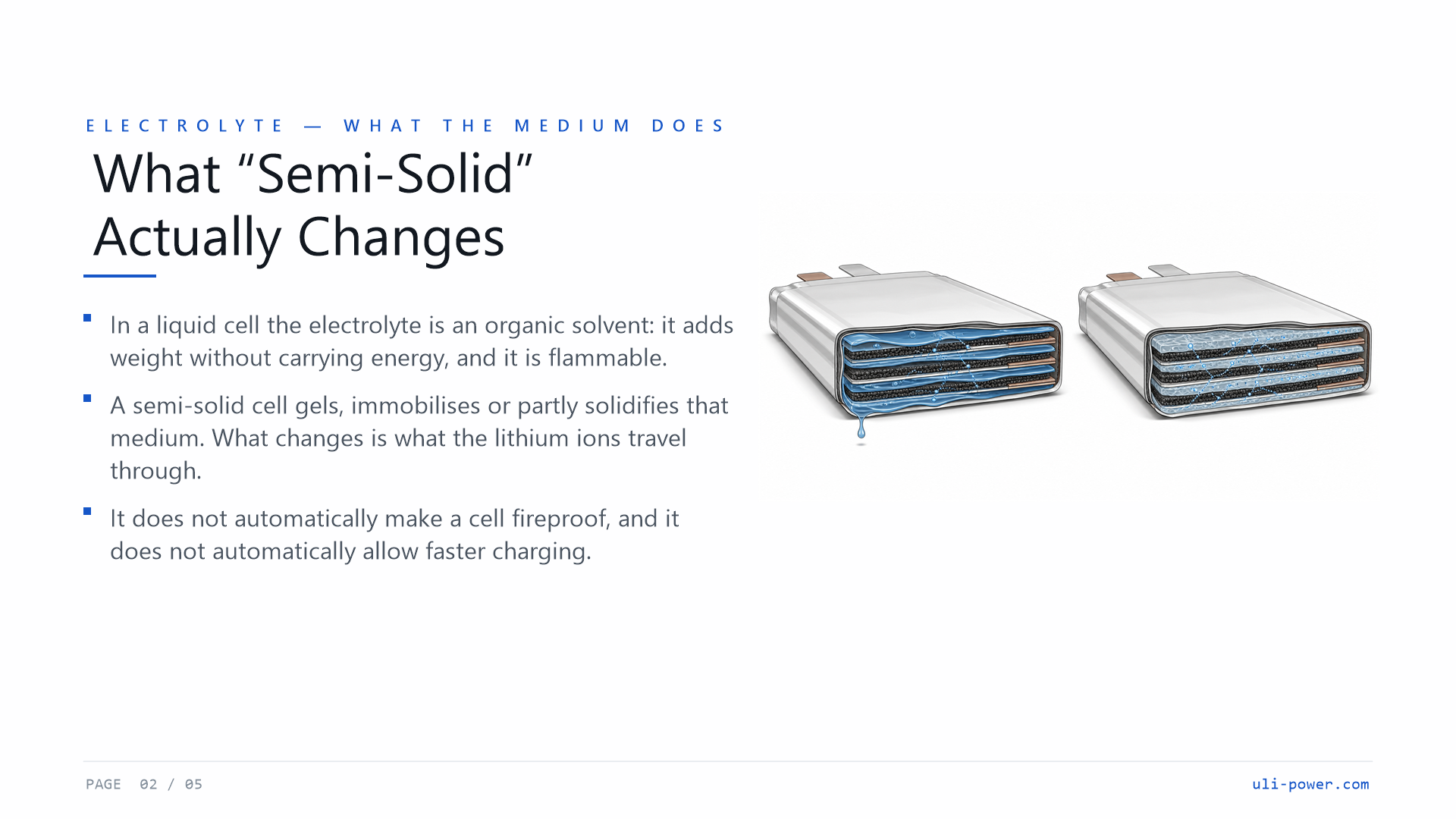
A conventional lithium-ion cell is, in one sense, a soup. The electrolyte is a liquid — an organic solvent carrying lithium salts between the anode and the cathode. It works well, but a liquid is compressible, flammable, and it sets a practical ceiling on how dense you can pack the cell, because the liquid adds weight without carrying energy.
A semi solid electrolyte battery changes part of that design. Depending on the manufacturer, the electrolyte may be gelled, immobilized, or combined with a solid component. This can support higher active-material loading and may improve resistance to leakage or thermal propagation, but the result depends on the exact chemistry, construction, and validation data. It does not automatically make a cell fireproof or suitable for faster charging. What changes is the medium through which lithium ions travel.
A fully solid-state cell replaces the liquid electrolyte with a solid ceramic, polymer, or composite system. It may offer a different route to higher density and safety, but its commercial timing varies by chemistry and manufacturer. Semi-solid designs are attractive because they can often use more familiar pouch-cell manufacturing processes, while still requiring product-specific validation.
Why the pouch format wins for drones
Among the possible formats — cylindrical, prismatic, and pouch — the semi solid state pouch is attractive for many drone designs, for three mechanical reasons.
First, weight. The pouch cell does not use the same metal can structure as a cylindrical cell. That can reduce inactive packaging mass, although the finished pack still needs compression, protection, thermal management, busbars, and housing. An NMC soft pouch cell may therefore achieve a favorable pack-level gravimetric result when the design is optimized.
Second, packaging freedom. A drone battery designer is rarely limited to a simple rectangle. Airframes may need wedges, stepped packs, or thin modules that use the available volume efficiently. A semi solid state pouch cell can be produced in different plan sizes and stacked or integrated into a pack architecture. The cell itself should not be bent or molded in service; the flexibility is mainly in the laminate format and pack layout.
Third, thermal management. Pouch cells have large flat surfaces that can simplify heat transfer to a designed cooling path. In a high-discharge drone platform, where the pack may experience high peak C-rates under full throttle, thermal design, cell spacing, compression, sensors, and control limits determine whether the battery maintains performance or shuts down.
When a UAV pouch cell specification sheet says “soft pack,” it means this: flexible aluminum-plastic laminate casing, high discharge capability, and a shape that is defined by the customer’s airframe, not by the battery factory.
The chemistry: NMC at the center
Many high-energy semi-solid drone programs use ternary chemistry, particularly NCM/NMC cathodes containing nickel, cobalt, and manganese. High-nickel cathodes are attractive because they can provide high specific energy, but NMC is not the only possible semi-solid chemistry. The right choice depends on energy density, discharge demand, thermal design, cycle life, certification, and cost.
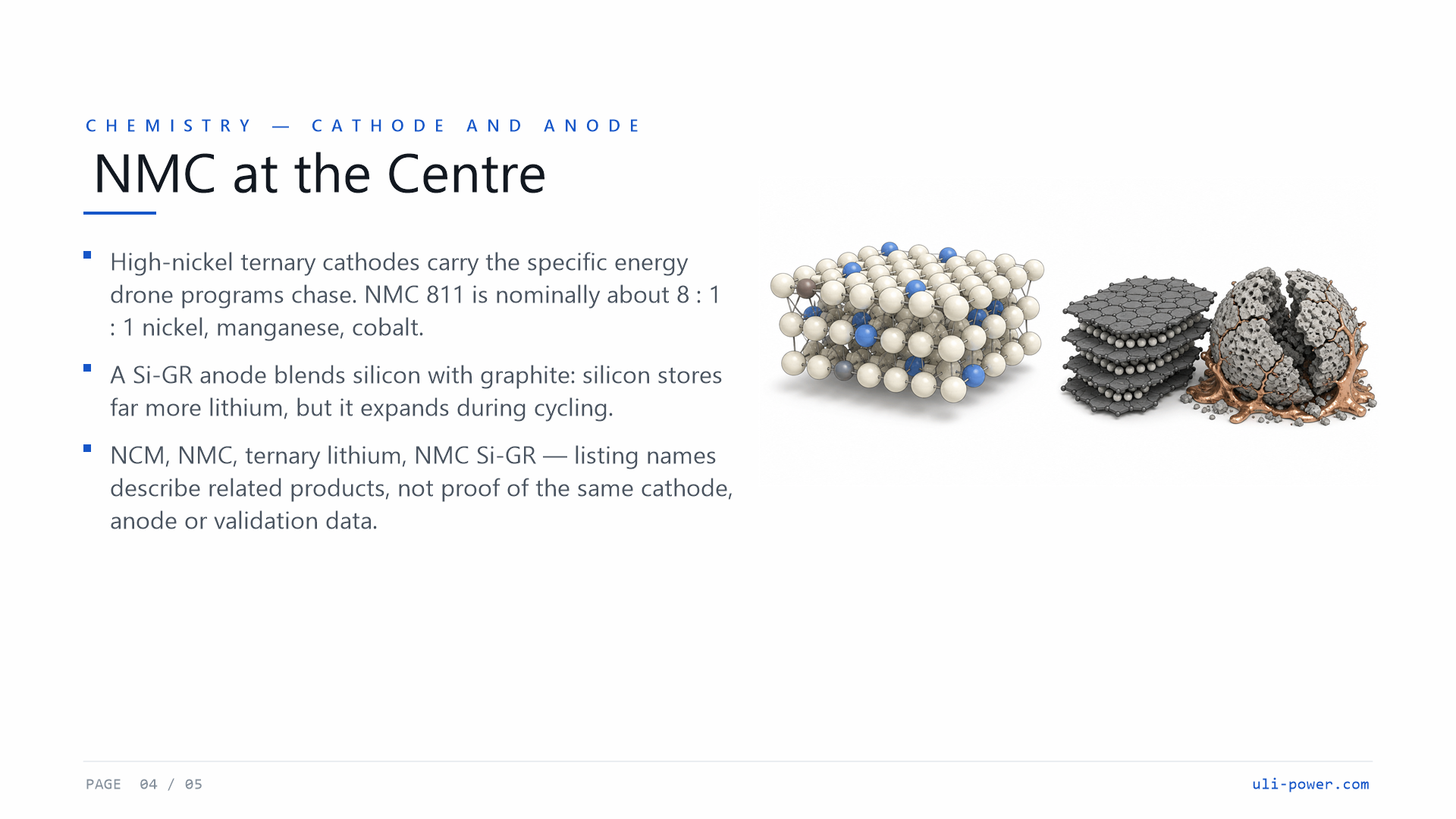
The NMC 811 pouch cell is one familiar high-nickel formulation, nominally using an approximately 8:1:1 ratio of nickel, manganese, and cobalt in the cathode. Actual commercial performance depends on electrode loading, cell design, formation, and test conditions. A semi solid electrolyte battery may exceed the energy density of a comparable liquid-electrolyte design, but any Wh/kg claim should be tied to a cell-level test method and not treated as a universal value.
You will see many names in supplier listings — NCM pouch cell, NMC pouch cell, ternary lithium pouch, NMC pouch cell battery, NMC pouch battery, and NMC pouch battery cell. These names may describe related products, but they do not by themselves prove the same cathode composition, anode, electrolyte, or production status. A semi solid pouch cell battery and an NMC high energy cell from the same factory may share a pouch format while differing substantially in chemistry and validation data.
One variant worth knowing is the NMC Si-GR pouch cell drone platform, where the anode uses a silicon-graphite blend rather than graphite alone. Silicon has a much higher theoretical lithium-storage capacity than graphite, but it also expands during cycling. The practical gain from a silicon addition depends on the silicon fraction, binder system, electrode loading, formation process, and cycle-life target; a supplier should provide measured cell data rather than a headline percentage.
Common capacity formats you will encounter
If you search for a semi solid battery supplier or a semi solid pouch cell supplier, the first thing you will notice is that capacities cluster around specific formats, because airframe designs have standardized around them.
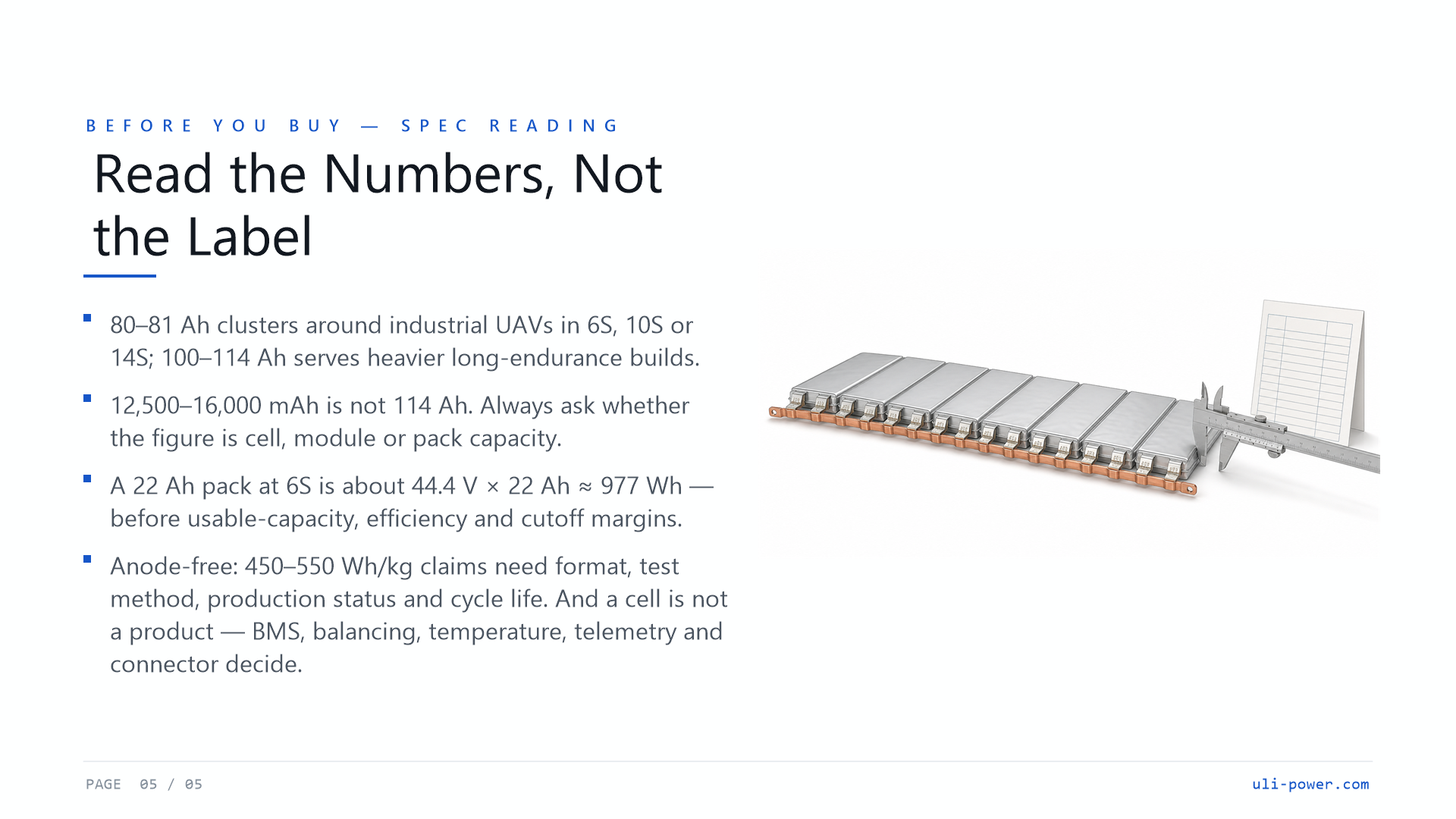
The 80 to 81 Ah range appears constantly in industrial drone platforms: an NMC pouch cell 80Ah or a semi solid state battery 81Ah configured in 6S, 10S, or 14S to match motor voltage requirements. The 100 to 114 Ah class may serve heavier long-endurance platforms, but capacity alone does not identify a complete pack. An NMC pouch cell 100Ah or a semi solid state battery 114Ah must be evaluated together with nominal voltage, series/parallel configuration, mass, C-rate, cooling, and usable state-of-charge window. Also, 12,500 to 16,000 mAh is not equivalent to 114 Ah: those are different capacity classes, not merely different units. Always verify whether a supplier is quoting cell capacity, module capacity, or total pack capacity.
When engineers search for a semi-solid state battery 16000mAh or a semi-solid state battery 22000mAh, they are usually looking for a module or pack capacity in that range. A 22 Ah pack configured as 6S has a nominal energy of approximately 44.4 V × 22 Ah = 977 Wh before usable-capacity, efficiency, and cutoff margins. A 22 Ah label alone does not tell you the pack voltage or the actual flight time.
The anode-free frontier
Beyond the mainstream semi solid state pouch sits the dry anode-free pouch cell, where there is no conventional graphite host before the first charge. Lithium plates onto the current collector during charging. The architecture can reduce inactive mass and increase cell-level energy density, but it remains a development-heavy route. Claims such as 450 to 550 Wh/kg must be checked for cell format, test conditions, production status, and cycle-life data; a laboratory result is not the same as a qualified commercial pack.
The main trade is durability. Anode-free designs must control lithium deposition, swelling, impedance growth, and safety across repeated cycles. A solid state drone battery or a dry anode-free pouch cell therefore needs application-specific validation. For many commercial drone operators, a well-tested NMC semi-solid drone battery may offer a more practical balance than a higher-density design with limited field data.
Putting it into a pack
A single cell is not a product. A drone needs a semi solid state battery pack with balancing, temperature monitoring, discharge telemetry, and a connector scheme that matches the aircraft. A semi-solid lithium battery pack specification should tell you, at minimum: cell chemistry and energy density in Wh/kg, cycle life at a defined discharge rate, operating temperature range, charging C-rate, and the BMS features. Anything less, and you are buying blind.
This is where a semi solid battery supplier you can actually talk to becomes valuable. The technology has moved fast enough that the difference between a lab sample and a flight-proven product is not always visible on the spec sheet.
We are ULi — Dongguan Youli Electronic Technology Limited. We build LiFePO4 and NMC pouch cell packs for aerial and ground platforms, from industrial drones to e-bikes and energy storage. If your airframe needs a semi solid state pouch cell in a specific shape, voltage, or capacity, send us the drawing. We will tell you honestly what we can build, what the cycle life will be, and what it costs.
Email: info@uli-power.com
Phone: +86 18565703627
Web: www.uli-power.com
Post time: Sep-29-2026