The electric vertical take-off and landing industry has a battery problem. Not a shortage problem, not a cost problem — a density problem. The batteries that power today’s air taxi prototypes are simply not dense enough to make the economics work at scale. And the industry knows it.
Current aviation-grade lithium-ion NMC cells deliver 250 to 300 watt-hours per kilogram. That sounds impressive compared to a standard EV battery, which runs around 180 Wh/kg. But for an aircraft that has to lift its own battery, its passengers, its structure, and its motors — all while burning continuous power with no coasting, no regenerative braking, no rest — 300 Wh/kg is the floor of viability, not the ceiling of ambition.
The industry target is 400 Wh/kg. At that density, an air taxi can carry four passengers across a city on a single charge with enough margin to handle weather, detours, and the degradation that accumulates over hundreds of flight cycles. Below 400, operators are running on thin margins that compound into unsustainable unit economics. Semi-solid pouch cells, which are now reaching 300 to 350 Wh/kg in early production, are the closest technology to closing that gap today.
Why the battery defines everything
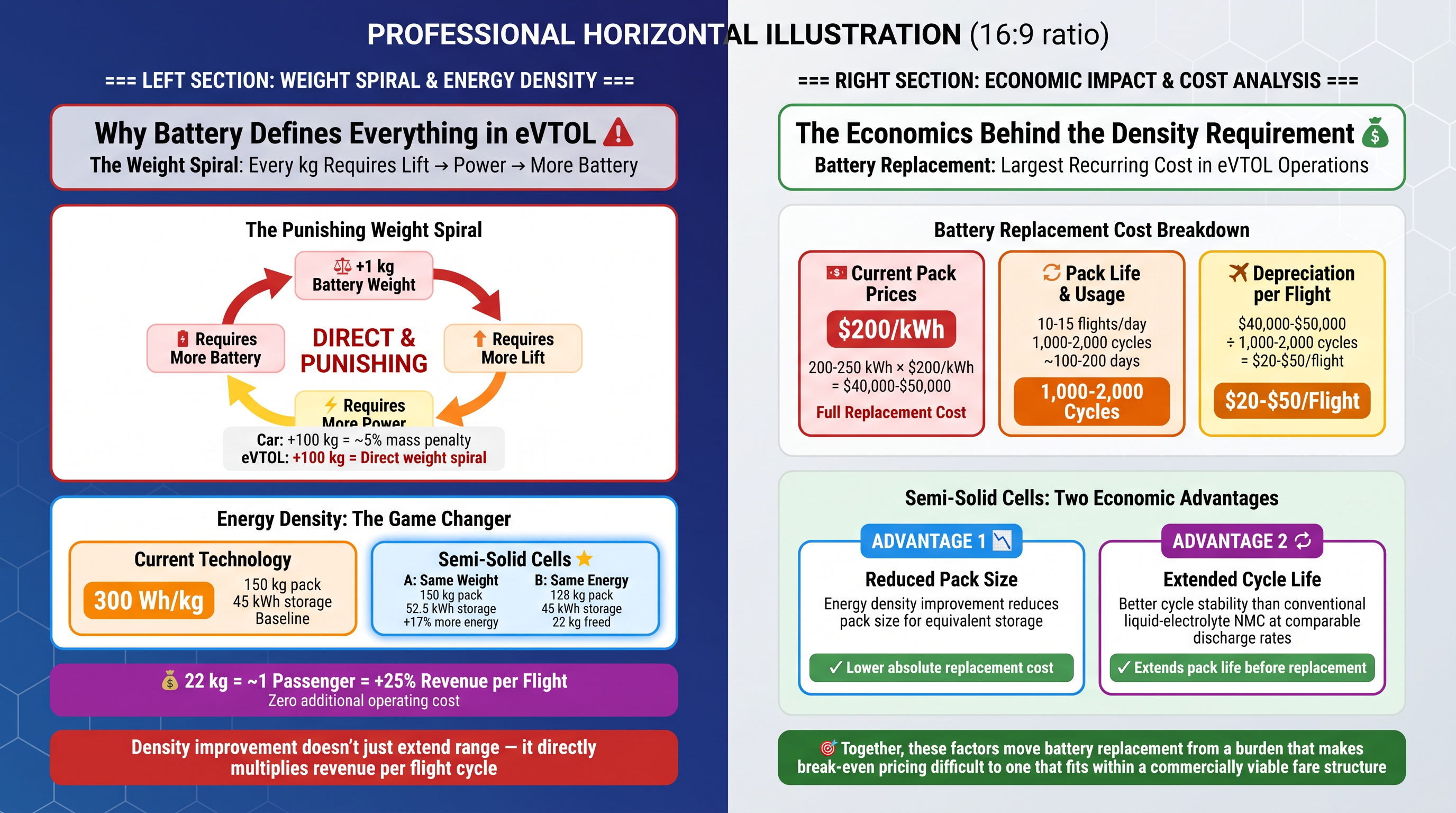
Battery weight on an eVTOL is not like battery weight in a car. In a car, an extra 100 kilograms of battery is about a 5 percent penalty on total vehicle mass and a minor reduction in handling dynamics. In an eVTOL, every kilogram of battery requires lift, and lift requires power, and power requires battery. The weight spiral is direct and punishing.
Current battery packs represent 25 to 35 percent of an eVTOL’s total take-off weight. At 300 Wh/kg, a 150-kilogram battery pack stores 45 kilowatt-hours. Replace those cells with 350 Wh/kg semi-solid cells and the same pack stores 52.5 kilowatt-hours — 17 percent more energy at identical weight. Or the operator achieves the same 45 kWh storage in a 128-kilogram pack, freeing 22 kilograms for payload, structure, or range extension.
Twenty-two kilograms is roughly one additional passenger. In a four-seat air taxi, that is a 25 percent revenue increase per flight with zero additional operating cost. The battery density improvement does not just extend range. It directly multiplies revenue per flight cycle.
The economics behind the density requirement
Battery replacement is the largest recurring cost in eVTOL operations. At current pack prices of 200 per kilowatt-hour, a full replacement runs 40,000 depending on aircraft size. At 10 to 15 flights per day and a pack life of 1,000 to 2,000 cycles, that replacement cost adds 50 per flight in depreciation.
Semi-solid cells bring two advantages to this equation. First, the energy density improvement reduces pack size for equivalent storage, which reduces absolute replacement cost per aircraft. Second, semi-solid cells generally show better cycle stability than conventional liquid-electrolyte NMC at comparable discharge rates, which extends pack life before replacement — the data is still accumulating from real-world deployments, but the materials science supports a meaningful improvement.
Together, these factors move the battery replacement line in the operating cost model from a burden that makes break-even pricing difficult to one that fits within a commercially viable fare structure.
What semi-solid actually changes in the cell
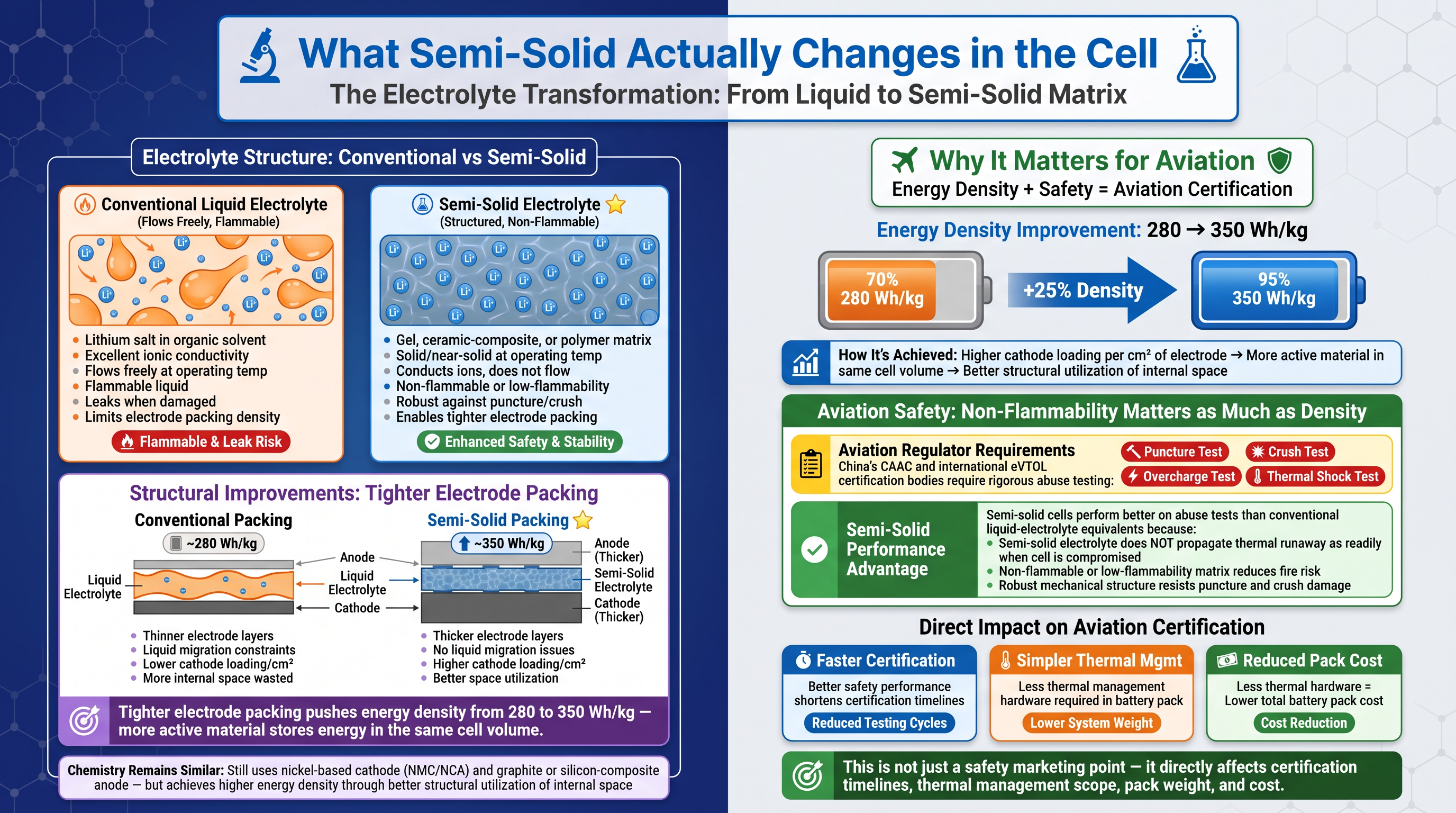
The term “semi-solid” refers to the electrolyte. In a conventional lithium-ion cell, the electrolyte is a liquid — a lithium salt dissolved in an organic solvent that allows ions to move between the anode and cathode. Liquid electrolytes have excellent ionic conductivity, but they are flammable, they leak when cells are mechanically damaged, and they impose constraints on how densely the electrode materials can be packed.
In a semi-solid cell, some or all of the liquid electrolyte is replaced with a gel, ceramic-composite, or polymer matrix that is solid or near-solid at operating temperature. The electrolyte still conducts ions but does not flow freely. The mechanical properties change: the cell becomes more robust against puncture and crush, the flammability risk decreases substantially, and — critically — the electrode layers can be made thicker and pressed together more tightly without the liquid migration problems that limit conventional cells.
This tighter electrode packing is what pushes energy density from 280 to 350 Wh/kg. The cathode loading per square centimeter of electrode increases, meaning more active material stores energy in the same cell volume. The result is a cell that is not fundamentally different in chemistry — it still uses a nickel-based cathode and graphite or silicon-composite anode — but achieves meaningfully higher energy density through better structural utilization of the internal space.
For aviation, the non-flammability benefit matters as much as the density improvement. Aviation regulators — including China’s CAAC and the international bodies certifying eVTOL aircraft — require battery systems to pass rigorous abuse testing including puncture, crush, overcharge, and thermal shock. Semi-solid cells perform better on these tests than conventional liquid-electrolyte equivalents because the semi-solid electrolyte does not propagate thermal runaway as readily when a cell is compromised. This is not just a safety marketing point. It directly affects certification timelines and the scope of thermal management hardware required in the battery pack — which in turn affects pack weight and cost.
Where 2026 stands for eVTOL battery certification
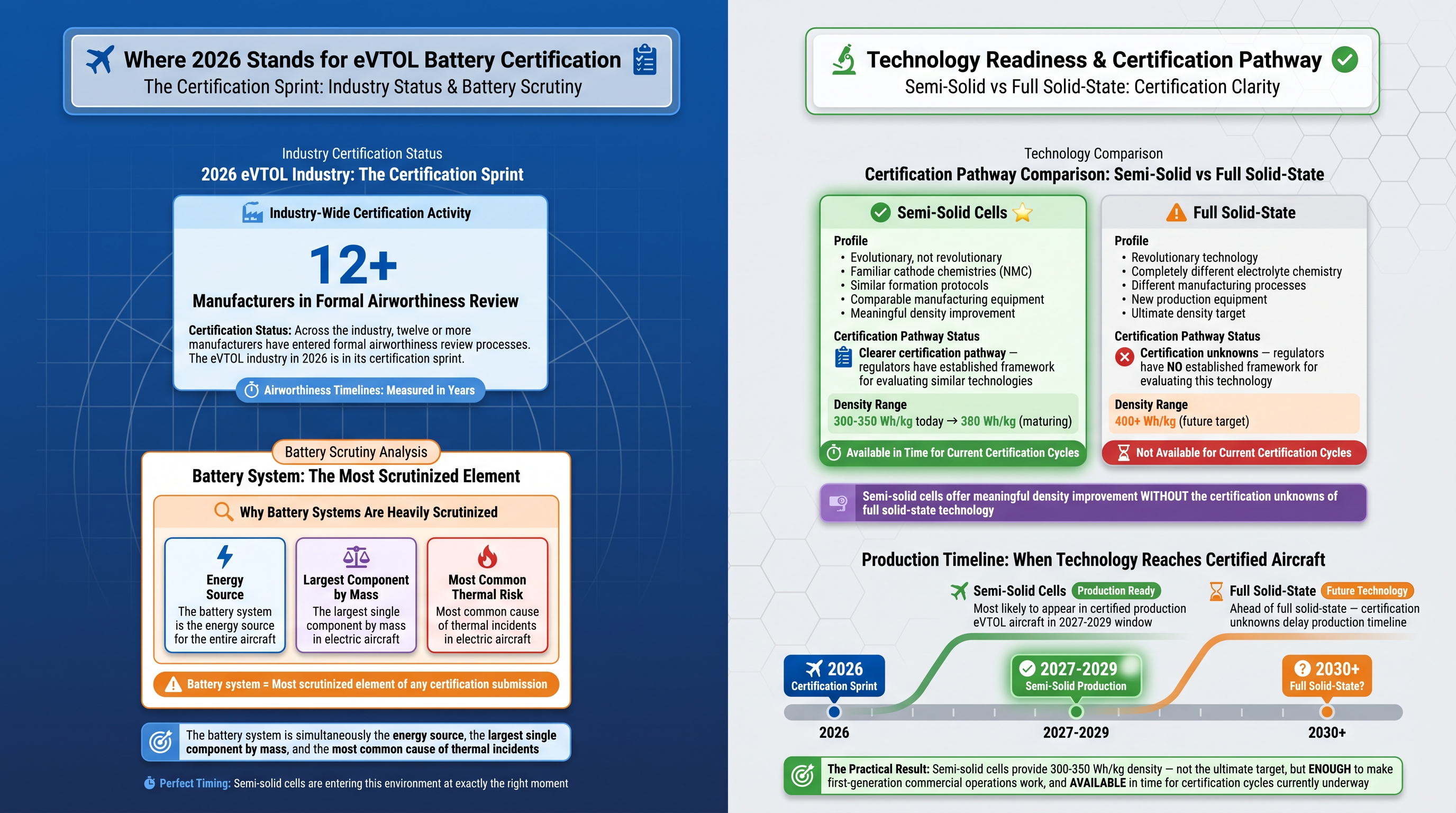
The eVTOL industry in 2026 is in its certification sprint. Across the industry, twelve or more manufacturers have entered formal airworthiness review processes. The battery system is one of the most scrutinized elements of any certification submission because it is simultaneously the energy source, the largest single component by mass, and the most common cause of thermal incidents in electric aircraft.
Semi-solid cells are entering this environment at exactly the right moment. They offer a meaningful density improvement over conventional NMC without the certification unknowns of full solid-state technology, which uses completely different electrolyte chemistry and manufacturing processes that regulators have no established framework for evaluating. Semi-solid cells are evolutionary, not revolutionary — they use familiar cathode chemistries, similar formation protocols, and comparable manufacturing equipment to conventional cells. The certification pathway is clearer, which matters enormously when airworthiness timelines are measured in years.
The practical result is that semi-solid cells are the technology most likely to appear in certified production eVTOL aircraft in the 2027 to 2029 window, ahead of full solid-state. The density they provide — 300 to 350 Wh/kg today, trending toward 380 Wh/kg as the technology matures — is not the ultimate target the industry wants. But it is enough to make the first generation of commercial operations work, and it is available in time for the certification cycles currently underway.
The gap that remains
The honest assessment is that semi-solid at 350 Wh/kg is a substantial improvement over today’s 280 Wh/kg average, but it falls short of the 400 Wh/kg that makes eVTOL economics unambiguously compelling. Operations at 350 Wh/kg will be viable with careful route design and load management. Operations at 400+ Wh/kg will be genuinely profitable across a broader range of conditions.
The path to 400 Wh/kg runs through continued refinement of semi-solid electrolyte formulations, higher-nickel cathode loading, and silicon-composite anode integration. None of these are exotic or unproven — they are incremental engineering improvements on an established trajectory. The industry consensus places commercially deployable 400 Wh/kg semi-solid cells in the 2028 to 2030 window, which aligns with the second generation of eVTOL aircraft currently in early design.
For battery manufacturers, the eVTOL market represents a demanding but lucrative entry point into aviation supply chains. The volume numbers are not yet large — the first wave of certified aircraft will likely be measured in hundreds, not thousands — but the specification requirements, the qualification process, and the relationships established in this phase will define supply chain positions for the decade that follows.
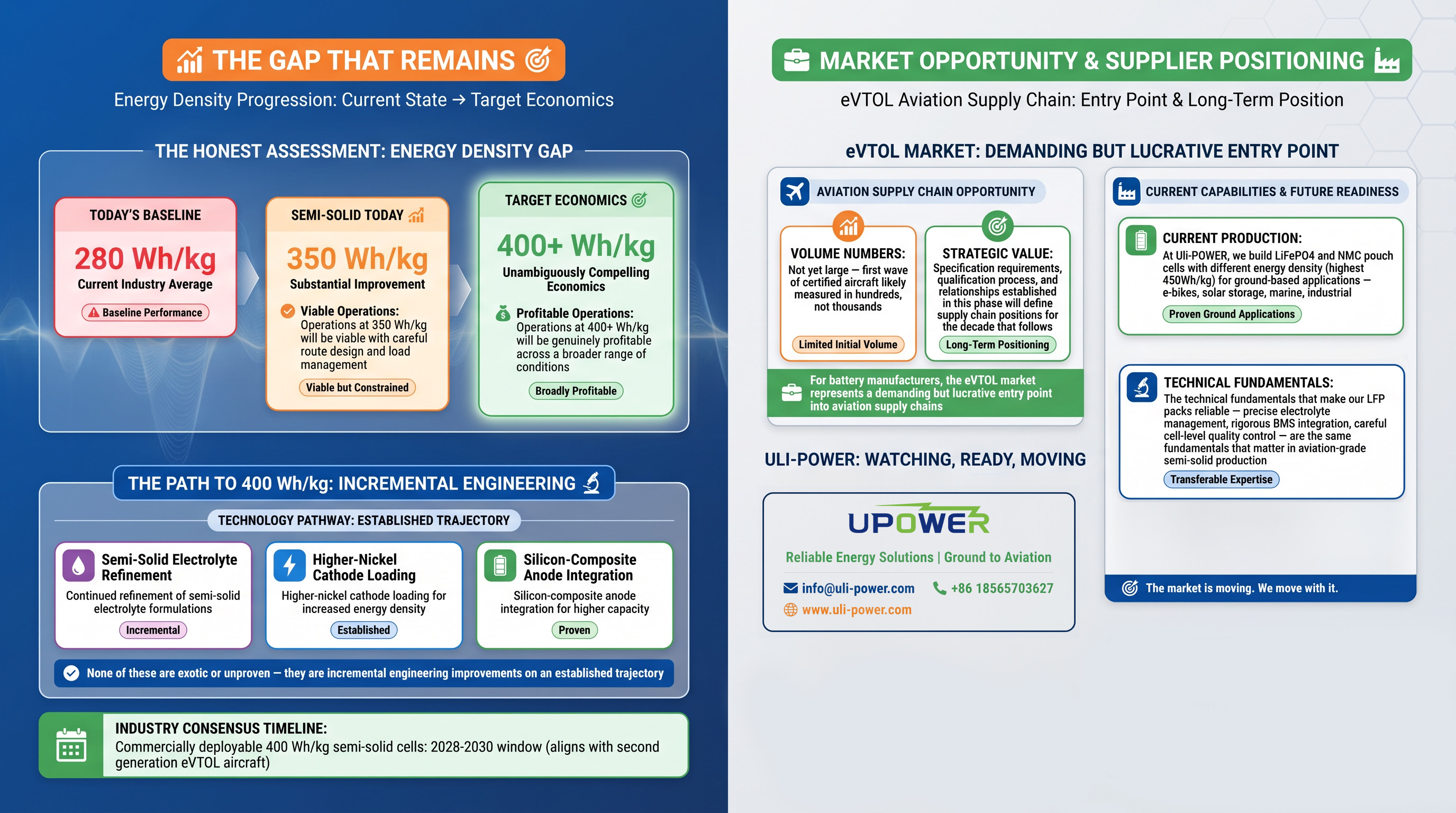
We are watching this market closely. At Uli-POWER, we build lifepo4 and NMC pouch cell with different energy density(highest 450Wh/kg) for ground-based applications — e-bikes, solar storage, marine, industrial.
Post time: Aug-26-2026