Cylindrical cells are standardized and widely available, and a single 21700 can be sourced from a mature supply chain. But in some drone layouts, the round shape works against the available volume. A cylinder in a rectangular bay can leave gaps that require additional structure or padding. During a full-throttle climb, the cell’s current demand and cooling path also matter; the right comparison is the measured voltage sag and temperature rise of the complete pack, not the shape alone.
The pouch cell exists to solve exactly that problem. And once you understand how the design works, the reason the drone industry moved to the soft pack is obvious.
What a pouch cell actually is
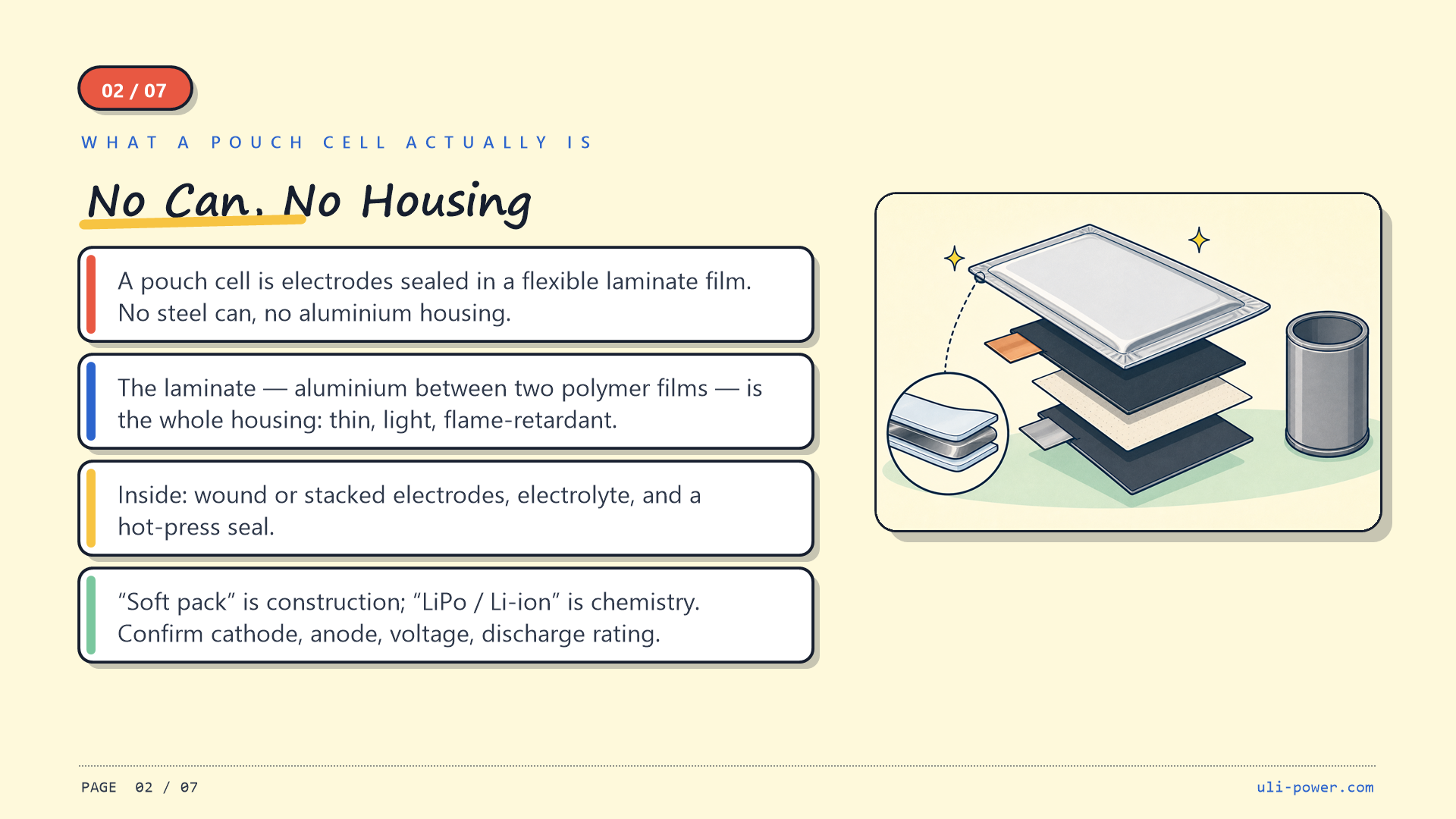
Strip away the branding and a pouch cell is a stack of electrodes sealed inside a flexible laminate film. No steel can. No aluminum housing. The pouch cell battery format is defined by what it is not: it has no structural casing that eats into its own energy budget.
The laminate — aluminum sandwiched between polymer films — is the cell’s entire “housing.” It is thin, light, and flame-retardant. The electrodes inside are wound or stacked, impregnated with electrolyte, and sealed by hot-press lamination. The result is a rechargeable pouch cell that can be lighter per watt-hour than many can-based designs, although the pack-level result depends on cooling, compression, busbars, BMS, and housing.
In the drone world this format often appears in listings as a soft pack drone battery. That term usually describes the flexible pouch construction, while lithium polymer or lithium-ion describes the cell chemistry and design. The two terms are related but not interchangeable in every listing, so buyers should confirm the cathode, anode, electrolyte, nominal voltage, and discharge rating rather than relying on the product title alone.
Why “no can” changes the energy math
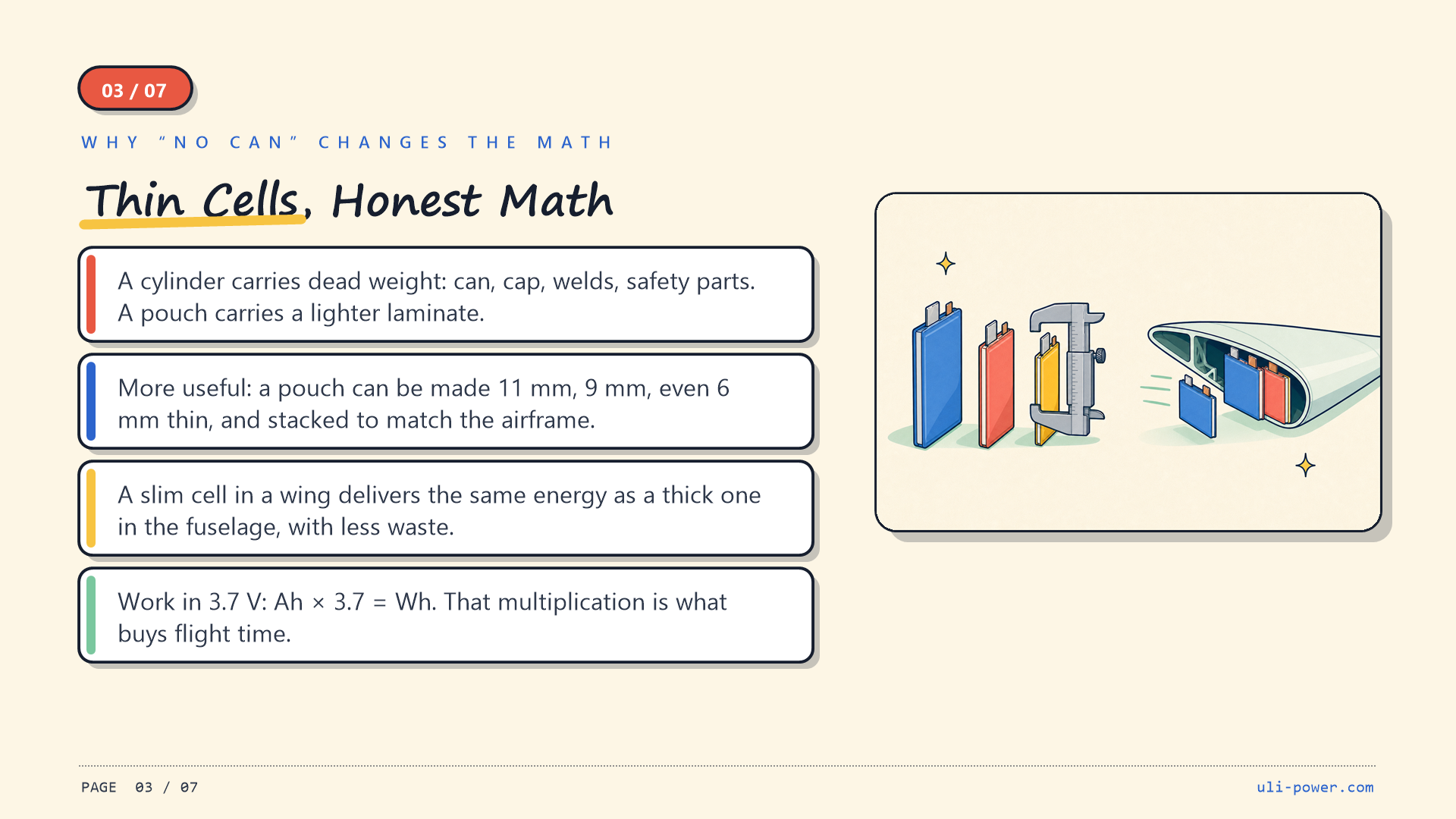
A cylindrical cell carries inactive packaging such as the can, cap, welds, and safety components. A pouch cell uses a lighter laminate package, but the exact packaging fraction depends on the cell design and manufacturing process. The practical benefit should therefore be evaluated at pack level, including busbars, compression, cooling, BMS, and housing — not inferred from a single percentage.
More important than the raw percentage is what the freedom allows. A flexible pouch battery cell can be made thin. A thin pouch cell — 11 millimeters, 9 millimeters, even 6 — can be stacked in configurations that match the internal volume of the airframe exactly. A slim pouch battery filling a wing section delivers the same energy as a thick cell in the fuselage with a fraction of the packaging waste.
The 3.7v pouch cell is the unit most drone engineers think in. At nominal 3.7 volts (3.6V pouch cell in some older datasheets), a single cell’s capacity in amp-hours multiplied by 3.7 gives you the watt-hours that determine flight time. That multiplication is why the industry clusters around specific cell sizes — and why the same “class” of cell shows up across every catalog.
The capacity classes that matter
Three cell formats dominate current drone design, and knowing them makes procurement easier.
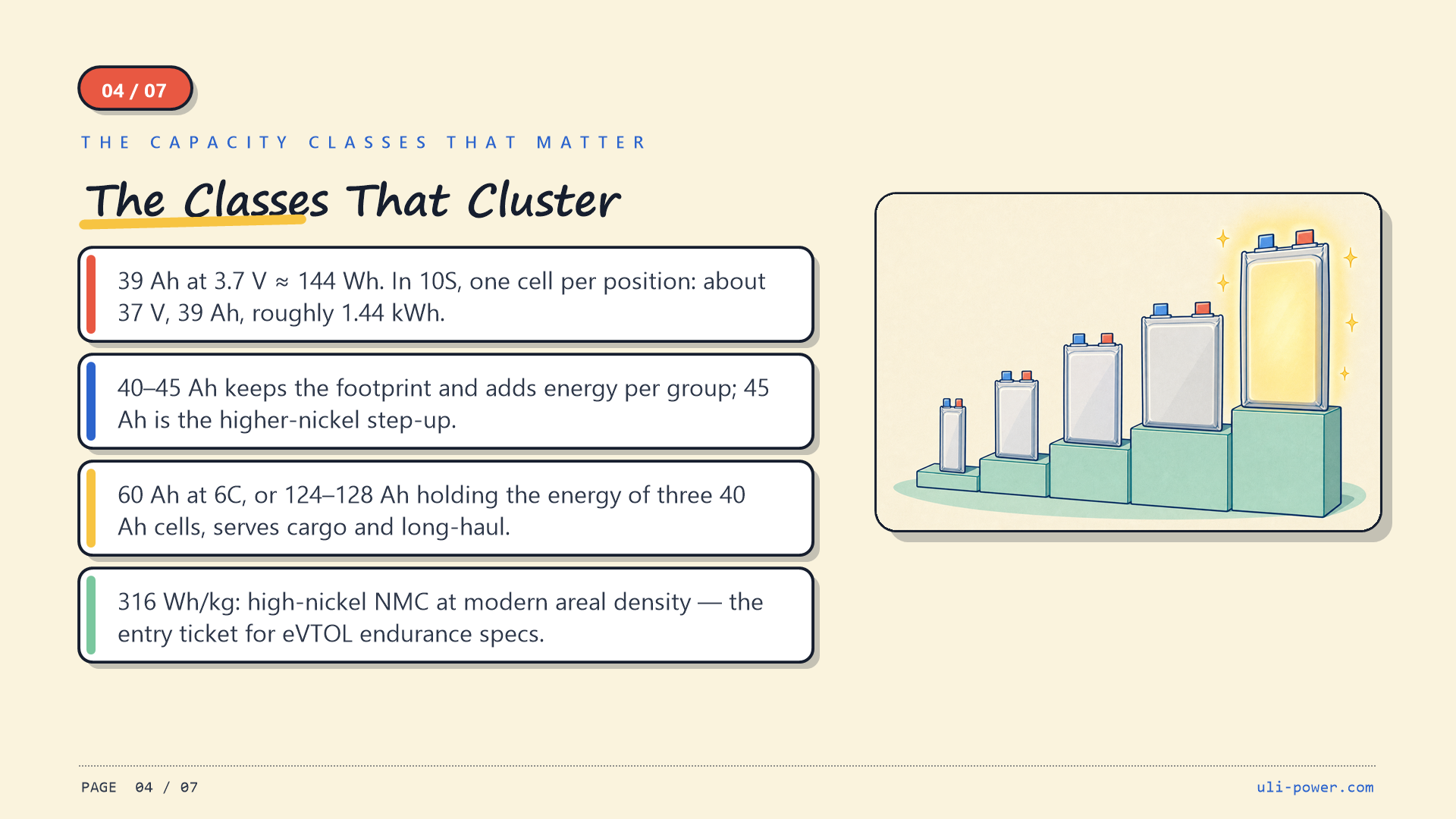
The 39 Ah class. A Li-ion pouch cell 39Ah — often listed as a pouch cell 39Ah or a 39Ah pouch battery — at 3.7 volts has a nominal energy of roughly 144 Wh, using the simple calculation 3.7 V × 39 Ah. A 140.4Wh pouch cell listing may refer to a different nominal voltage or a rounded rating, so confirm the supplier’s voltage and test conditions. In a 10S configuration, one cell per series position would produce about 37 V nominal and 39 Ah, or roughly 1.44 kWh nominal before usable-capacity and pack losses.
The 40 to 45 Ah class. A pouch cell 3.7v 40Ah sits just above the 39, and the NMC pouch cell 3.7v 45Ah is the step-up version with higher-nickel chemistry. These serve platforms where the engineer wants slightly more energy per cell group without changing the physical layout.
The 60 Ah and above class. A 3.7v 60ah 6c pouch cells specification — note the 6C discharge rating — describes a cell that can dump six times its rated capacity continuously. For the largest agricultural and cargo airframes, cells in this range are configured in 6S or 10S packs where total weight matters less than total energy. At the extreme, semi-solid state battery 36000mAh formats and semi-solid state battery 12500mAh cells serve the same purpose in next-generation chemistry: more energy per kilogram at the same physical footprint.
Then there is the high-nickel long-haul class. An NMC pouch cell 124Ah or an NMC pouch cell 128Ah is a single cell holding the energy of three 40 Ah cells. These lithium NMC pouch cells may suit cargo platforms and long-range UAVs where the pack design has limited space for additional cell groups, provided the mass, current, thermal, and safety requirements are met. A 20ah pouch cell NMC is, conversely, the compact option for lighter industrial platforms — same chemistry family, smaller footprint, faster to charge.
High-energy lithium NMC pouch cells are also the base for the 316Wh/kg battery class: a NMC 811 chemistry at modern areal density lands right in that range, which is exactly why a 316Wh/kg battery appears so often in eVTOL and long-endurance drone specifications. A high energy density Li-ion cell in the 300-plus Wh/kg range is the entry ticket for serious endurance platforms, and the high specific energy density of the 45 Ah NMC family is what puts it there.
Discharge performance: the number that kills designs
Energy density gets the attention, but discharge rate kills more drone designs than energy does.
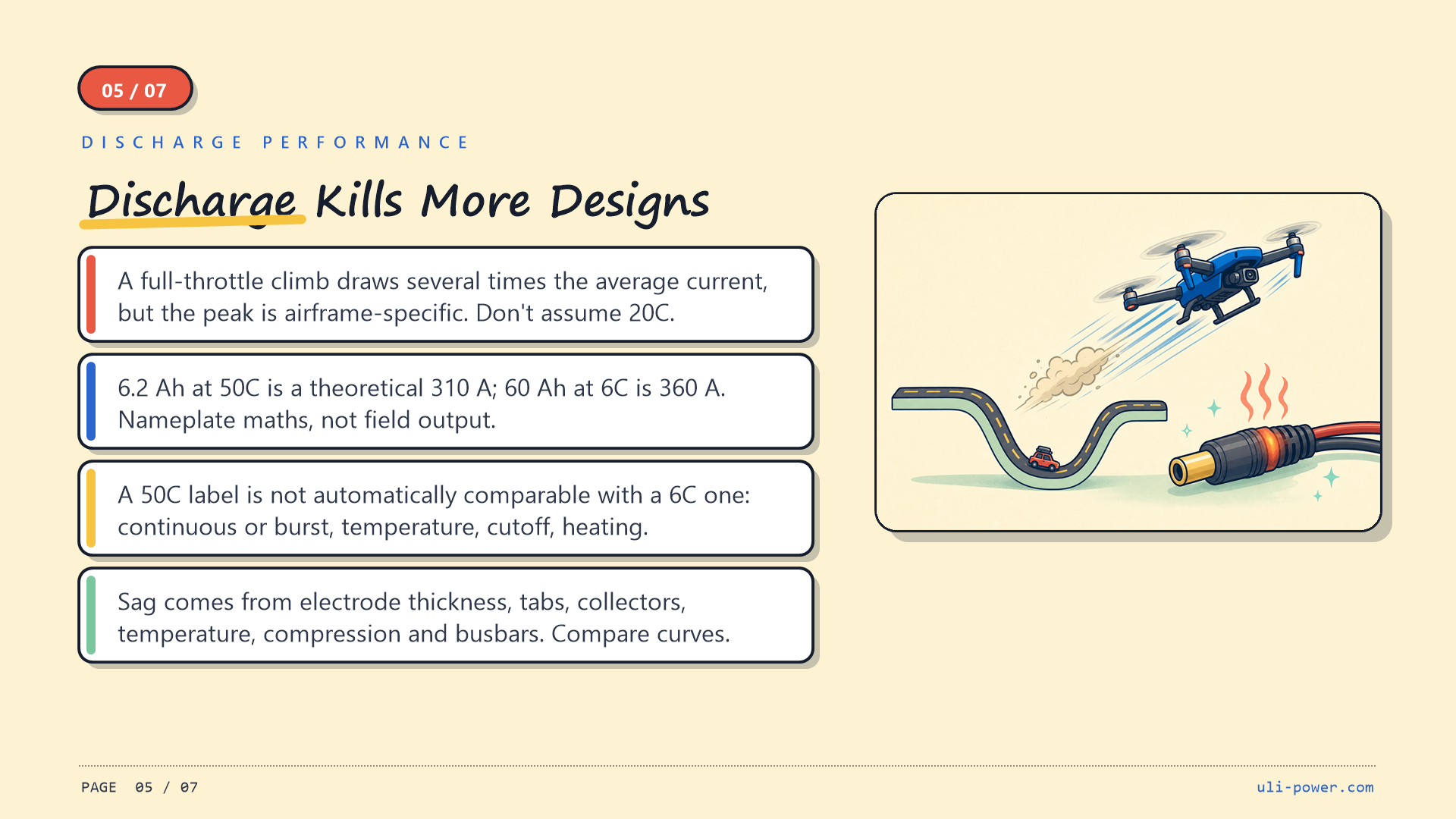
A drone climbing at full throttle can draw several times its average current, but the actual peak depends on the aircraft, propellers, motors, payload, and controller. Do not assume that a 20C demand applies to every platform. A cell that cannot maintain voltage under the aircraft’s measured load may cause reduced thrust, temperature rise, or protection cut-off. This is why the same capacity in two different cells can be completely different products.
Compare two common listings: 6200mah 50c 3.7v lipo pouch cells and a 3.7v 60ah 6c pouch cells part. Both are pouch cells, both may nominally store similar energy. The first is a high energy density lipo battery designed for the RC segment. If the advertised 50C rating is continuous, 6.2 Ah × 50C corresponds to a theoretical 310 A; a 60 Ah cell at 6C corresponds to 360 A. These are nameplate calculations, not guaranteed field output. The supplier must define continuous versus burst rating, test temperature, voltage cutoff, and acceptable temperature rise. A 50C label is not automatically comparable with a 6C label. For a platform flying frequently in the field, measured temperature rise and cycle-life data are more useful than a headline C-rate.
Punch out, sag, and pack design go together. A pouch cell lithium polymer/ion design can be optimized for low internal resistance and high current collection, helping the drone maintain voltage under load. That advantage is not automatic: electrode thickness, tab design, current collectors, cell temperature, compression, and the pack busbars all affect voltage sag. Compare pouch and cylindrical cells using measured discharge curves at the same temperature, C-rate, and cutoff voltage.
How to evaluate a lithium pouch cell manufacturer
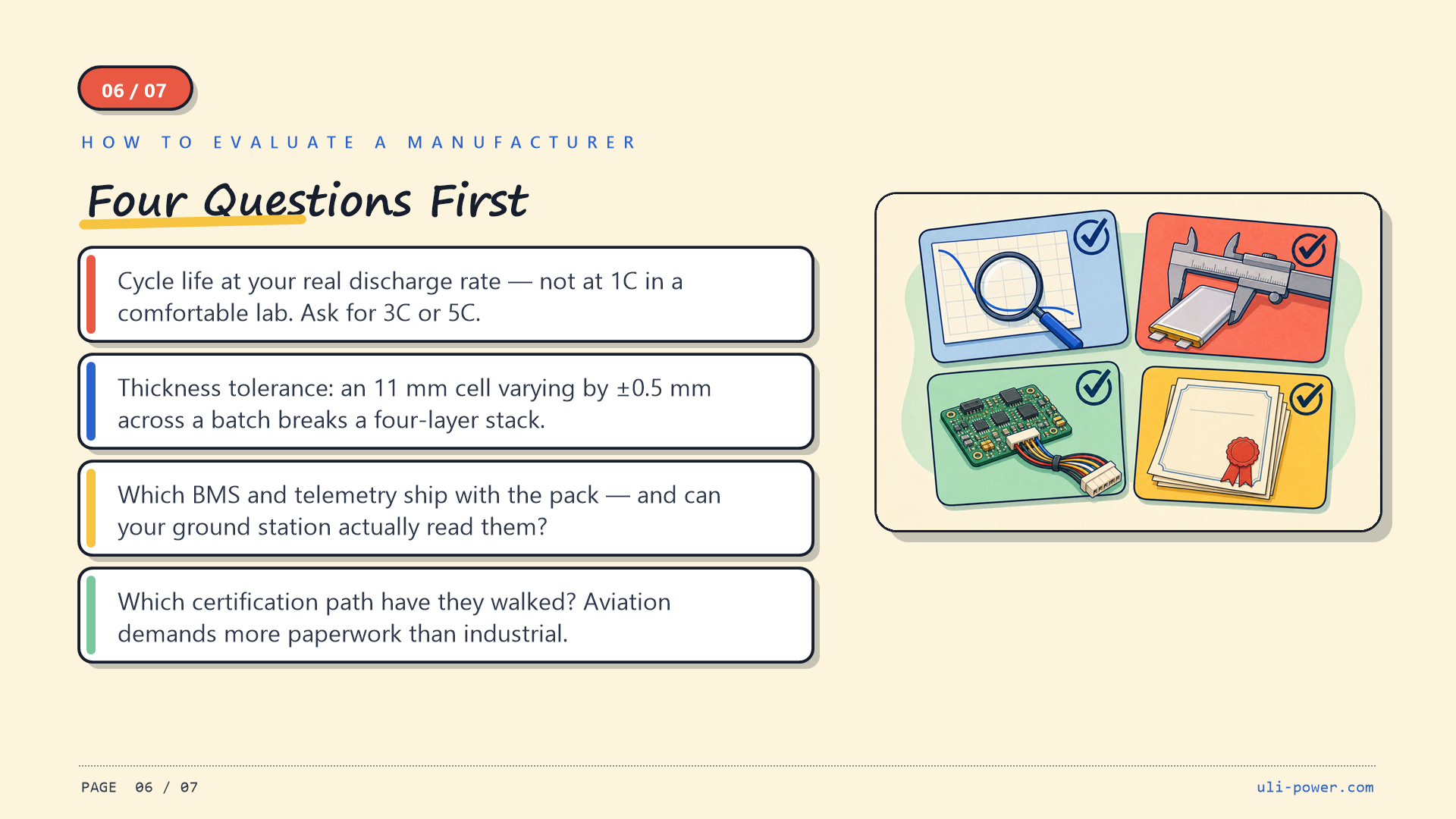
When you shortlist a rechargeable pouch cell manufacturer or a lithium pouch cell manufacturer, the datasheet is only half the story. The questions that matter:
What is the cycle life at your actual discharge rate, not at 1C in a comfortable lab? Ask for the data at 3C or 5C — that is the number your drone lives at.
What is the thickness tolerance? An 11 millimeter thin pouch cell 11mm specification that varies by ±0.5 mm across a batch will make or break a pack that stacks four layers.
What BMS and telemetry do they offer with the pack, and can your ground station read it?
What certification path have they walked before? An aviation-grade program will demand more documentation than an industrial one.
These are not gotcha questions. They are the difference between a pouch lithium ion batteries program that flies and one that limps.
The semi-solid upgrade path
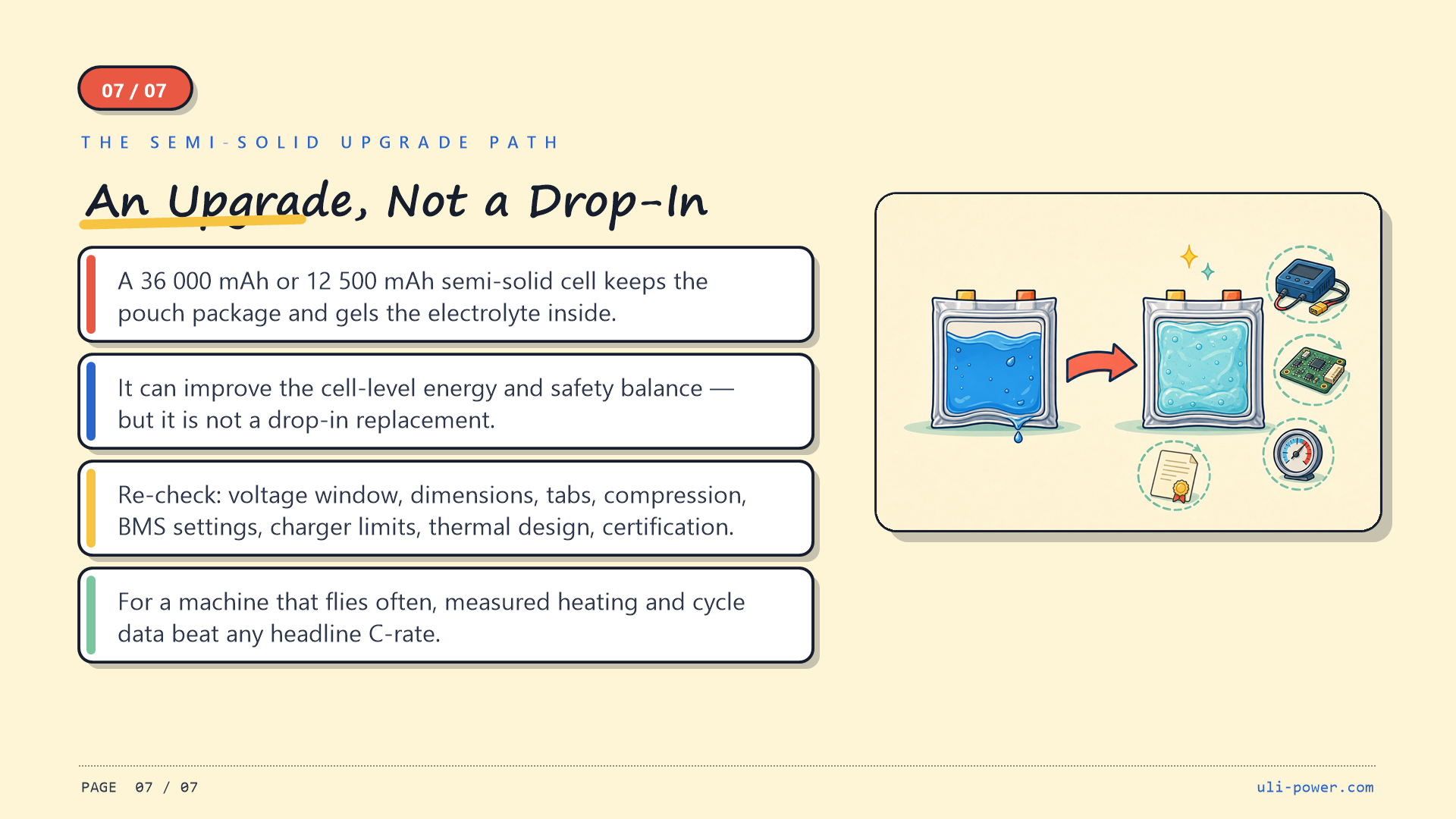
The final reason engineers revisit their cell choice is the development of semi-solid designs. A semi solid state battery 36000mah cell or semi-solid 12500mAh format may use a partially gelled or immobilized electrolyte while retaining a pouch-style package. It may improve the cell-level energy-density or safety balance, but it is not automatically a drop-in replacement: voltage window, dimensions, tabs, compression, BMS settings, charger limits, thermal design, and certification all need to be revalidated.
We are ULi — Dongguan Youli Electronic Technology Limited. We build LiFePO4 and NMC pouch cell packs for aerial and ground platforms, from thin high-discharge cells for FPV and inspection drones to large-format semi-solid packs for cargo and endurance airframes. Send us your cell format, your C-rate, and your target flight time. We will come back with a cell recommendation, a pack architecture, and a quote.
Email: info@uli-power.com
Phone: +86 18565703627
Web: www.uli-power.com
Post time: Sep-30-2026