Open your phone. If it was made in the last twenty years, the battery inside is almost certainly NMC. Your laptop, same thing. The wireless earbuds in your ears, the smartwatch on your wrist, the handheld radio in a fire truck, the portable ultrasound machine in an ambulance — all of them run on the same chemistry: lithium nickel manganese cobalt oxide.
NMC did not win consumer electronics because it was cheapest. It won because it is the lightest way to store a given amount of energy. And in anything that moves — especially anything that you carry — weight is everything.
Consumer electronics: the test lab for high density
The consumer electronics industry has been pushing NMC energy density upward for three decades. Every generation of smartphones got thinner and lasted longer because NMC cells got incrementally better. A 1990s laptop battery weighed two kilograms and lasted 90 minutes. A 2026 laptop battery weighs 300 grams and lasts 12 hours. That improvement is almost entirely NMC energy density progress — from roughly 100 watt-hours per kilogram in the 1990s to over 250 Wh/kg in today’s premium cells.
This market is often overlooked in battery industry discussions because individual cells are small. A phone battery is 15 watt-hours. A laptop battery is 60. But there are billions of them. And the relentless consumer demand for thinner, lighter, longer-lasting devices has funded the R&D that eventually trickles up to bigger applications.
The manufacturing techniques that enable high-nickel NMC cathodes, the electrolyte formulations that stabilize them, the quality control processes that catch microscopic defects before they become failures — all of this was developed and paid for by the consumer electronics industry. Every drone battery, every EV pack, every aviation cell stands on that foundation.
Drones: when NMC leaves the ground
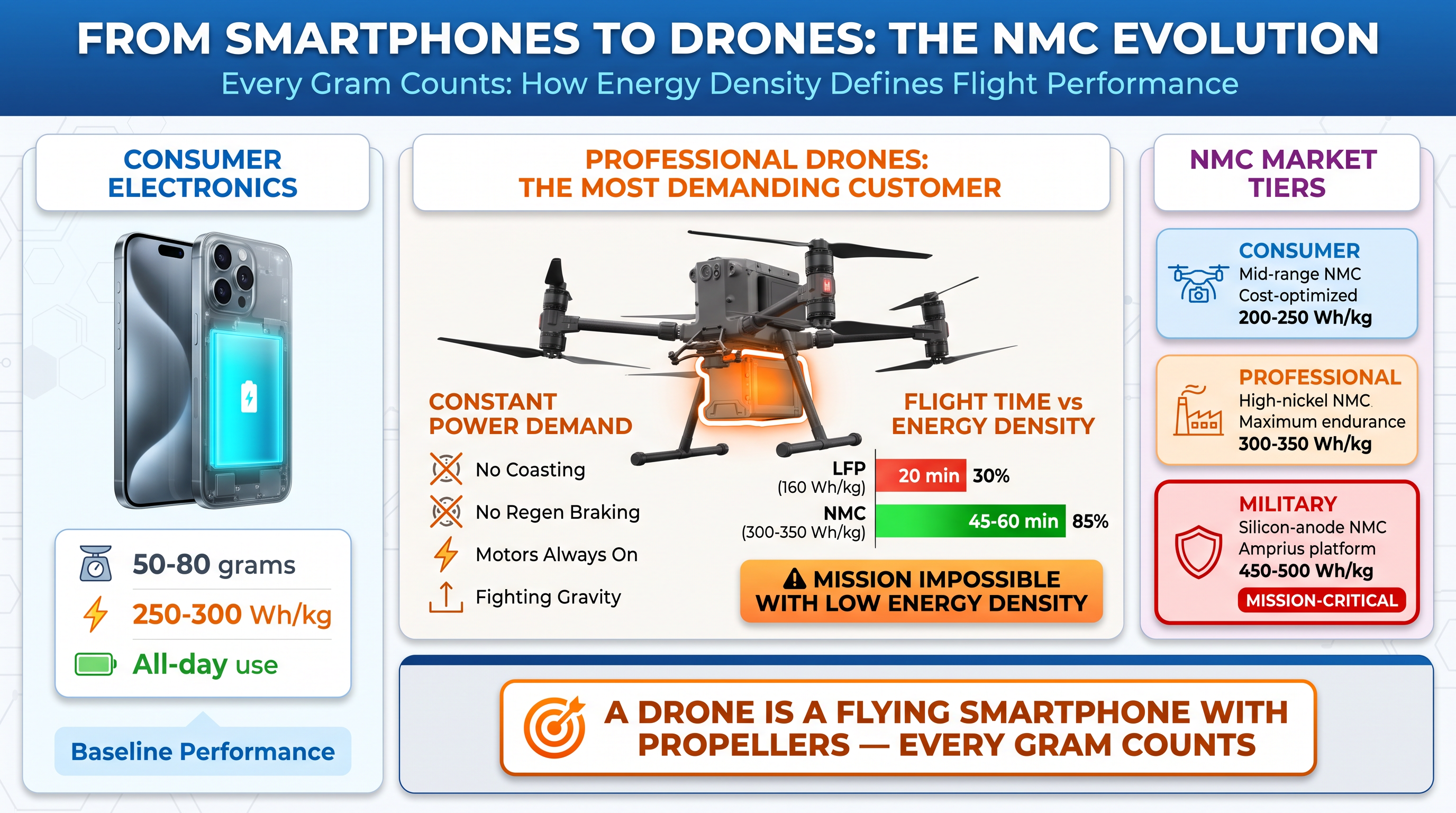
The step from consumer electronics to drones is a step from grams to kilograms, but the physics is the same. A drone is a flying smartphone with propellers. Every gram of battery weight is a gram that the motors have to lift for the entire duration of the flight. There is no coasting. There is no regenerative braking. The motors are always on, always fighting gravity.
This is why the drone industry is the most demanding customer in the battery market. Not in total volume — Tesla buys more cells in a quarter than the entire drone industry buys in a year — but in performance requirements. A drone battery needs maximum energy density, maximum power density for sudden maneuvers, and enough cycle life to justify its cost over a few hundred flights.
NMC delivers all three. A high-end NMC drone pack at 300 to 350 Wh/kg gives a professional UAV 45 to 60 minutes of flight time. Swap in LFP at 160 Wh/kg and that drops to 20 minutes. The mission simply becomes impossible.
The drone market also splits NMC into distinct tiers. Consumer drones use mid-range NMC cells optimized for cost. Professional and industrial drones use premium NMC with higher nickel content for maximum endurance. Military drones use the absolute best — silicon-anode NMC cells like Amprius’s 450 to 500 Wh/kg platform — because the mission cost of a battery that dies early is measured in operational failure, not dollars.
Electric vehicles: NMC at scale
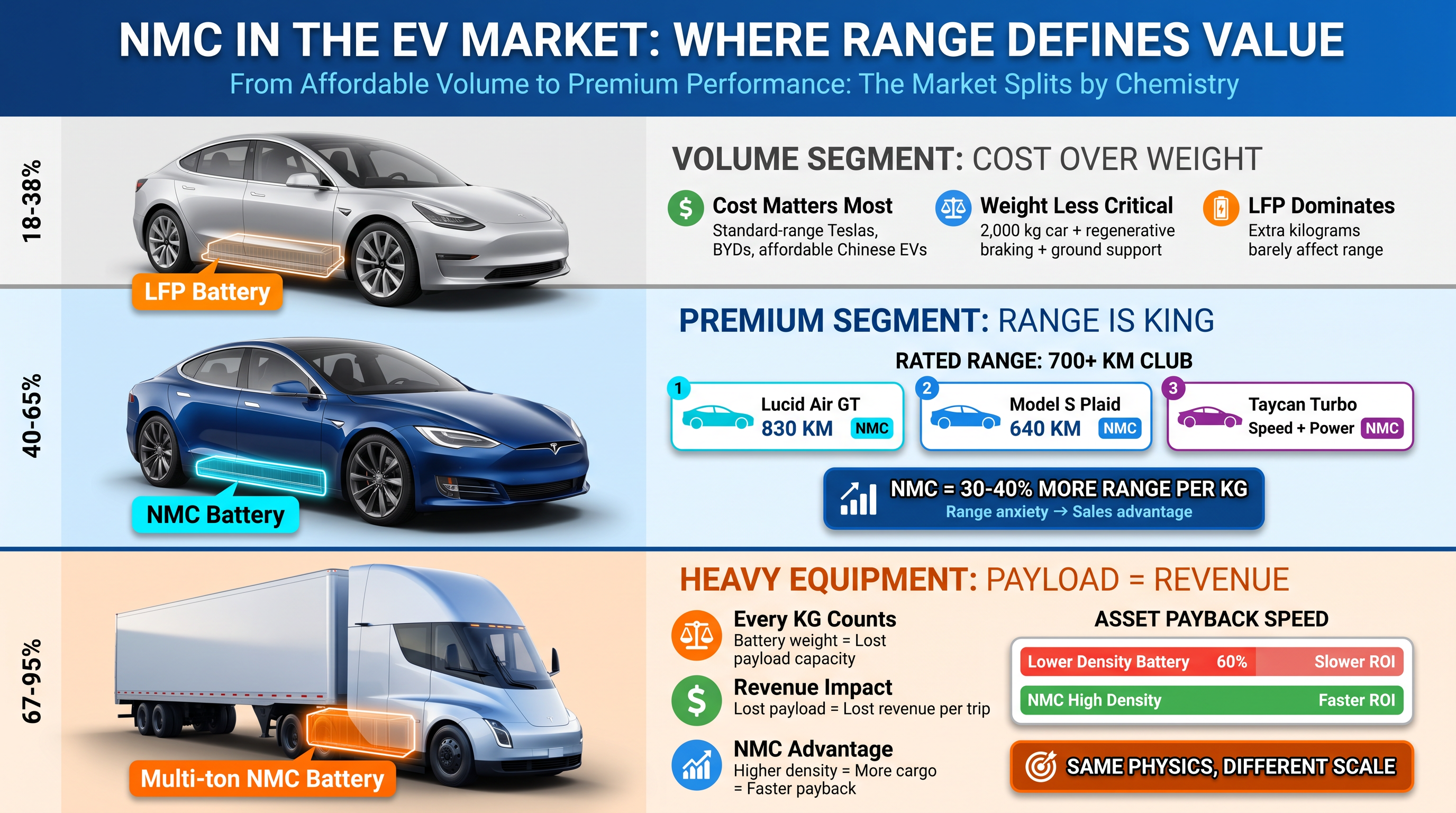
In the EV market, the story is more nuanced. LFP has captured the volume segment — the standard-range Teslas, the BYDs, the affordable Chinese EVs — because cost matters more than weight in a 2,000-kilogram car with regenerative braking. The ground holds you up. A few extra kilograms of battery barely affects range.
But NMC still owns the premium segment for a simple reason: range. Every production EV with a rated range above 700 kilometers uses NMC chemistry. The Lucid Air Grand Touring, 830 kilometers. The Tesla Model S Plaid, 640 kilometers. The Porsche Taycan Turbo, built for speed and handling with a battery that has to deliver enormous power in a compact, lightweight package. All NMC.
The physics is the same as in drones, just at a different scale. To get a luxury sedan across a continent with one charging stop instead of three, you need the highest possible energy density. NMC gives you roughly 30 to 40 percent more range per kilogram of battery. In a market where “range anxiety” is still the number one buyer concern, that advantage translates directly into sales.
Electric trucks and heavy equipment add another dimension. A battery-electric semi-truck carries a battery that weighs several tons. Every kilogram of battery is a kilogram of payload you cannot carry, which is a kilogram of revenue you cannot earn. NMC’s density advantage means more cargo per trip, which means faster payback on a very expensive asset.
Electric aviation: the final frontier
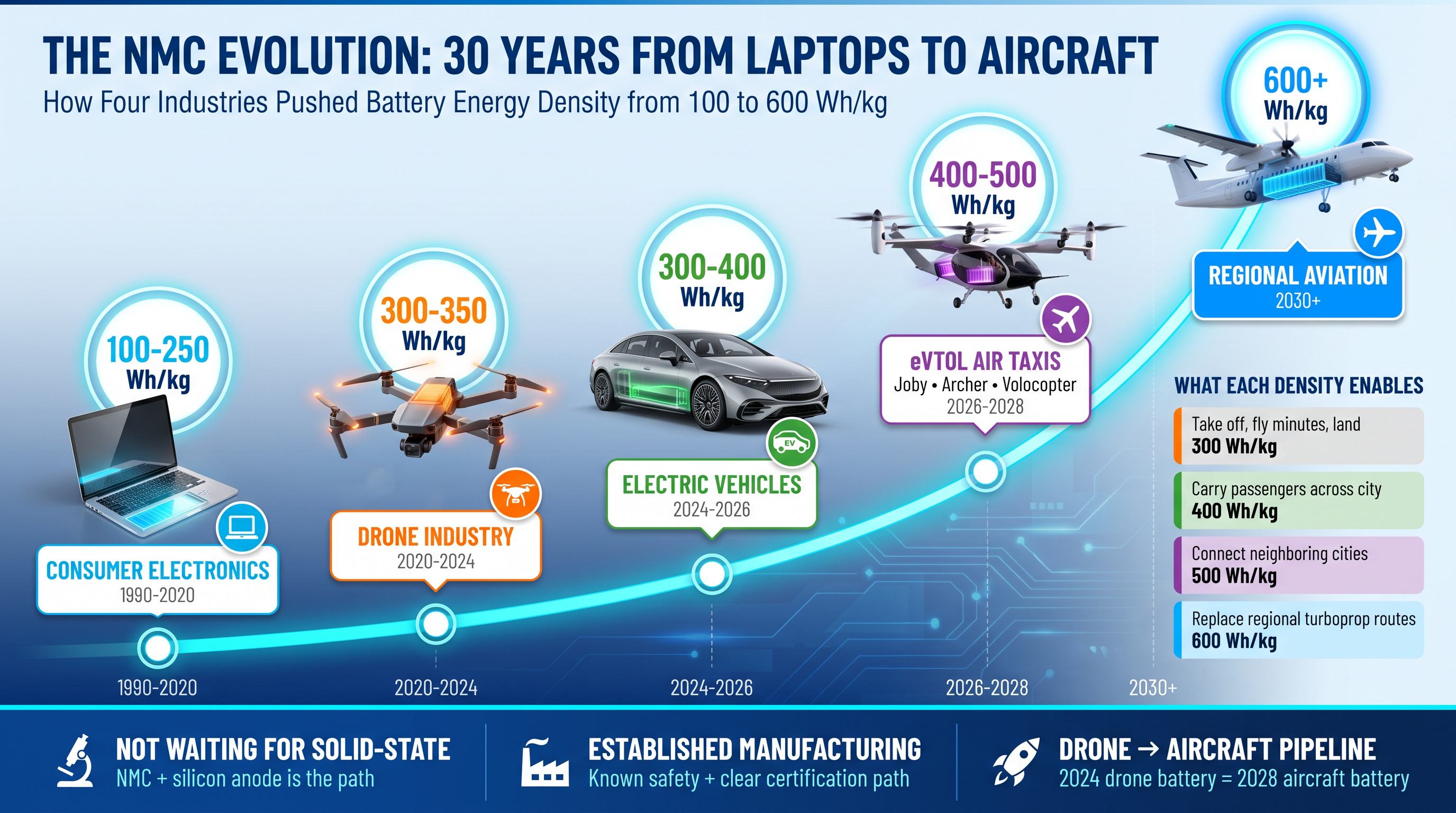
The consumer electronics industry pushed NMC from 100 to 250 Wh/kg over thirty years. The drone industry pushed it to 350. The EV industry pushed it to 300 in production and funded the R&D pipeline toward 400. And now the aviation industry is picking up the baton, because it has no other choice.
An eVTOL air taxi — the kind that Joby, Archer, and Volocopter are certifying right now — needs battery energy density north of 400 Wh/kg to carry a pilot and four passengers on a commercially viable route. At 300 Wh/kg, the aircraft can take off, fly a few minutes, and land. At 400, it can carry passengers across a city. At 500, it can connect neighboring cities. At 600, which multiple manufacturers believe is achievable by 2030 with silicon-anode NMC, it can start replacing regional turboprop routes.
The electric aviation industry is not waiting for solid-state. It is not waiting for lithium-sulfur or lithium-air, which are decades away from certification. It is betting on NMC with advanced anodes, because NMC is the only high-density chemistry with an established manufacturing base, a known safety profile, and a clear path to aviation certification.
The drone-to-aircraft pipeline is already flowing. Amprius, which started in consumer electronics and expanded into military drones, is now shipping evaluation cells to eVTOL manufacturers. The same silicon-anode technology that doubled UAV flight times is now being tested for piloted aircraft. What was a drone battery in 2024 will be an aircraft battery in 2028.
The throughline
NMC has been the invisible enabler of portable electronics for thirty years. It let us put computers in our pockets. It let us fly cameras over wildfires. It let us drive across continents on electricity. And it is about to let us fly between cities without burning a drop of fuel.
LiFePO4 is the right chemistry for most things on the ground. We build it, we sell it, we believe in it. But we also believe in understanding the full technology landscape. NMC high density is not a competitor to LFP. It is a different tool for a different job. And the jobs it does — in your pocket, in the sky, and soon in piloted electric aircraft — are some of the most important jobs batteries will ever do.
At UPOWER, we have been manufacturing battery packs for 15 years. Our expertise is LFP&NMC, and we stand by it. But we watch every chemistry, because the industry that moves is the industry that learns.
Email: info@uli-power.com Phone: +86 18565703627 Web: www.uli-power.com
Post time: Jul-31-2026