Anode-Free Pouch Batteries: The Architecture That Changes the Energy Density Equation
There is a part inside every lithium battery that stores almost no energy. It is there anyway, because for decades nobody knew how to build without it. That part is the graphite anode.
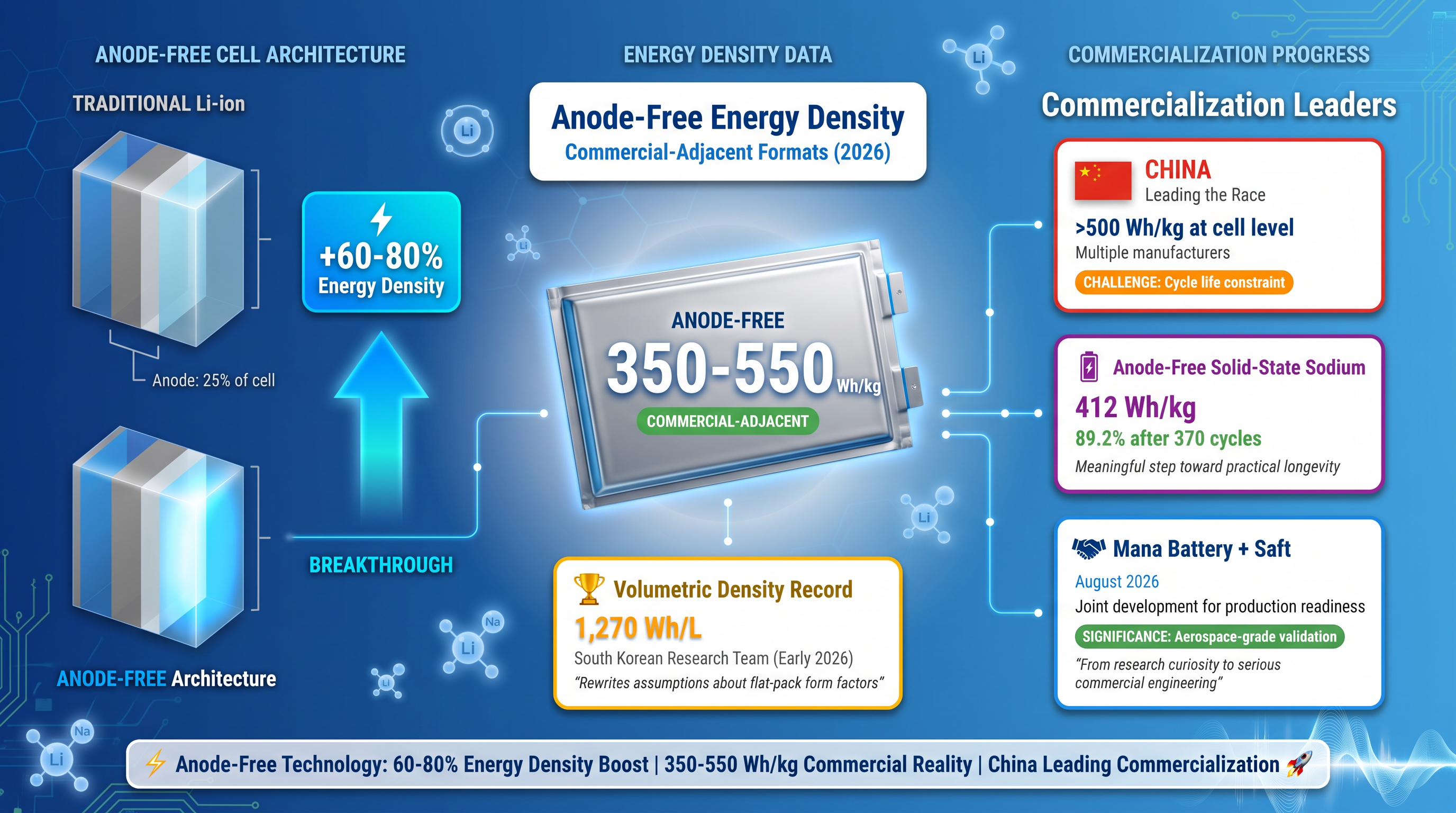
The graphite anode exists as a host — a structure that holds lithium ions in place during charging and releases them during discharge. It works well. It is safe. It is cheap. And it accounts for roughly 15 to 25 percent of a cell’s total weight and volume while contributing nothing directly to energy storage.
Anode-free batteries remove it entirely. No host material. The lithium deposits directly onto a bare copper current collector during charging and strips back off during discharge. The result is a cell that is fundamentally thinner, lighter, and more energy-dense than anything the conventional lithium-ion architecture can achieve — without changing the cathode, the electrolyte concept, or the fundamental electrochemistry.
That sounds simple. The engineering is not.
What the numbers actually show
Removing the anode boosts cell-level energy density by 60 to 80 percent over conventional lithium-ion. In practical terms, anode-free pouch cells today achieve 350 to 550 Wh/kg in commercial-adjacent formats. A South Korean research team demonstrated 1,270 watt-hours per liter volumetric density in early 2026 — a number that rewrites assumptions about what is physically possible in a flat-pack form factor.
China is leading the commercialization race. Multiple Chinese manufacturers have pushed anode-free architectures past 500 Wh/kg at the cell level, though cycle life at those densities remains a constraint. The anode-free solid-state sodium variant — which pairs the anode-free architecture with a sodium chemistry and solid electrolyte — has achieved 412 Wh/kg with 89.2 percent capacity retention after 370 cycles, a meaningful step toward practical longevity.
On the industrial side, Mana Battery and Saft announced a joint development agreement in August 2026 specifically to advance anode-free cell technology toward production readiness. When Saft — one of the most conservative, aerospace-grade battery manufacturers in the world — puts its name on an anode-free partnership, it signals that the technology has crossed from research curiosity to serious commercial engineering.
The core technical challenge: cycle life
The anode-free architecture’s Achilles heel has always been cycle life, and understanding why matters if you are evaluating this technology for any real application.
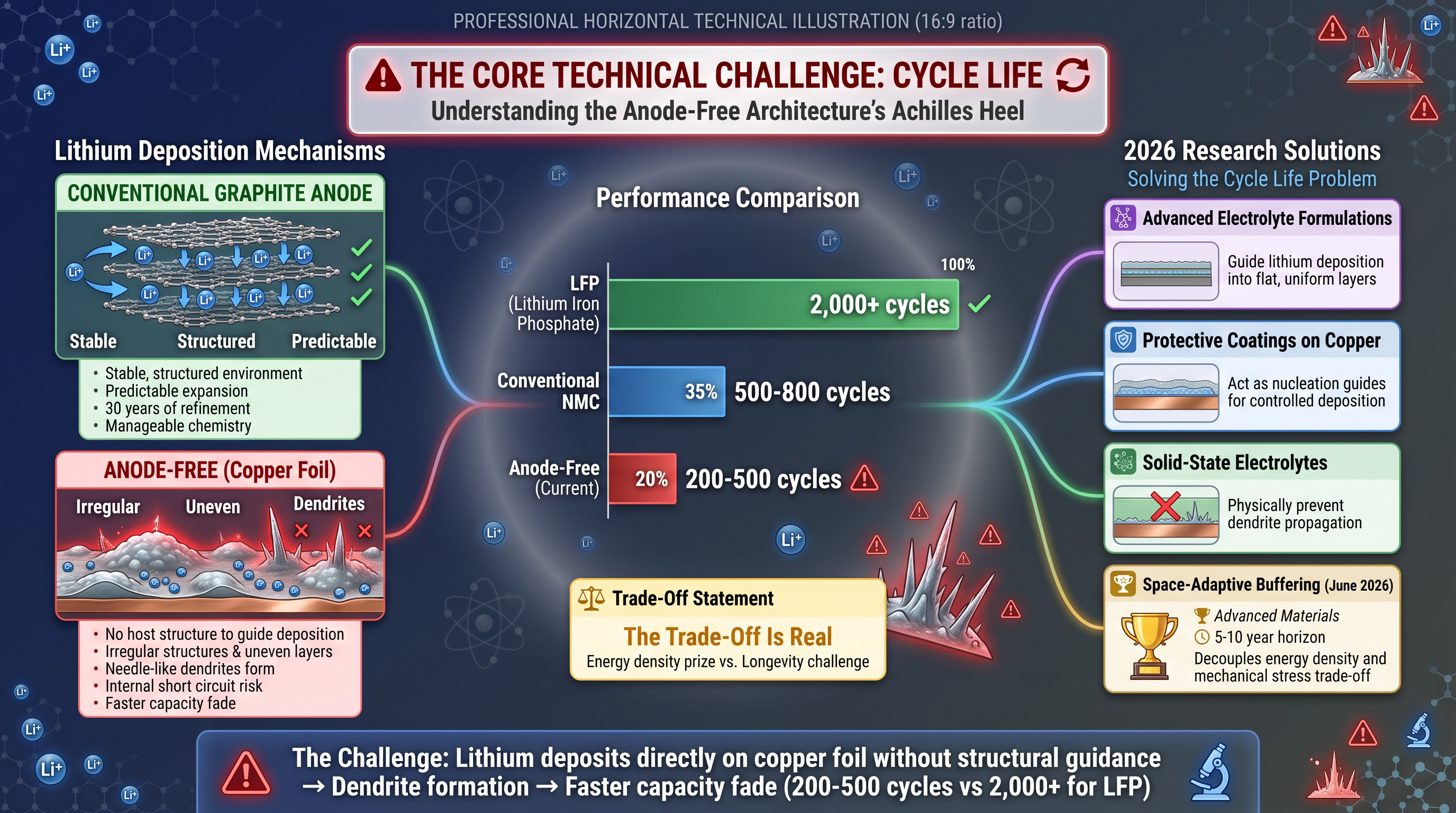
In a conventional lithium-ion cell, the graphite anode provides a stable, structured environment for lithium ions to park during charging. The structure is predictable. The expansion is manageable. The chemistry is well-understood after thirty years of refinement.
In an anode-free cell, lithium deposits directly onto a copper foil — a process called electroplating at the nanoscale. Without a host structure to guide deposition, lithium can form irregular structures, uneven layers, and in the worst case, needle-like dendrites that grow across the separator and cause internal short circuits. Each charge-discharge cycle risks slightly worsening the deposition quality, leading to capacity fade that is faster and less predictable than in graphite-anode cells.
Performance Comparison
This is why current anode-free cells typically deliver 200 to 500 cycles at depth before meaningful degradation, compared to 2,000 or more for quality LFP and 500 to 800 for conventional NMC. The energy density prize is real. The longevity trade-off is equally real.
The 2026 research push is focused almost entirely on solving this problem. Advanced electrolyte formulations that guide lithium deposition into flat, uniform layers. Protective coatings on the copper collector that act as nucleation guides. Solid-state electrolytes that physically prevent dendrite propagation. A June 2026 paper in Advanced Materials introduced a space-adaptive buffering architecture specifically designed to decouple the energy density and mechanical stress trade-off in anode-free lithium metal pouch cells — the kind of incremental materials engineering that compounds into commercial viability over a five-to-ten-year horizon.
Where anode-free makes sense today
Given the cycle life constraint, the applications that benefit most from anode-free batteries in 2026 are those where energy density is the primary metric and cycle count is secondary.
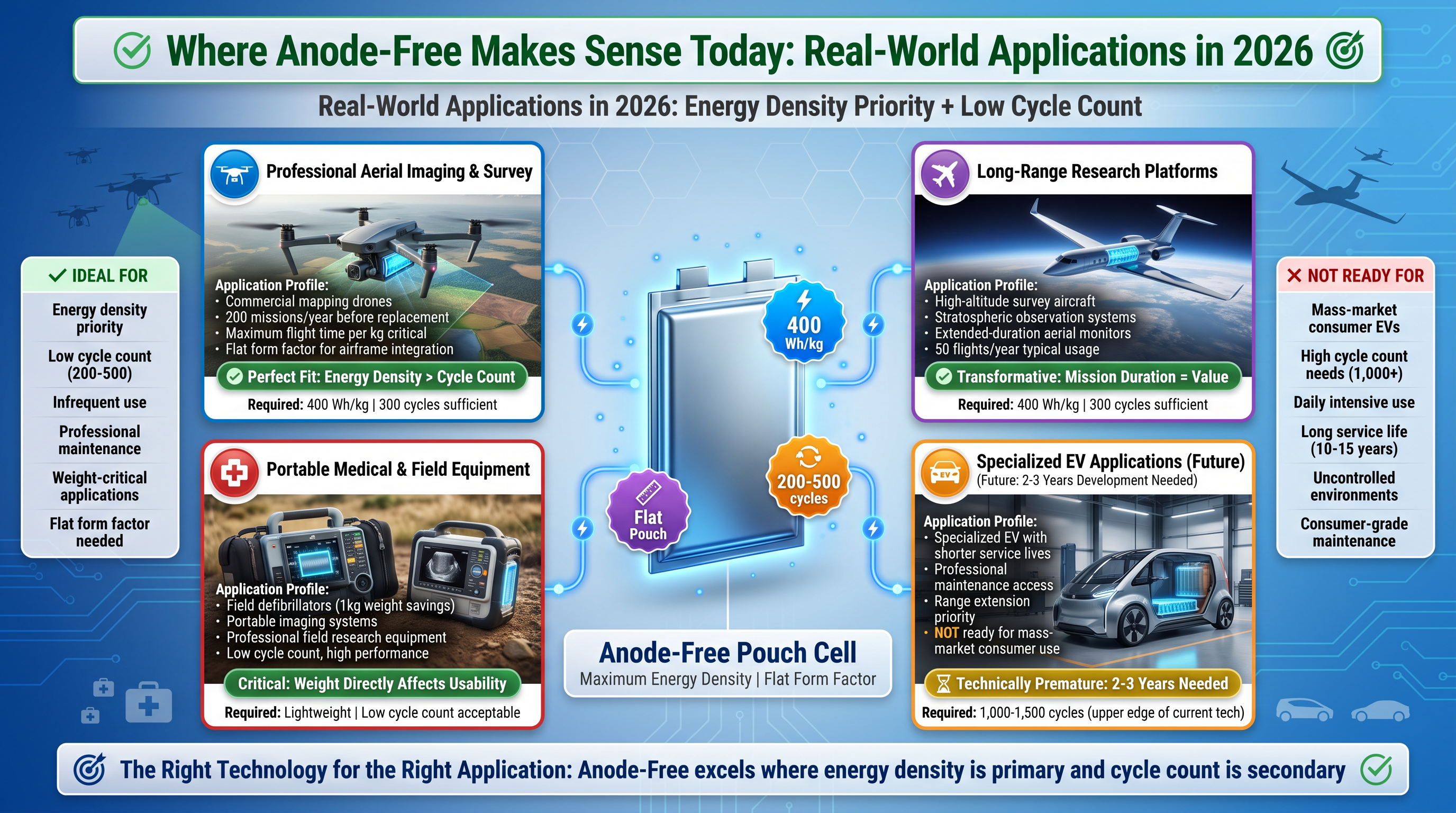
Professional aerial imaging and survey platforms are an obvious fit. A commercial mapping drone that flies 200 missions per year before scheduled maintenance replacement does not need 2,000 cycles. It needs the maximum possible flight time per kilogram of battery, and it needs a flat form factor that integrates cleanly into airframe design. Anode-free pouch cells deliver on both.
Long-range research platforms — high-altitude survey aircraft, stratospheric observation systems, extended-duration aerial monitors — have similar profiles. These are assets that fly infrequently, are maintained by engineers who understand their limitations, and where mission duration directly determines value. A cell that delivers 400 Wh/kg and lasts 300 cycles is transformative for an operator who uses it 50 times per year.
Electric vehicle range extension is a compelling future application but remains technically premature for everyday consumer use. The cycle life requirements for an EV battery — 1,000 to 1,500 full cycles over a vehicle lifetime of ten to fifteen years — are at the upper edge of what current anode-free technology can sustain. For specialized EV applications with shorter service lives or access to frequent professional maintenance, the math may already work. For mass-market passenger vehicles, two to three more years of cycle life development are likely needed.
Portable medical devices, field research equipment, and professional electronics where weight directly affects usability are natural candidates. A field defibrillator that weighs one kilogram less saves the person carrying it. A portable imaging system with twice the battery life enables procedures in locations where power is unavailable. These applications run low cycle counts and high performance requirements — exactly the profile where anode-free cells shine.
The pouch format advantage
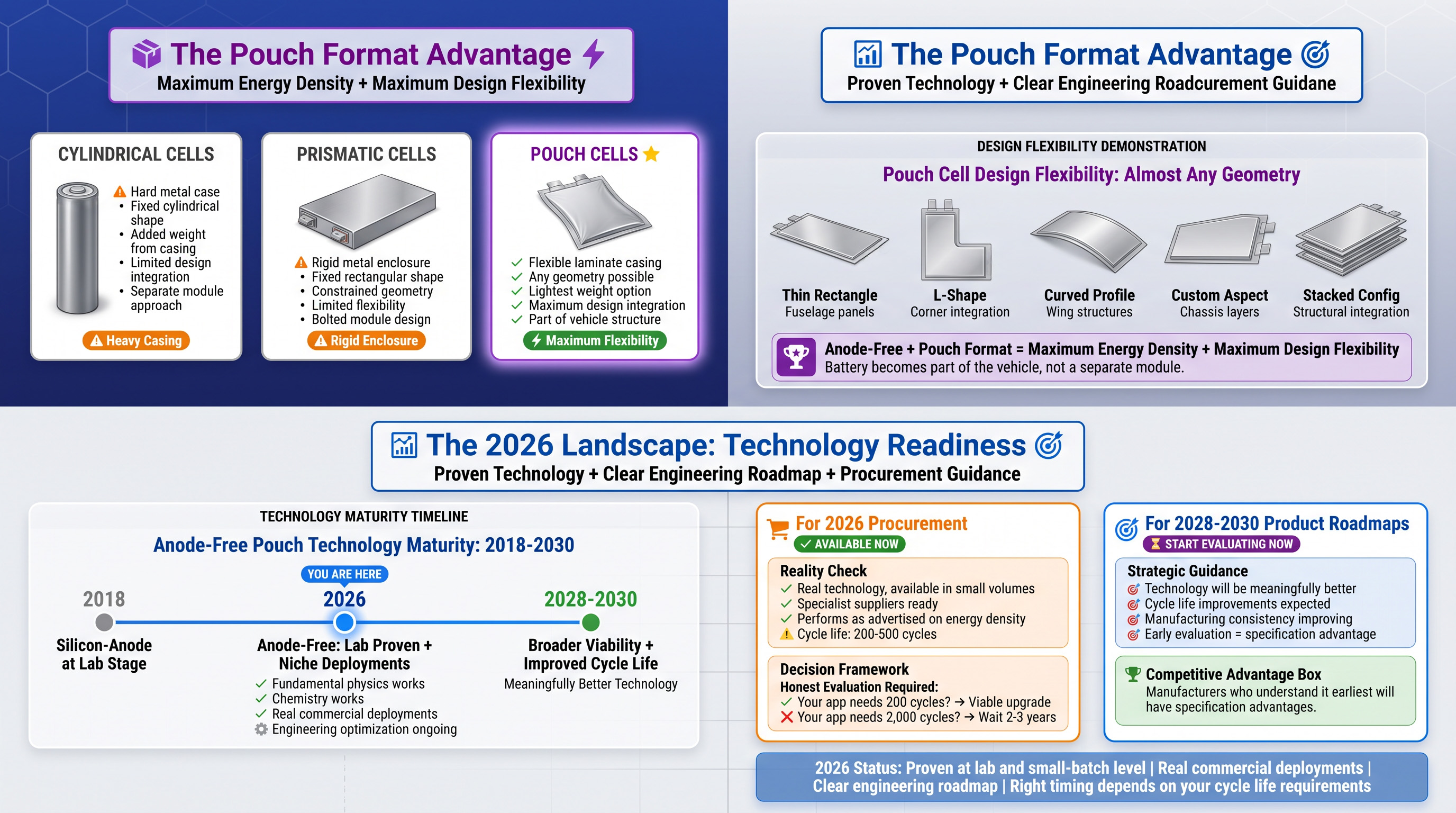
Most of the attention in this article has focused on anode-free chemistry, but the pouch format deserves its own discussion because it multiplies the architectural benefits. Cylindrical and prismatic cells have hard cases — metal cans or rigid enclosures — that add weight and constrain shape. A pouch cell uses a flexible laminate casing, which is lighter and can be manufactured in almost any geometry: thin rectangles, L-shapes, curved profiles, custom aspect ratios. When you combine the anode-free electrode stack with a pouch format, you get maximum energy density with maximum design flexibility. This matters enormously for integrated designs where the battery is part of the structure. Thin pouch cells can be embedded in fuselage panels, built into wing structures, or layered within chassis components in ways that cylindrical cells never could. The battery becomes part of the vehicle rather than a separate module bolted inside it.
The 2026 landscape
Anode-free pouch technology in 2026 sits at the same developmental stage that silicon-anode cells occupied around 2018: proven at the lab and small-batch level, real commercial deployments in high-value niche applications, and a clear engineering roadmap toward broader viability. The fundamental physics works. The chemistry works. The remaining challenges are engineering — electrolyte optimization, manufacturing consistency, formation protocol refinement — and those challenges have known solutions, even if those solutions are not yet fully implemented.
For battery buyers evaluating this technology for 2026 procurement: it is real, it is available in small volumes from specialist suppliers, and it performs as advertised on energy density. The cycle life specification requires honest evaluation against your actual use case. If your application needs 200 cycles, anode-free is a viable upgrade. If it needs 2,000, wait two to three years.
For battery buyers evaluating it for 2028 to 2030 product roadmaps: start evaluating now. The technology will be meaningfully better, and the manufacturers who understand it earliest will have specification advantages over those who encounter it for the first time during procurement.
Dongguan Youli Electronic Technology Limited
——
At Uli-POWER, we build lifepo4 and NMC pouch cell with different energy density. It is what we have trusted for 15 years and what we recommend for the vast majority of applications. But we track every serious development in battery architecture, because the customers we serve in 2030 will be asking questions about technologies that are just entering pilot production today. Anode-free is one of those technologies.
Post time: Aug-25-2026