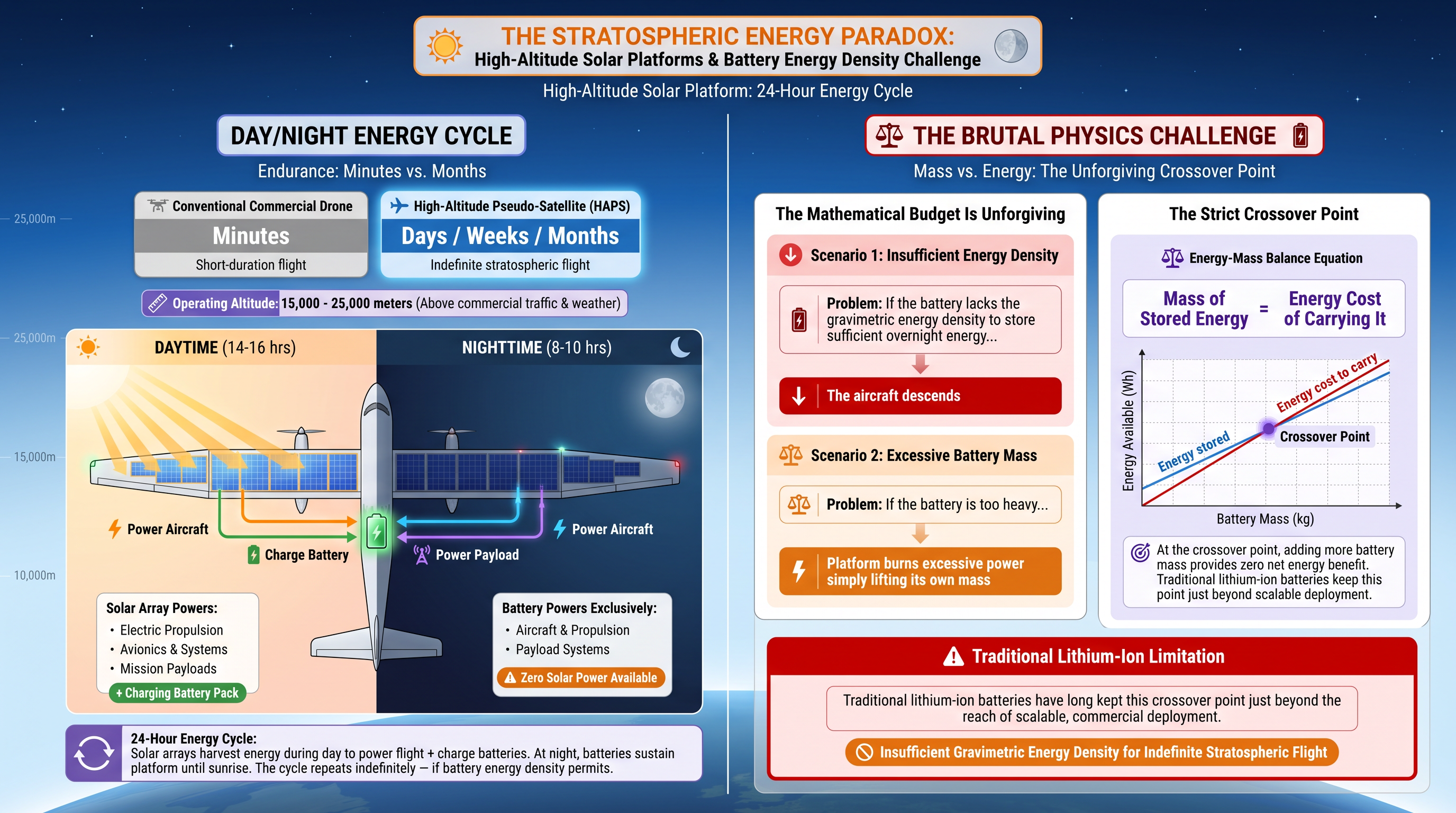
A conventional commercial drone measures endurance in minutes. High-altitude solar platforms—often operating as High-Altitude Pseudo-Satellites (HAPS)—measure flight duration in days, weeks, or months. Operating at stratospheric altitudes between 15,000 and 25,000 meters, these aircraft soar above commercial air traffic and weather systems. However, staying aloft indefinitely presents a brutal physics challenge.
During daylight, solar arrays covering the upper wing surfaces harvest energy to power electric propulsion, avionics, and mission payloads while simultaneously charging the onboard energy storage. At night, the solar array yields zero power, leaving the battery to sustain the platform until sunrise.
The mathematical budget is unforgiving. If the battery lacks the gravimetric energy density to store sufficient overnight energy, the aircraft descends. If the battery is too heavy, the platform burns excessive power simply lifting its own mass. This creates a strict crossover point where the mass of stored energy equals the energy cost of carrying it. Traditional lithium-ion batteries have long kept this crossover point just beyond the reach of scalable, commercial deployment.
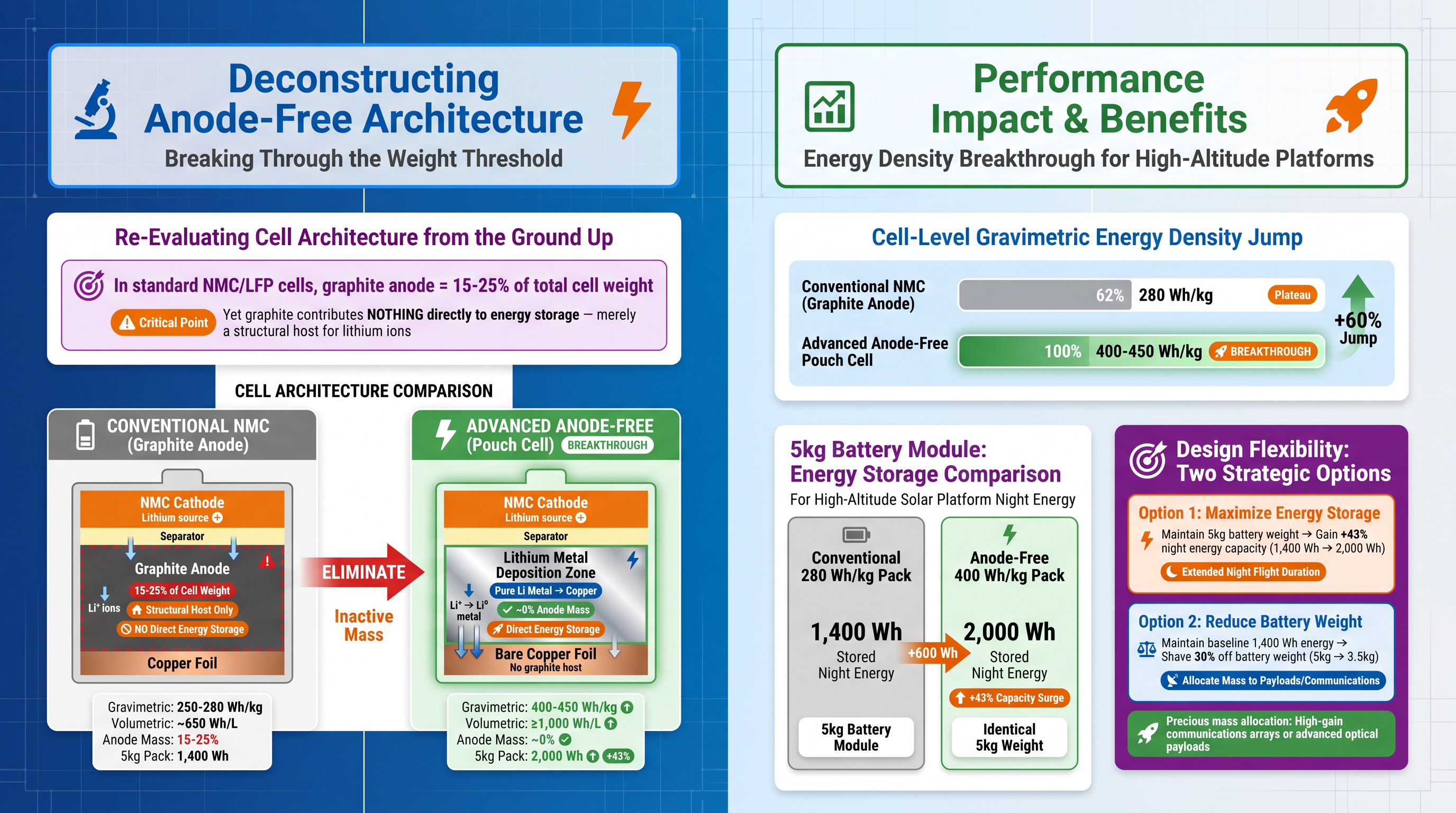
To break through the weight threshold, battery engineers are re-evaluating cell architecture from the ground up. In a standard NMC or LFP lithium-ion cell, the graphite or silicon-graphite anode represents 15% to 25% of total cell weight. Yet, graphite contributes nothing directly to energy storage—it acts merely as a structural host structure for lithium ions.
Anode-free chemistry eliminates this host completely. During the initial charge cycle, lithium ions migrate from the cathode and deposit as pure lithium metal directly onto the bare copper current collector.
- • Gravimetric Energy Density: ~250 – 280 Wh/kg
- • Volumetric Energy Density: ~650 Wh/L
- • Anode Mass Contribution: 15% – 25% of cell weight
- • 5kg Pack Energy Storage: 1,400 Watt-hours
By removing inactive structural mass, cell-level gravimetric energy density jumps from the 280 Wh/kg plateau up to 400–450 Wh/kg. For a high-altitude solar platform carrying a 5 kg battery module:
Alternatively, aircraft designers can shave 30% off battery weight while maintaining the baseline energy budget, allocating precious mass toward high-gain communications arrays or advanced optical payloads.
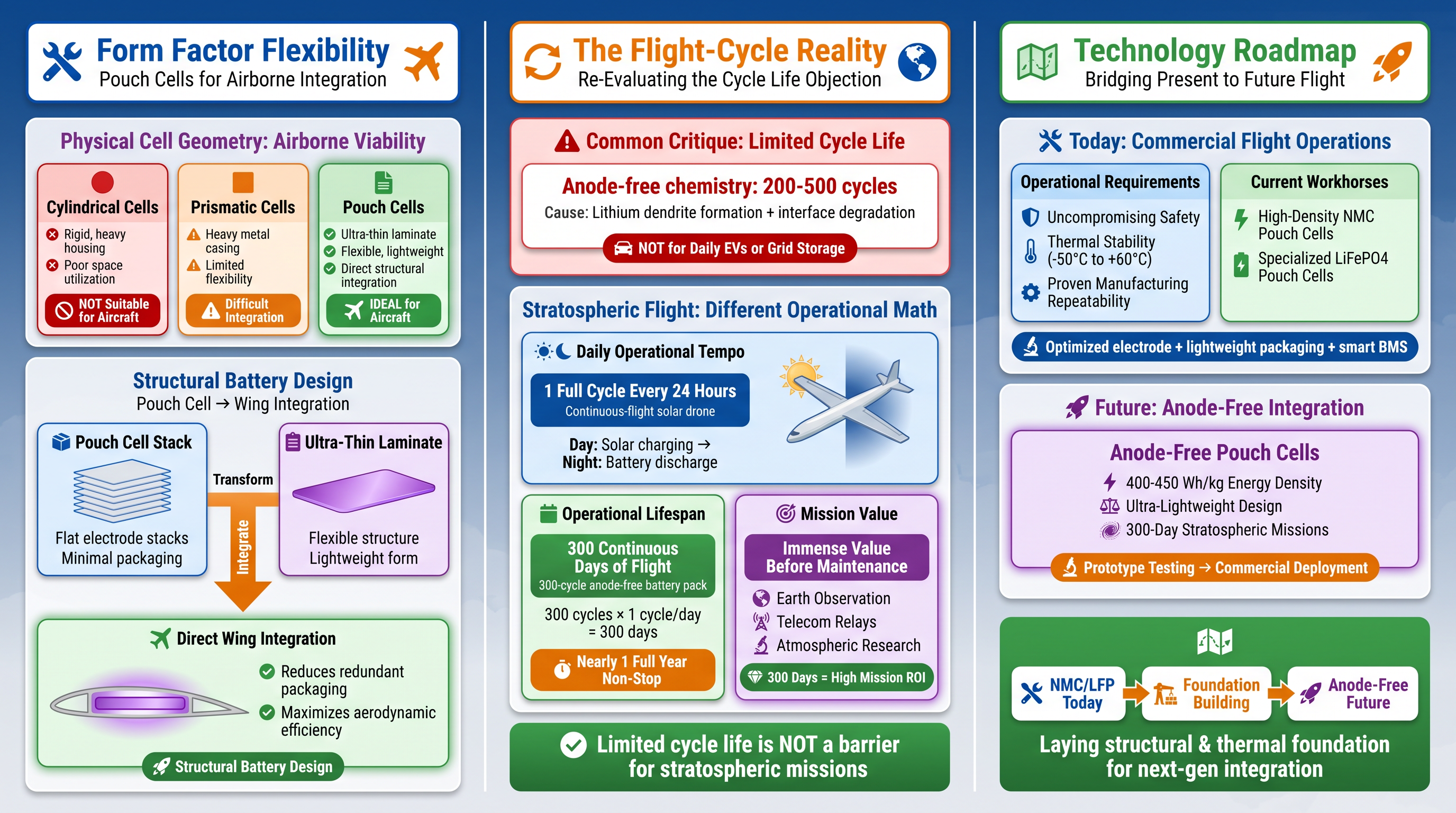
Beyond pure electrochemistry, physical cell geometry dictates airborne viability. Stratospheric aircraft cannot accommodate rigid, heavy cylindrical or prismatic housings easily. Flexible pouch cell architectures allow ultra-thin, flat electrode stacks to be embedded directly into wing structures or internal fuselage bays. This structural battery design reduces redundant outer packaging and maximizes aerodynamic efficiency.
Re-evaluating the Cycle Life Objection A common critique of anode-free chemistry is its limited cycle life (currently 200 to 500 cycles due to lithium dendrite formation and interface degradation). While this limitation renders anode-free cells unsuitable for daily-driven electric vehicles or grid storage, the operational math for solar stratospheric platforms is entirely different:
While anode-free pouch cells represent the long-term future of stratospheric flight, bridging the gap between current prototype testing and commercial-scale deployment requires a phased engineering roadmap. Today’s commercial flight operations demand uncompromising safety, thermal stability across extreme environmental ranges (-50°C to +60°C), and proven manufacturing repeatability.
High-density NMC and specialized LiFePO4 pouch cells remain the workhorses of high-performance UAVs today. By optimizing electrode thickness, utilizing lightweight pouch packaging, and implementing smart battery management systems (BMS), modern pouch cell configurations continue to push current flight envelopes while laying the structural and thermal foundation for next-generation anode-free integration.
Evaluating airborne energy storage requires analyzing the total system—balancing cell chemistry, thermal enclosure overhead, and structural integration to ensure every gram of weight delivers maximum operational endurance.
At Uli-POWER (Dongguan Youli Electronic Technology Co., Ltd.), we specialize in the design, custom enclosure, and precision manufacturing of high-energy-density LiFePO4 and NMC pouch cells engineered for rigorous applications.
With over 15 years of battery manufacturing experience, our engineering team collaborates closely with aerospace, industrial UAV, and robotics innovators to push the limits of gravimetric efficiency, safety, and operational reliability. Whether you are optimizing current flight platforms or prototyping next-generation architectures, Uli-POWER delivers tailored battery solutions designed to meet stringent weight and performance targets.
Connect with Our Engineering Team
- Global Website: www.uli-power.com
- Direct Email: info@uli-power.com
- Phone / WhatsApp: +86 18565703627
Post time: Aug-31-2026