Every few months, a new energy density number hits industry headlines — 350 Wh/kg, then 400, then 500. Each announcement can make your current battery solution feel outdated, and it’s rarely clear which specs are ready for real-world deployment, which are still in development, and which actually matter for your application.
Below is a clear breakdown of where each density tier stands in 2026, what use cases they serve, and what you can actually source and deploy today.
The Energy Density Ladder
Baseline: 160–180 Wh/kg — Standard LiFePO4
This is the workhorse chemistry of ground-based applications. It powers nearly every e-bike, home solar backup system, 12V RV battery and industrial energy storage unit on the market. It is not the highest density option, but it is the most proven: low cost, excellent thermal stability, long cycle life and widespread, mature supply chains.
250–300 Wh/kg — Premium NMC/NCA/NCM
Common in consumer electronics and passenger EVs, this tier delivers higher energy at the cost of thermal stability and cycle life. For ground use where weight is a moderate concern, it is a well-established option; for aviation, it has long been the entry-level baseline.
350 Wh/kg — Semi-Solid State, Mass Production Ready
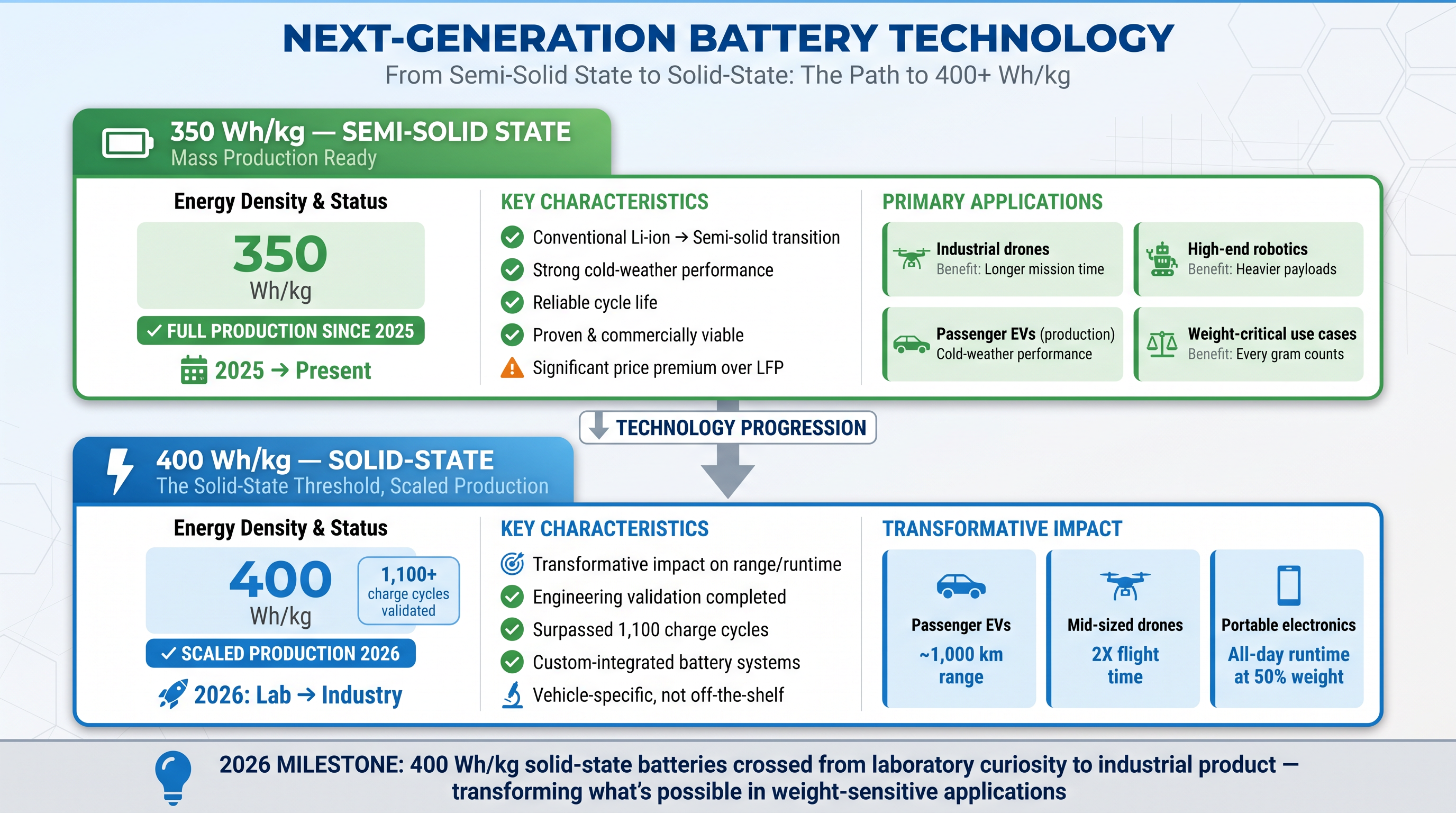
This tier marks the point where conventional lithium-ion transitions into semi-solid-state architecture. Since 2025, 350 Wh/kg semi-solid cells have been in full production for industrial drones and high-end robotics — applications where every gram of weight saved directly translates to longer mission time or heavier payloads. Some passenger vehicle manufacturers have also launched production vehicles equipped with 350 Wh/kg semi-solid battery packs, demonstrating strong cold-weather performance and reliable cycle life.
This tier is proven, available and commercially viable — but it carries a significant price premium over LFP, making it only practical for weight-critical use cases.
400 Wh/kg — The Solid-State Threshold, Scaled Production
2026 is the year 400 Wh/kg-class solid-state batteries crossed from laboratory curiosity to industrial product. Multiple manufacturers have completed engineering validation, surpassed 1,100 charge cycles in testing, and entered scaled production for integrated battery systems.
At this density, the impact is transformative: roughly 1,000 km of range for a passenger EV, doubled flight time for mid-sized drones, and all-day runtime for portable electronics at half the weight. These cells are primarily deployed as part of custom-integrated battery systems designed for specific vehicles and devices, rather than sold as off-the-shelf standard form factors.
 450 Wh/kg — Fully Production-Ready for Specialty Applications
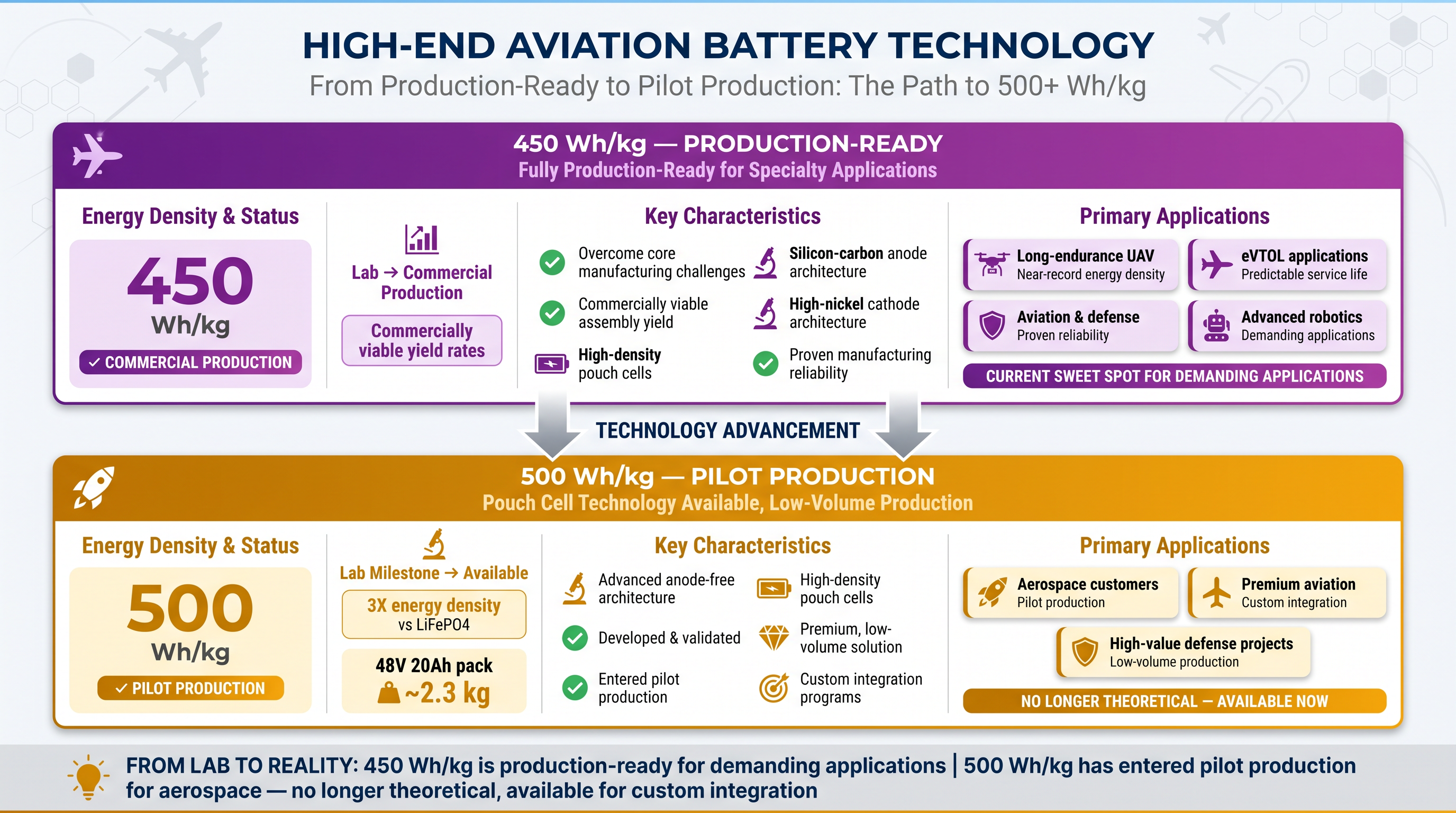
What was once a laboratory-only benchmark is now in commercial production. The 450 Wh/kg tier has overcome its core manufacturing challenges: assembly yield rates have improved to commercially viable levels, and high-density pouch cells built with silicon-carbon anode and high-nickel cathode architectures are now being delivered to customers in the aviation, defense and advanced robotics sectors.
This is the current sweet spot for demanding long-endurance UAV and eVTOL applications: it delivers near-record energy density with proven manufacturing reliability and predictable service life.
500 Wh/kg — Pouch Cell Technology Available, Low-Volume Production
500 Wh/kg is no longer just a lab milestone. High-density pouch cells — including designs leveraging advanced anode-free architecture — have been developed, validated and entered pilot production for aerospace and premium aviation customers.
At roughly triple the energy density of standard LiFePO4, a 48V 20Ah pack built at this density would weigh only about 2.3 kg. While still a premium, low-volume solution best suited for high-value aerospace and defense projects, 500 Wh/kg pouch cells are no longer theoretical — they are available for custom integration programs.
What This Means for Your Application
The density race is real and accelerating. Semi-solid cells from 350 to 450 Wh/kg are in full production today, and 500 Wh/kg solutions are moving from pilot line to real-world projects. But higher density is not always the right choice.
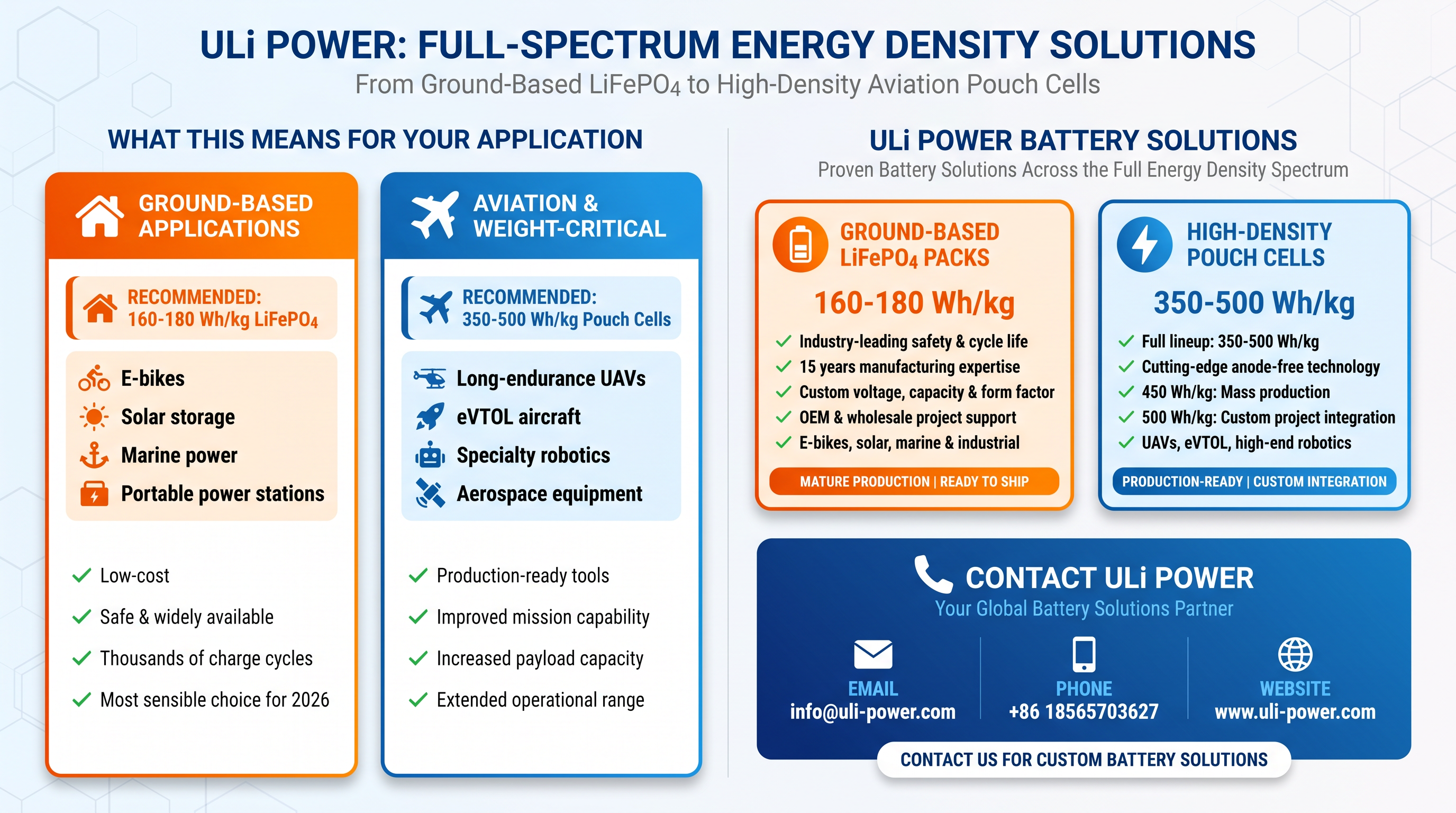
- For ground-based applications (e-bikes, solar storage, marine power, portable power stations): Standard 160–180 Wh/kg LiFePO4 remains the most sensible choice for almost every buyer. It is low-cost, safe, widely available, and delivers thousands of charge cycles. No higher-density chemistry can compete on all four of those criteria in 2026, and for use cases where weight is not a critical constraint, the premium simply does not pay off.
- For aviation and weight-critical industrial applications (long-endurance UAVs, eVTOL aircraft, specialty robotics, aerospace equipment): 350–500 Wh/kg high-density pouch cells are no longer future technology — they are production-ready tools that directly improve mission capability, payload capacity and operational range.
ULi Power Battery Solutions
At ULi Power, we deliver proven battery solutions across the full energy density spectrum.
For ground-based applications, our mature 160–180 Wh/kg LiFePO4 packs deliver industry-leading safety, cycle life and cost performance — built on 15 years of manufacturing expertise for e-bikes, solar storage, marine and industrial use. We support custom voltage, capacity and form factor design for OEM and wholesale projects.
For weight-critical aviation and specialty industrial scenarios, we offer a full lineup of high-density pouch cells ranging from 350 Wh/kg to 500 Wh/kg, including cutting-edge anode-free pouch battery technology. Our 450 Wh/kg cells are in mass production, and 500 Wh/kg solutions are available for custom project integration, purpose-built for long-endurance UAVs, eVTOL aircraft, and high-end robotics.
Email: info@uli-power.com
Phone: +86 18565703627
Web: www.uli-power.com
Post time: Aug-05-2026