In the energy storage industry, the terms ESS and BESS are often used interchangeably, but they carry distinct meanings that are critical for understanding energy storage solutions, especially for industry newcomers, businesses, and technical teams. Below is a clear, professional breakdown of their definitions, core differences, and real-world relevance.
What is the difference between BESS and ESS?
ESS (Energy Storage System) is the broad, umbrella term for any technology that captures energy, stores it, and releases it later to meet demand. It includes all forms of energy storage, from chemical batteries and pumped hydro to compressed air and flywheels. ESS is the “big picture” category.
BESS (Battery Energy Storage System) is a specific subset of ESS that uses rechargeable battery technologies (like Li-ion, LiFePO4, lead-acid, or flow batteries) to store electrical energy. It is the most common and fastest-growing type of ESS today, especially for grid-scale, commercial, and residential applications.

Core Differences Between ESS and BESS
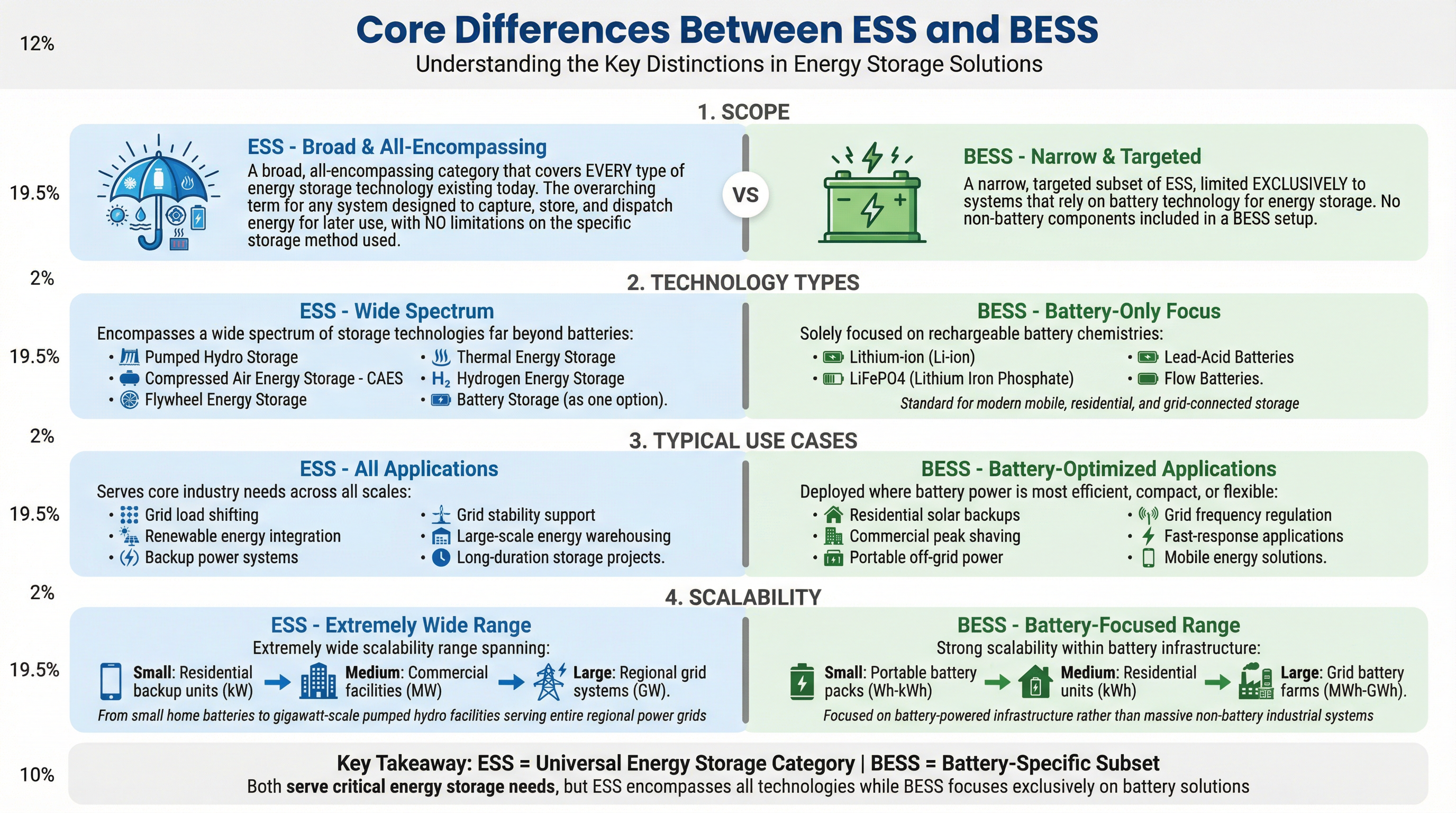
The clearest distinctions between ESS and BESS lie in their scope, technology range, application focus, and scalability, which help clarify how each term applies to real-world energy storage solutions.
Scope
ESS is a broad, all-encompassing category that covers every type of energy storage technology existing today. It is the overarching term for any system designed to capture, store, and dispatch energy for later use, with no limitations on the specific storage method used. In contrast, BESS is a narrow, targeted subset of ESS, limited exclusively to systems that rely on battery technology for energy storage—there are no non-battery components included in a BESS setup.
Technology Types
ESS encompasses a wide spectrum of storage technologies far beyond batteries, including pumped hydro storage, compressed air energy storage (CAES), flywheels, thermal storage, and even hydrogen storage. BESS, however, is solely focused on rechargeable battery chemistries, the most common being lithium-ion (Li-ion), LiFePO4, lead-acid, and flow batteries, which are the standard for modern mobile, residential, and grid-connected storage.
Typical Use Cases
Both ESS and BESS serve core industry needs like grid load shifting, renewable energy integration, backup power, and grid stability support. The key difference is that BESS is deployed specifically for use cases where battery power is the most efficient, compact, or flexible solution, such as residential solar backups, commercial peak shaving, and portable off-grid power. ESS as a broader category includes large-scale, non-battery projects that are better suited for long-duration, grid-level energy warehousing.
Scalability
ESS systems have an extremely wide scalability range, spanning from small residential backup units all the way up to gigawatt-scale pumped hydro facilities that serve entire regional power grids. BESS also offers strong scalability, ranging from compact portable battery packs and small residential units to large-scale grid battery farms, but it remains focused on battery-powered infrastructure rather than the massive, non-battery industrial systems that fall under general ESS.
Simple Analogy
Think of it like “Fruit vs. Apples”:
- ESS = Fruit: The general category of all energy storage solutions.
- BESS = Apples: A specific, popular type of fruit (in this case, a battery-based storage system).
Why This Matters for Your Business
For companies in the battery and energy storage sector:
- BESS is your core product: It refers directly to the LiFePO4, lithium-ion, or other battery systems you design, manufacture, or deploy.
- ESS is the market context: It helps you position your BESS products within the larger energy transition and grid modernization narrative.
Final Takeaway
All BESS are ESS, but not all ESS are BESS.
When you see “ESS,” it’s a general reference to energy storage. When you see “BESS,” it’s specifically talking about a battery-powered energy storage system—the kind that powers everything from residential solar backups to utility-scale grid stabilizers.

Post time: Mar-11-2026