E-bikes, e-scooters, and electric motorcycles have become core choices for urban commuting and short-distance travel globally. As the “power heart” of these vehicles, batteries directly determine range, performance, safety, and lifespan. Due to significant differences in regional regulations, usage scenarios, and infrastructure among Europe, America, and Southeast Asia—paired with varying vehicle power and weight—battery selection logic varies greatly. Choosing the right one ensures durability and compliance, while the wrong choice not only compromises the riding experience but also poses potential safety or regulatory risks. Combining regional characteristics and practical needs, this article breaks down the core points of battery selection for each vehicle type, helping you avoid pitfalls and make precise matches.
E-Bike Battery Selection: Prioritize Compliance, Portability & Sufficient Range
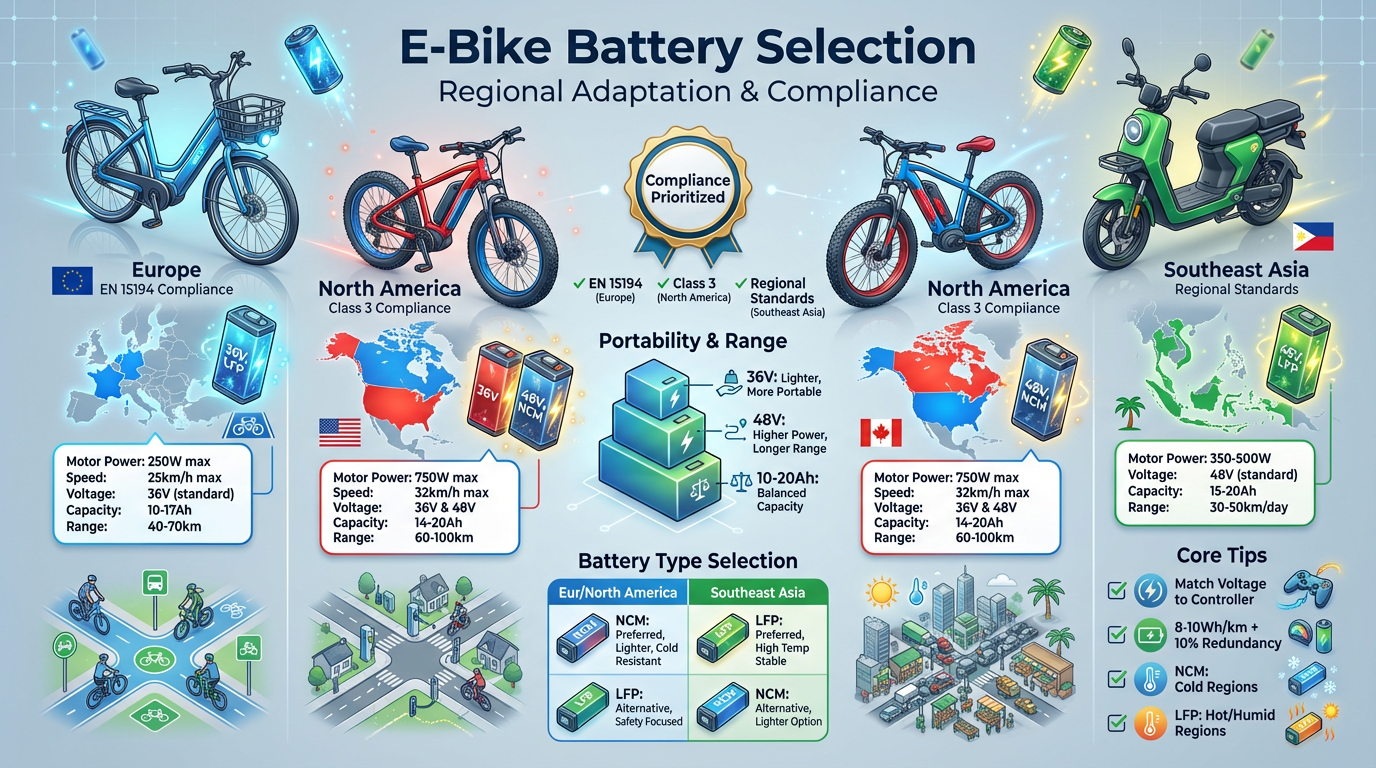
E-bikes are primarily designed for short-distance travel (≤30km/day) and easy mobility, with regional regulations shaping voltage and power limits.
Regional Adaptation
- Europe: Strictly adheres to the EN 15194 standard—motor power capped at 250W, with a maximum assisted speed of 25km/h. 36V is the dominant voltage (compatible with 250W motors), and capacities typically range from 10-17Ah (360-612Wh). This configuration delivers a 40-70km range, ideal for urban commutes in countries like Germany, the Netherlands, and France (where bike lanes are well-developed). LFP batteries are preferred for shared e-bikes due to their long cycle life, while NCM batteries are popular for personal use (lighter and better for cold winters in Northern Europe, retaining 80% capacity at -10°C).
- North America: U.S. and Canadian regulations allow motor power up to 750W (Class 3 e-bikes, max speed 32km/h). 36V (for 250-500W motors) and 48V (for 500-750W motors) are mainstream. Capacities range from 14-20Ah, with 48V 17Ah (816Wh) models offering 60-100km range—suited for longer suburban commutes. NCM batteries are widely used for their portability, while LFP is favored for commercial fleets (e.g., food delivery e-bikes) due to higher safety.
- Southeast Asia: No strict power limits for personal e-bikes; 48V is the most common voltage (paired with 350-500W motors), aligning with hot and humid climates and longer daily commutes (30-50km). Capacities of 15-20Ah are standard, with LFP batteries dominating—their high-temperature stability (resistant to 60°C+ outdoor parking) and low maintenance needs fit the region’s usage habits (frequent outdoor storage, less regular charging).
Core Tips
Voltage must match the controller (never mix 36V and 48V). Calculate capacity based on “8-10Wh per kilometer” and reserve 10% redundancy. For cold regions (Northern Europe, Canada), choose NCM; for hot/humid areas (Southeast Asia, Southern Europe), opt for LFP.
E-Scooter Battery Selection: Focus on Compatibility, Portability & Regional Regulations
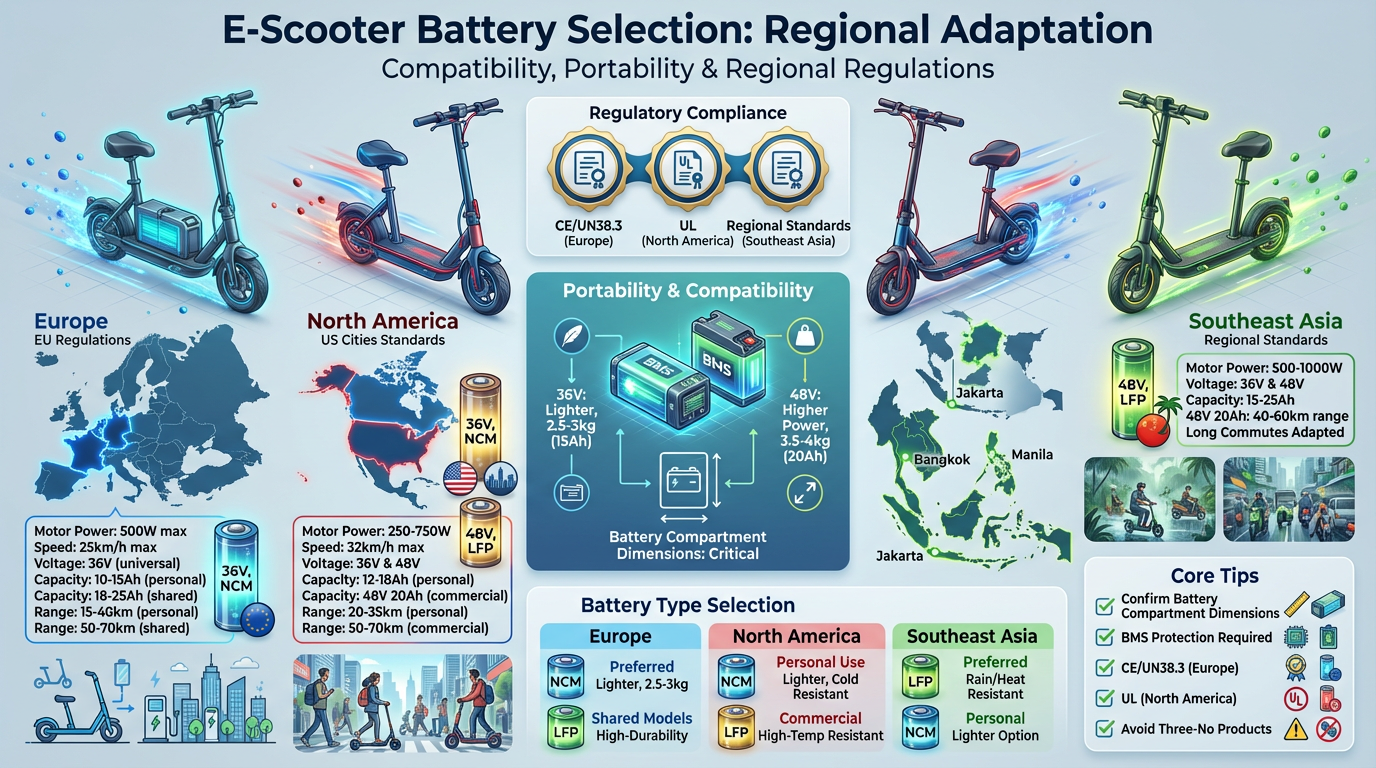
Most e-scooter batteries are built-in, with size constraints and regional power limits driving selection.
Regional Adaptation
- Europe: EU regulations cap motor power at 500W (max speed 25km/h). 36V is universal (compatible with 250-500W motors), with capacities of 10-15Ah (360-540Wh) for personal use (15-40km range) and 18-25Ah for shared scooters (e.g., Lime, Dott) in cities like Paris and Berlin. NCM batteries are preferred for their light weight (2.5-3kg for 36V 15Ah), while LFP is used for shared models (better durability for high-frequency charging). All batteries must carry CE and UN38.3 certifications for cross-border sales.
- North America: U.S. cities allow 250-750W motors (max speed 32km/h). 36V (personal use) and 48V (commercial/high-power models) are common. Personal scooters use 12-18Ah capacities (36V 15Ah for 20-35km range), while commercial fleets (e.g., Bird) adopt 48V 20Ah (960Wh) batteries for 50-70km range. NCM is popular for personal use, and LFP for commercial models (resistant to high temperatures in states like Arizona).
- Southeast Asia: Unregulated motor power (often 500-1000W for off-road or heavy loads). 36V (civilian models) and 48V (high-power scooters) are mainstream. Capacities of 15-25Ah are standard—48V 20Ah models deliver 40-60km range, fitting long commutes in Bangkok, Jakarta, or Manila. NCM is used for portable personal scooters, while LFP dominates commercial/shared scooters (withstands rain, humidity, and outdoor storage without leakage risks).
Core Tips
Confirm battery compartment dimensions before purchase (critical for built-in designs). Ensure BMS protection and international certifications (CE/UN38.3 for Europe, UL for North America). Avoid “three-no” products to prevent thermal runaway.
Electric Motorcycle Battery Selection: Prioritize Power Matching, Range Redundancy & Regional Usage
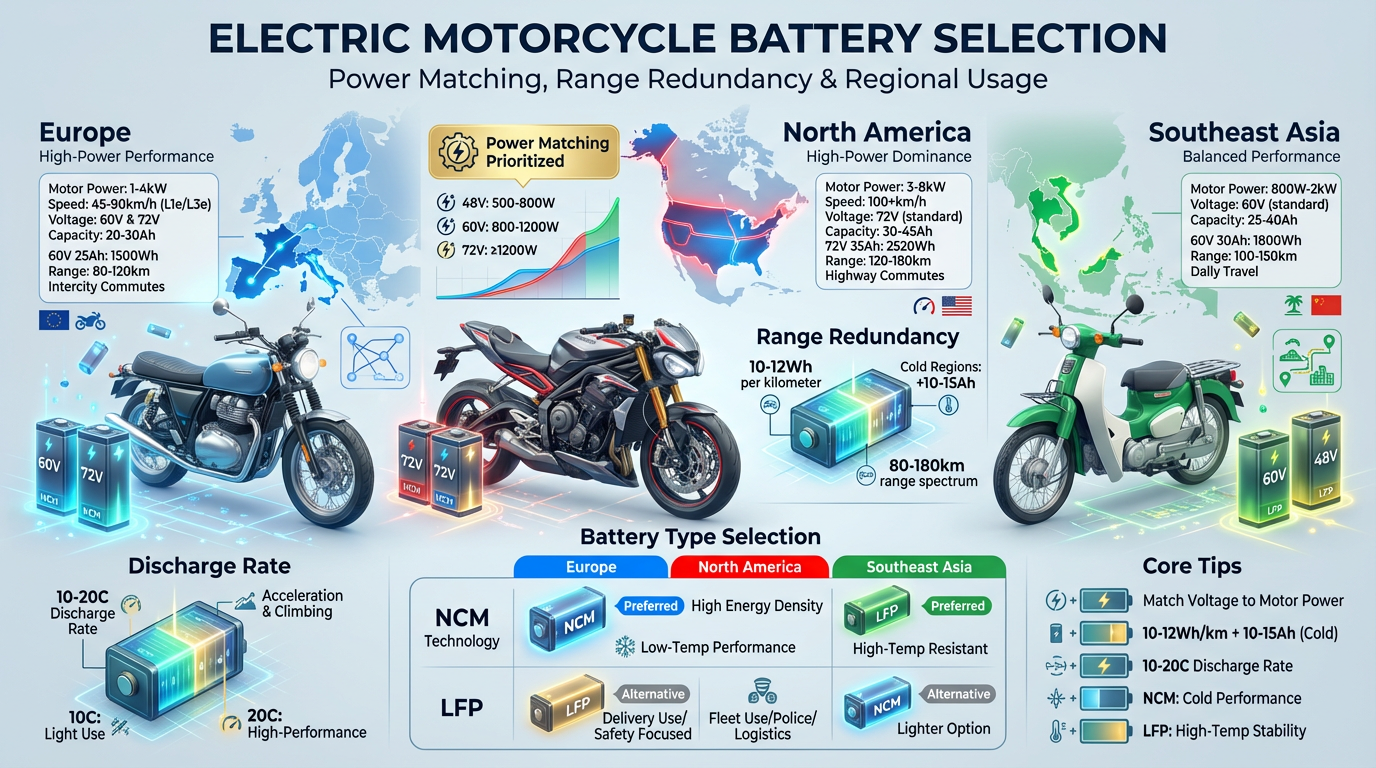
Electric motorcycles are heavier with higher power (500W-2000W+), tailored to regional travel needs (long distances, hills, or heavy loads).
Regional Adaptation
- Europe: Motor power typically ranges from 1-4kW (max speed 45-90km/h for L1e/L3e categories). 60V (for 1-2kW motors) and 72V (for 2-4kW motors) are common. Capacities of 20-30Ah (60V 25Ah = 1500Wh) offer 80-120km range—suited for intercity commutes in countries like Italy and Spain. NCM batteries are preferred for their high energy density (supporting faster acceleration), while LFP is used for delivery motorcycles (better safety for frequent stops/starts).
- North America: High-power models (3-8kW, max speed 100+km/h) dominate. 72V is standard (paired with 3-6kW motors), with capacities of 30-45Ah (72V 35Ah = 2520Wh) delivering 120-180km range—ideal for highway commutes in the U.S. NCM batteries are widely used (excellent low-temperature performance for Northern U.S. winters), while LFP is gaining traction for fleet use (e.g., electric motorcycles for police or logistics).
- Southeast Asia: Motor power ranges from 800W-2kW (suited for flat roads and light loads). 60V is the most popular voltage (balancing range and cost), with capacities of 25-40Ah (60V 30Ah = 1800Wh) offering 100-150km range—fitting daily travel in Vietnam, Thailand, and Malaysia. LFP batteries are the top choice—their resistance to high temperatures (up to 80°C) and long cycle life (≥2000 cycles) align with frequent use and outdoor parking. 48V models (15-25Ah) are also available for short-distance urban commutes.
Core Tips
Voltage must match motor power (48V for 500-800W, 60V for 800-1200W, 72V for ≥1200W). Calculate capacity based on “10-12Wh per kilometer”—add 10-15Ah for cold regions (Europe/North America winters) to offset capacity loss. Discharge rate (10C-20C) must meet acceleration and climbing needs.
Universal Tips to Avoid Pitfalls
- Compliance First: Follow regional regulations (e.g., EU 250W limit for e-bikes, UL certification for North America) to avoid legal issues.
- Reputable Cells: Choose CATL, EVE, Farasis, BYD, or Samsung cells—performance is 30-50% more stable than unknown brands, with longer cycle life.
- Verify Real Capacity: Avoid inflated claims—purchase through official channels and request test reports if needed.
- Compatibility Check: Measure battery compartment dimensions (e-scooters/motorcycles) and confirm connector types (XT60, DC plug) for e-bikes.
Custom Battery Solutions from ULi Power
ULi Power offers region-specific lithium battery solutions for e-bikes, e-scooters, and electric motorcycles, tailored to European, American, and Southeast Asian regulations and climates. Our product range covers 36V-72V voltages, 10Ah-70Ah capacities, and both NCM and LFP cell types—all equipped with high-precision BMS and international certifications (CE, UN38.3, UL). Whether you need lightweight NCM batteries for European e-bikes, high-temperature-resistant LFP for Southeast Asian scooters, or high-power 72V models for North American motorcycles, we can customize dimensions, capacities, and connectors to meet your needs.
For Inquiries: info@uli-power.com
Contact: +86 18565703627

Post time: Jan-09-2026