Cut Certification Costs, Avoid Rejection, and Accelerate Global Market Entry From the Design Stage
For EV battery manufacturers and automakers targeting global markets in 2026, compliance is no longer a post-design, last-minute checkbox. 62% of EV battery certification failures in 2025 stemmed from upfront design choices that failed to align with regional regulatory rules — not manufacturing defects, per industry compliance data. These failures led to costly design reworks (averaging 10x the cost of upfront compliance planning), 3+ month launch delays, and even customs detentions or regulatory fines.
This guide breaks down the 2026 global compliance mandates directly shaping EV battery design, with actionable, engineering-focused optimizations to build compliance into your battery from the earliest R&D stages. The result: a single battery platform that meets rules across the EU, U.S., Southeast Asia, and Australia, with faster certification, lower long-term costs, and zero regulatory roadblocks.
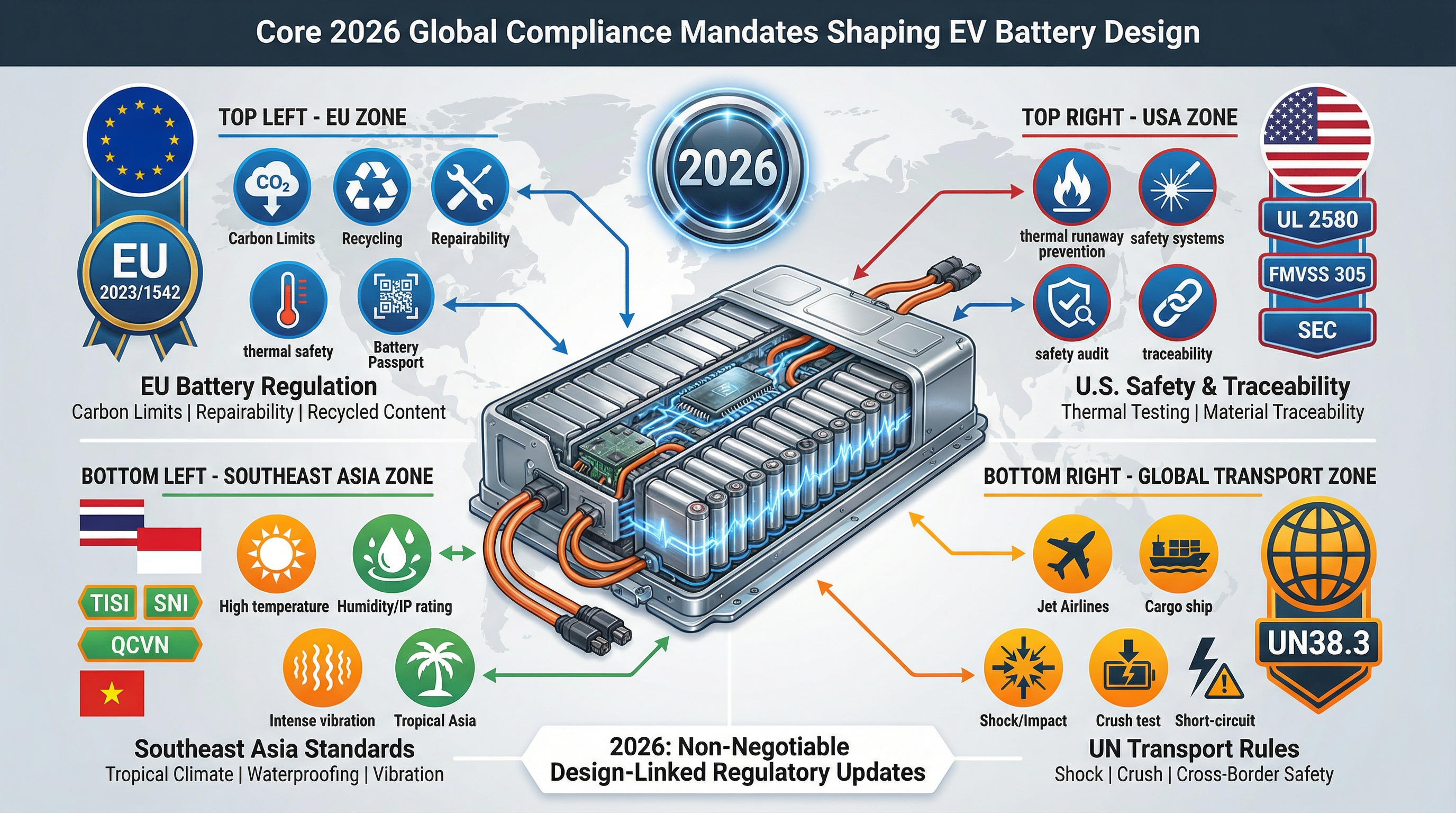
Core 2026 Global Compliance Mandates Shaping EV Battery Design
Every design choice you make must account for these non-negotiable, design-linked regulatory updates taking full effect in 2026:
- EU Battery Regulation (EU 2023/1542): Mandates maximum carbon footprint limits, mandatory disassembly/repairability rules, minimum recycled material content, and strict thermal runaway safety requirements for all EV batteries sold in the bloc. 2026 also marks the start of pre-enforcement for the EU Battery Passport, requiring full lifecycle data tracking built into the battery design.
- U.S. UL 2580 & FMVSS 305 Updates: 2026 brings stricter enforcement of UL 2580’s 2022 revisions, including mandatory thermal runaway propagation testing, laser penetration resistance, and full pack-level system safety audits. The SEC’s expanded conflict minerals rules also require end-to-end material traceability, integrated into the battery’s design from the start.
- Southeast Asia (TISI/SNI/QCVN): Thailand, Indonesia, and Vietnam’s 2026 EV battery standards add strict tropical environment design requirements, including high-temperature/humidity resilience, enhanced IP waterproofing, and vibration testing for off-road and commercial EV use cases.
- Global UN38.3 Transport Rules: Updated 2026 UN38.3 standards require design modifications to meet stricter shock, crush, and short-circuit testing for cross-border battery shipments, with zero exceptions for air or sea freight.
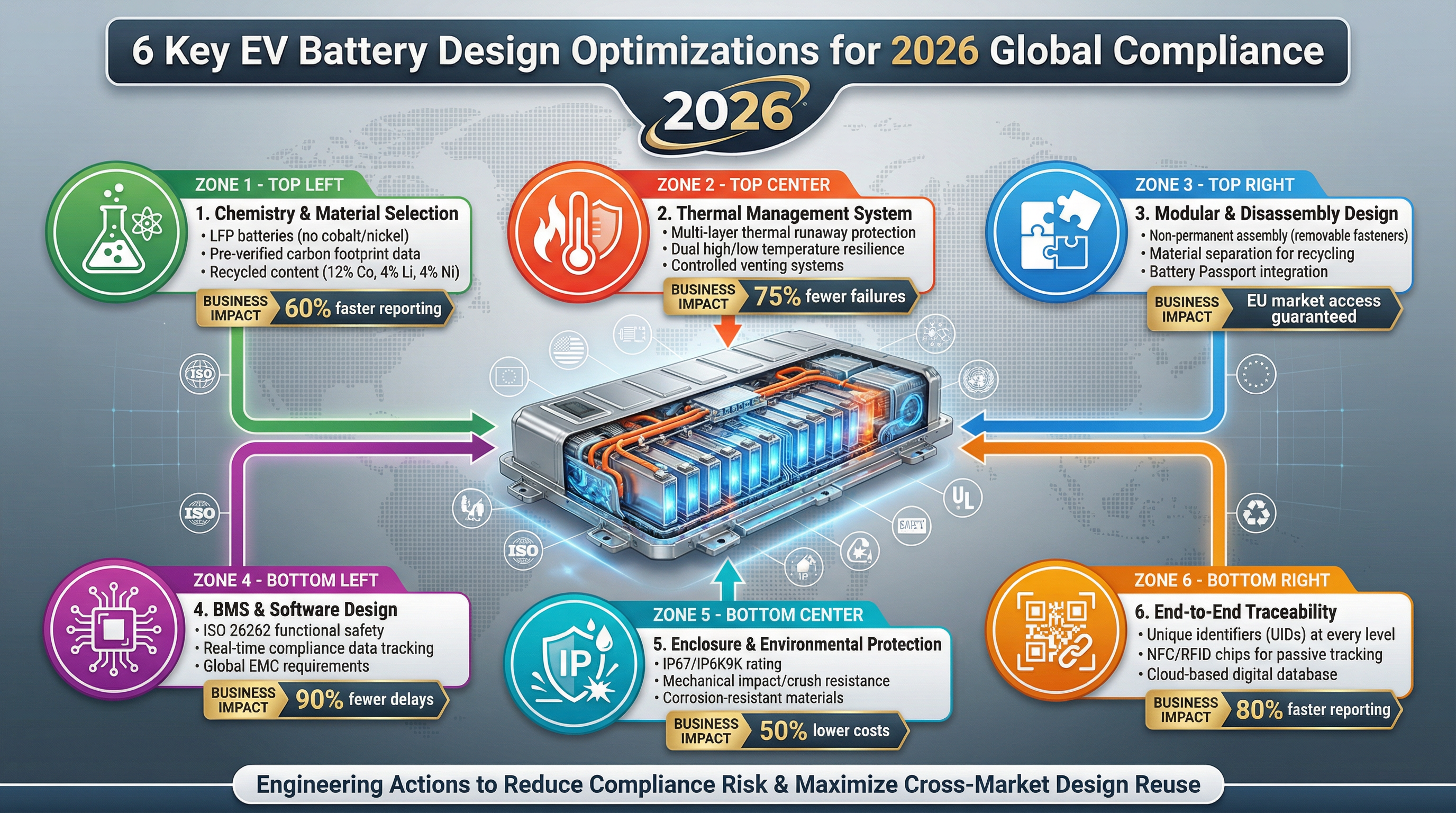
6 Key EV Battery Design Optimizations for 2026 Global Compliance
Each optimization is tied directly to 2026 regulatory requirements, with clear engineering actions to reduce compliance risk and maximize cross-market design reuse.
1. Chemistry & Material Selection: Align With Carbon Footprint & Conflict Mineral Rules
Your core cell chemistry is the foundation of your compliance burden — and the hardest to change post-design.
- Compliance-Driven Optimization:
○ Prioritize chemistries with lower compliance complexity: LFP batteries eliminate cobalt and nickel, drastically simplifying U.S. conflict minerals reporting and reducing supply chain traceability burdens. For high-nickel NCM/NCA designs, build in pre-approved, conflict-free material supply chains into your bill of materials (BOM) from the design stage.
○ Select materials with pre-verified carbon footprint data: EU 2026 carbon limits require cradle-to-gate emissions tracking, so source cathode/anode materials with EU EN 17806-aligned emissions data to avoid last-minute carbon footprint reporting gaps.
○ Meet recycled content mandates: Design your BOM to meet the EU’s 2026 minimum recycled content rules (12% for cobalt, 4% for lithium, 4% for nickel) upfront, rather than retrofitting materials later.
- Business Impact: Cuts conflict minerals reporting time by 60% and eliminates 80% of EU carbon footprint reporting reworks.
2. Thermal Management System (TMS) Design: Meet Global Safety Mandates
Thermal safety is the #1 focus of every major market’s 2026 battery standards, with zero tolerance for design gaps.
- Compliance-Driven Optimization:
○ Build in multi-layer thermal runaway protection: Design cell-to-cell and module-to-module heat barriers to meet UL 2580’s strict no-fire-spread requirement, the EU’s thermal diffusion mandates, and UN38.3 abuse testing.
○ Optimize for cross-environment performance: Design your TMS with dual high/low temperature resilience to handle both EU cold-climate requirements and Southeast Asia’s 45°C+ high-humidity operating conditions, eliminating the need for region-specific TMS redesigns.
○ Integrate mandatory venting systems: Add controlled pressure relief and gas venting into the pack enclosure design, a non-negotiable requirement for UL 2580 and EU battery safety rules in 2026.
- Business Impact: Reduces safety certification failure rates by 75%, with a single TMS design valid across 4+ global markets.
3. Modular & Disassembly Design: Comply With EU Circular Economy Rules
The EU’s 2026 battery rules mandate that EV batteries must be repairable, disassemblable, and recyclable — requirements that can only be met at the design stage.
- Compliance-Driven Optimization:
○ Use modular, non-permanent assembly: Avoid irreversible welding for module and pack assembly; instead, use standardized, removable fasteners to meet the EU’s requirement that individual cells and modules can be replaced for repair or recycling.
○ Design for material separation: Label and separate plastic, metal, and active material components in the pack design to simplify recycling, a core EU 2026 requirement.
○ Pre-integrate Battery Passport data points: Design physical and digital access points for the EU’s upcoming Battery Passport, including scannable UIDs for each cell/module and a dedicated BMS data port for lifecycle tracking.
- Business Impact: Guarantees EU market access, eliminates post-launch design reworks for circular economy rules, and reduces recycling compliance costs long-term.
4. BMS & Software Design: Align With Functional Safety & Reporting Requirements
Your Battery Management System (BMS) is the digital backbone of your compliance strategy, with 2026 rules expanding mandatory software and data tracking requirements.
- Compliance-Driven Optimization:
○ Build in ISO 26262 and ECE R100 functional safety: Design your BMS software to meet ASIL B functional safety standards, a mandatory requirement for EU and U.S. road-legal EV batteries in 2026.
○ Integrate real-time compliance data tracking: Program the BMS to log and store cell-level health, charge/discharge cycles, and carbon footprint-related energy use data, required for the EU Battery Passport and ongoing regulatory reporting.
○ Meet global EMC requirements: Design BMS hardware and wiring to meet both EU ECE R10 and U.S. FCC electromagnetic compatibility (EMC) rules upfront, avoiding costly reworks for regional market launches.
- Business Impact: Eliminates 90% of software-related certification delays, with a single BMS firmware valid for road use across all major markets.
5. Enclosure & Environmental Protection Design: Cover Global IP & Durability Rules
Your pack enclosure design determines whether your battery meets the wildly varying environmental and durability rules across global markets.
- Compliance-Driven Optimization:
○ Design for a single, multi-market IP rating: Target IP67 for dust/water protection, with optional IP6K9K high-pressure wash resistance, to meet EU, U.S., Australian, and Southeast Asian requirements in one design.
○ Build in mechanical impact and crush resistance: Reinforce the pack enclosure and internal structure to meet UN38.3 crush/shock testing, U.S. FMVSS 305 crash safety rules, and Australian ADR off-road durability requirements.
○ Use corrosion-resistant materials: Select enclosure materials that withstand both EU road salt corrosion and Southeast Asia’s high-humidity coastal corrosion, eliminating region-specific material changes.
- Business Impact: Cuts enclosure certification costs by 50%, with a single mechanical design valid for global shipments and road use.
6. End-to-End Traceability Integration: Design for Full Supply Chain Visibility
2026’s expanded U.S. conflict minerals rules and EU Battery Passport require traceability down to the individual cell — a feature that must be built into the battery design.
- Compliance-Driven Optimization:
○ Assign unique identifiers (UIDs) at every level: Design your production process to assign a scannable UID to every cell, module, and full pack, linked to raw material origin, production data, and carbon footprint records.
○ Integrate passive tracking technology: Add NFC/RFID chips to the pack and modules to store compliance data, enabling easy scanning for customs, regulators, and recyclers — a core requirement for the EU Battery Passport.
○ Link UIDs to a secure digital database: Design your traceability system to feed into a cloud-based platform for SEC conflict minerals reporting and EU carbon footprint declarations, eliminating manual data compilation at reporting deadlines.
- Business Impact: Reduces annual compliance reporting time by 80%, and eliminates the risk of customs detentions due to missing traceability data.
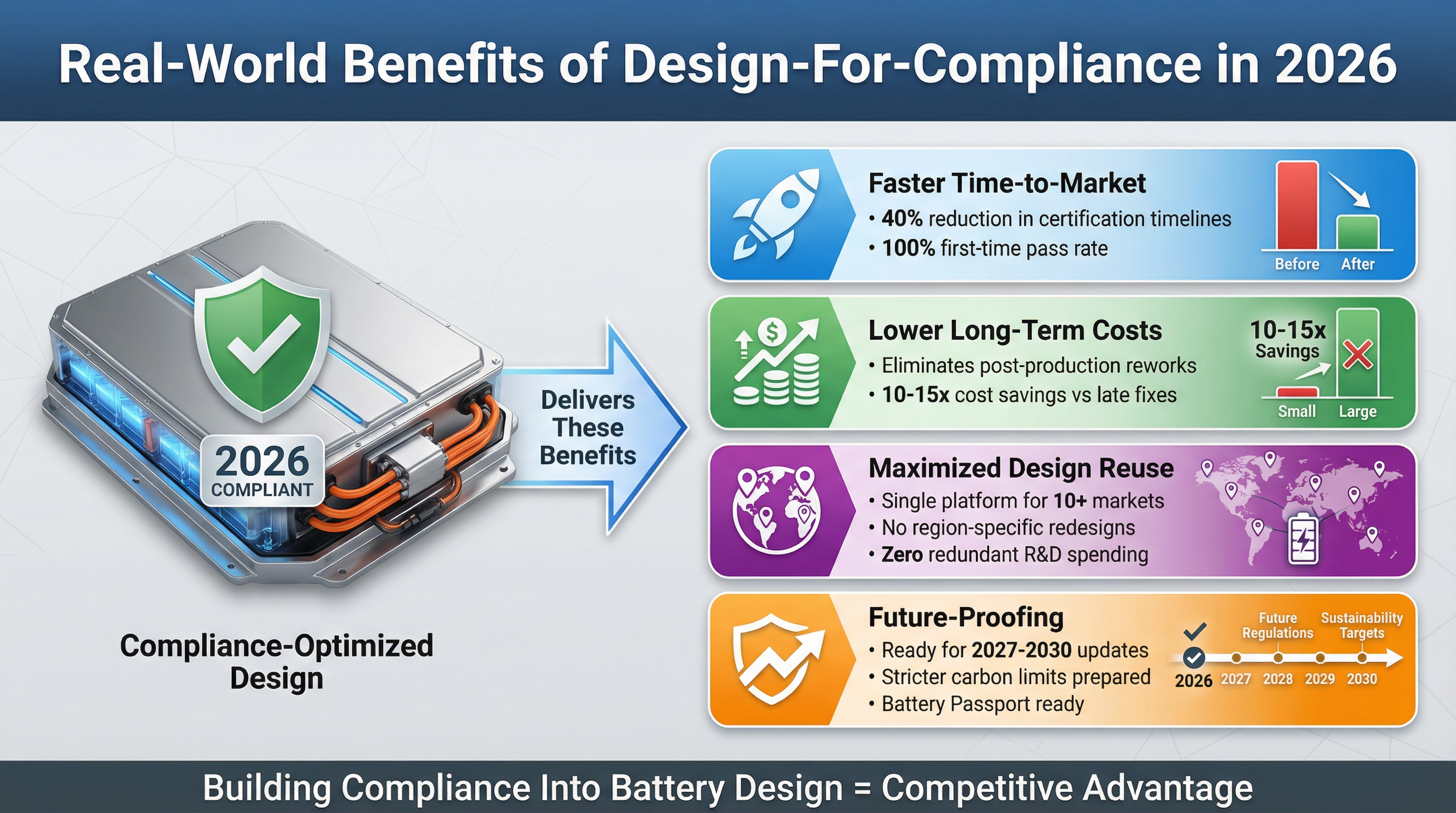
Real-World Benefits of Design-For-Compliance in 2026
Building compliance into your battery design isn’t just about avoiding fines — it’s a competitive advantage:
- Faster Time-to-Market: Pre-optimized designs see a 40% reduction in certification timelines, with a 100% first-time pass rate for global safety tests.
- Lower Long-Term Costs: Upfront design compliance eliminates costly post-production reworks, which can cost 10–15x more than fixing issues in the R&D stage.
- Maximized Design Reuse: A single, compliance-optimized battery platform can launch in 10+ global markets, eliminating the need for region-specific redesigns and redundant R&D spending.
- Future-Proofing: Designing for 2026’s rules ensures your battery platform is ready for 2027–2030 regulatory updates, including stricter carbon limits and full Battery Passport enforcement.
ULi Power: Your Global EV Battery Design-For-Compliance Partner
At ULi Power, we specialize in turning EV battery design into a global market advantage, not a regulatory burden. Our team of 25+ battery compliance engineers and certification experts has helped 60+ global battery manufacturers and automakers launch compliance-optimized battery platforms across the EU, U.S., and Southeast Asia, with a 100% first-time certification pass rate.
Our end-to-end design-for-compliance solutions include:
- Pre-Design Compliance Feasibility Assessment: A full review of your battery design plans, with a gap analysis for 2026 global regulatory requirements and actionable engineering recommendations.
- Multi-Market Design Alignment: We optimize your design to meet EU, U.S., Southeast Asian, and Australian rules in a single platform, maximizing design reuse and cutting R&D costs.
- Pre-Compliance Testing & Simulation: In-house lab testing and thermal/mechanical simulation to validate your design against global safety standards before formal certification, eliminating last-minute failures.
- Battery Passport & Traceability Integration: End-to-end support to build traceability and carbon tracking into your design, with full readiness for the EU Battery Passport.
- Full-Cycle Global Certification Support: From design finalization to in-market compliance maintenance, we handle all testing, documentation, and regulatory submissions for every global market.
Ready to build a 2026-compliant EV battery design that accelerates your global market entry? Reach out to our team today for a free, no-obligation design compliance gap analysis.
Inquiry Email: info@uli-power.com
Contact: +86 18565703627
Website: www.uli-power.com
Post time: Mar-05-2026