“So can you build a custom pack for our aircraft?” is the question every real battery manufacturer gets weekly. The honest answer is yes — and the difference between a program that ships prototypes in six weeks and one that drifts for six months is almost never the factory. It is the inputs the buyer brings and the sequence both sides follow.
Here is what a custom drone battery program actually looks like, stage by stage, with the delays that kill timelines and how to avoid them.
Stage one: the requirements brief
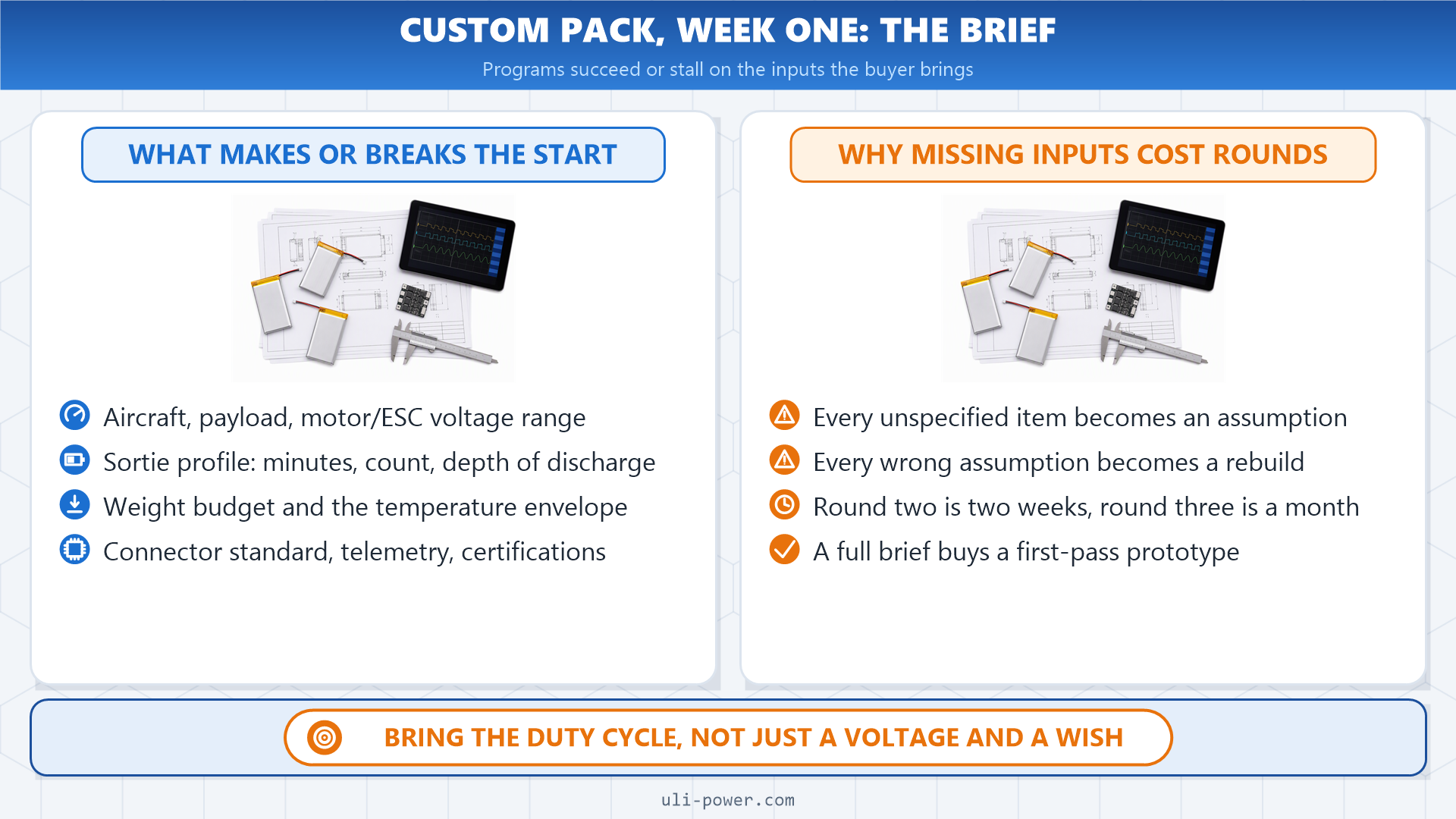
A custom pack is defined by the aircraft, not by a wish list. The brief that lets engineering start on day one covers: aircraft type and payload mass; motor and ESC voltage range and the connector standard already in the harness; the daily sortie profile — flight minutes per sortie, sorties per day, typical depth of discharge; the weight budget the pack must fit; operating temperature range; how the pack will be shipped and serviced; the telemetry the ground system must see; the certifications the market requires; and a target cost band.
Missing inputs do not stop the program — they guarantee round two. Every unspecified item becomes an assumption, and every assumption that misses becomes a rebuild.
Stage two: the cell selection triangle
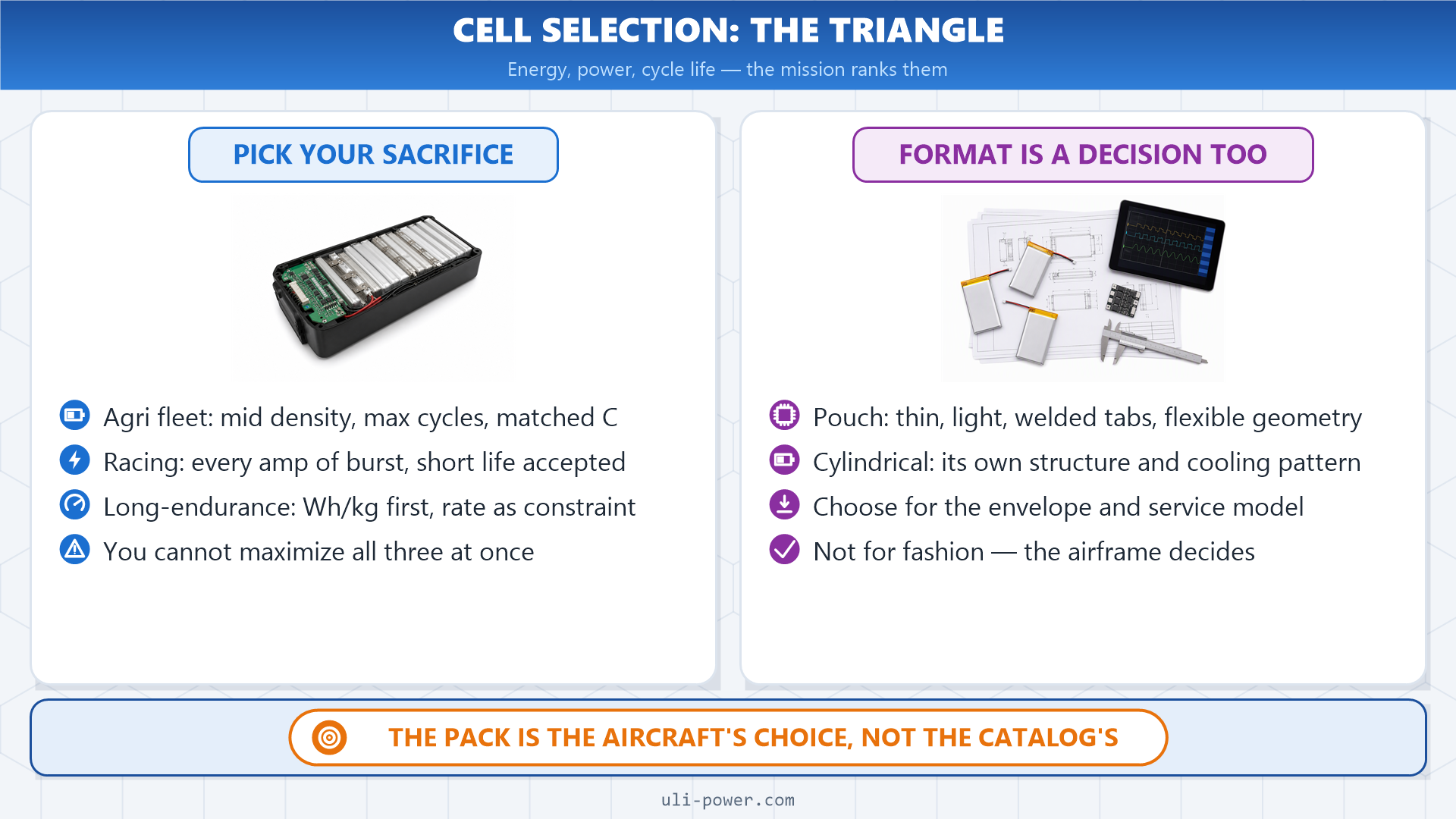
Energy, power, cycle life — plus cost — cannot all be maximized, and the selection is a ranking of what the mission sacrifices. An agricultural fleet pack wants moderate energy density, high cycle count, and a continuous C-rate matched to the pump load. A racing pack wants every ampere of burst the chemistry can give and accepts a short life. A long-endurance platform wants watt-hours per kilogram first and treats discharge rate as a constraint, not a trophy.
Format is part of the decision: pouch cells shape the pack — thin, light, flexible geometry, welded tab connections — while cylindrical formats bring their own structural and cooling patterns. Which is right depends on the airframe’s packaging envelope and the service model, not on fashion.
Stage three: pack engineering
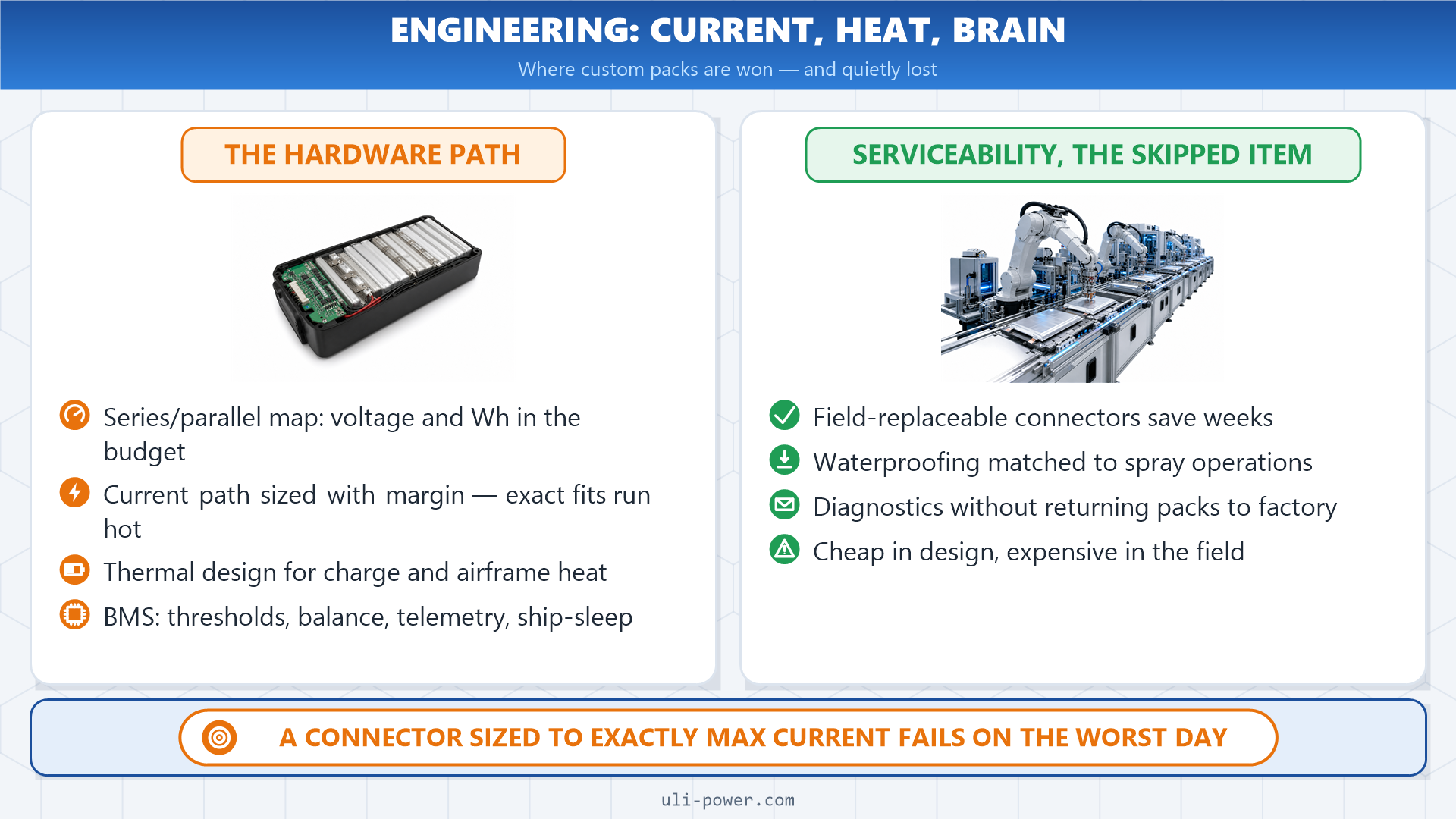
Engineering turns the brief into hardware: the series/parallel map that lands the voltage and energy inside the weight budget; the current path — busbar or wire gauge, connector ratings with margin, because a connector sized to exactly the maximum current runs hot on the worst day of the season; the thermal design for charging and for the aircraft’s own heat; and the BMS feature set — protection thresholds, balance current, the telemetry channels the fleet actually reads, and a sleep/wake behavior that survives the 30 percent state-of-charge air shipping rules.
Serviceability is the design item most often skipped: field-replaceable connectors, a waterproofing level matched to spraying operations, and diagnostic access that does not require returning packs to the factory.
Stage four: prototype and validation
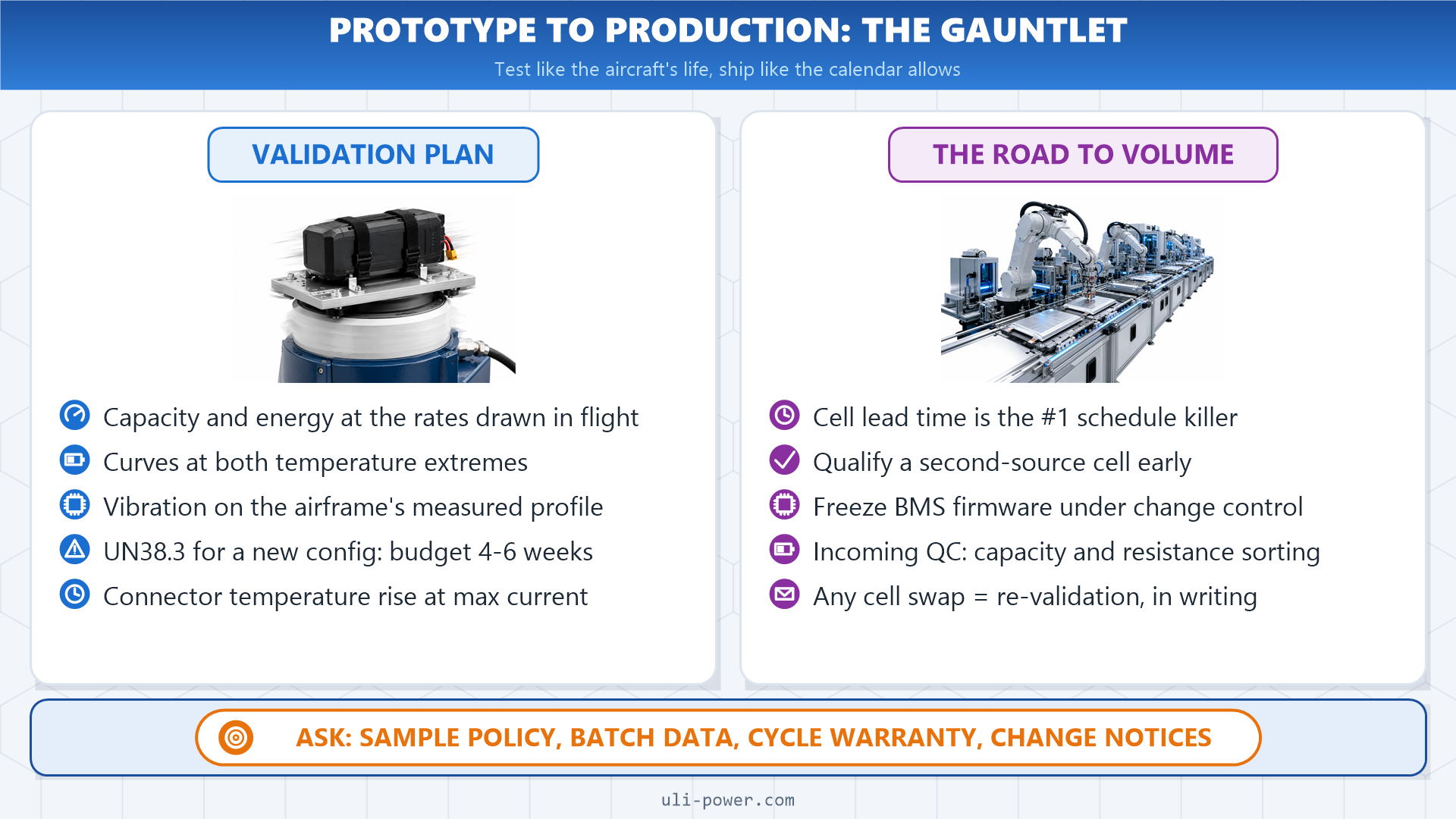
Prototype builds typically run two to three weeks once cells are on hand. The validation plan should read like the aircraft’s life, not a lab exam: capacity and energy at the rates the ESC will actually draw; discharge curves at the temperature extremes of the operating region; vibration testing on the airframe’s measured profile; connector temperature rise at maximum current; a cycling sample at duty depth; and UN38.3 for the pack configuration if it is new — budget four to six weeks for that test cycle and plan the schedule around it, not through it.
The classic surprises are small and specific: connectors running warm, cell imbalance drifting across a batch, and chargers that do not match the pack’s profile. All three are cheap to fix in prototype and expensive in the field.
Stage five: pilot to production
The number-one schedule risk in production is cell lead time — which is why the smart programs qualify a second-source cell early and keep the design tolerant of it. Then: a firmware freeze for the BMS with change control; incoming quality checks that sort cells by capacity and internal resistance so packs are built matched; and an export document package — test summaries, declarations, safety data sheets — prepared with the same care as the goods.
Any cell substitution after approval is not a part swap; it is a re-validation, and the buyer should require written change notification as a contract term.
What good buyers ask
Before committing: what is the sample policy and timeline; does every batch ship with its data package; is the warranty measured in capacity cycles or calendar months; how will you notify me of design changes; and what is the pilot quantity before full production. Manufacturers who answer these crisply are the ones worth the deposit.
We are ULi — Dongguan Youli Electronic Technology Limited. We build LiFePO4 and NMC pouch cell packs for aerial and ground platforms, from agricultural fleet packs to high-C FPV packs, with BMS and telemetry matched to the mission and export documentation included. Send us the aircraft, the motors, and the daily duty cycle — we will come back with a plan, a timeline, and a prototype.
Email: info@uli-power.com
Phone: +86 18565703627
Web: www.uli-power.com
Post time: Oct-26-2026