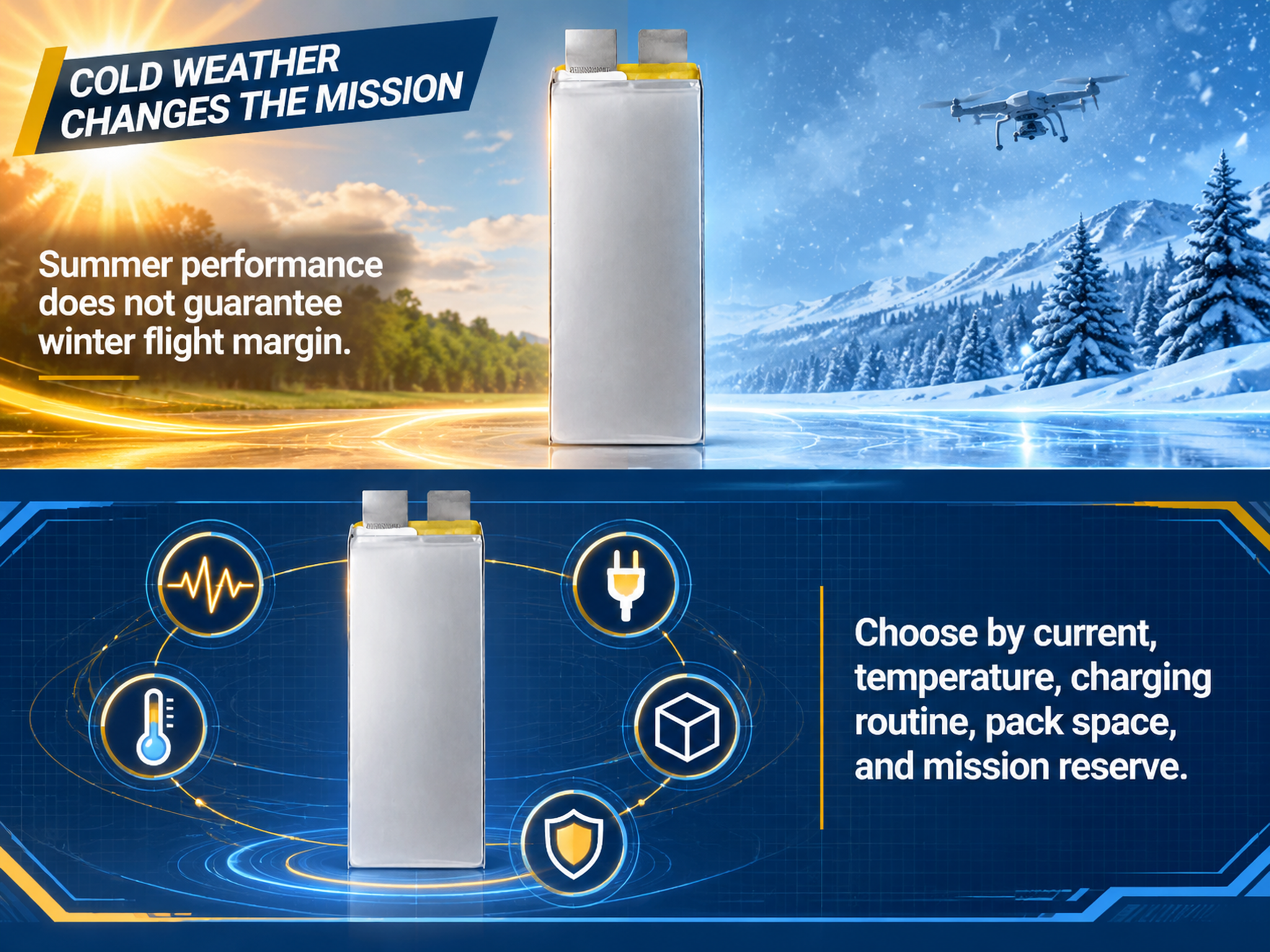
When temperatures drop, the battery specification that looked comfortable in a summer test can become a constraint on the aircraft. Voltage sag appears earlier, usable energy falls, charging takes longer, and the pack may reach a low-voltage limit before its nominal capacity has been fully used.
That does not mean one chemistry is automatically the winter winner. The right cold-weather drone battery depends on the aircraft’s current profile, operating temperature, charge routine, packaging limits, and the amount of reserve the mission requires.
This guide compares LiFePO4, NMC, and LiPo for cold-weather drone applications and explains which data buyers should request before choosing a pack.
What low temperature changes inside a lithium battery
Cold affects more than the number shown on the battery gauge.
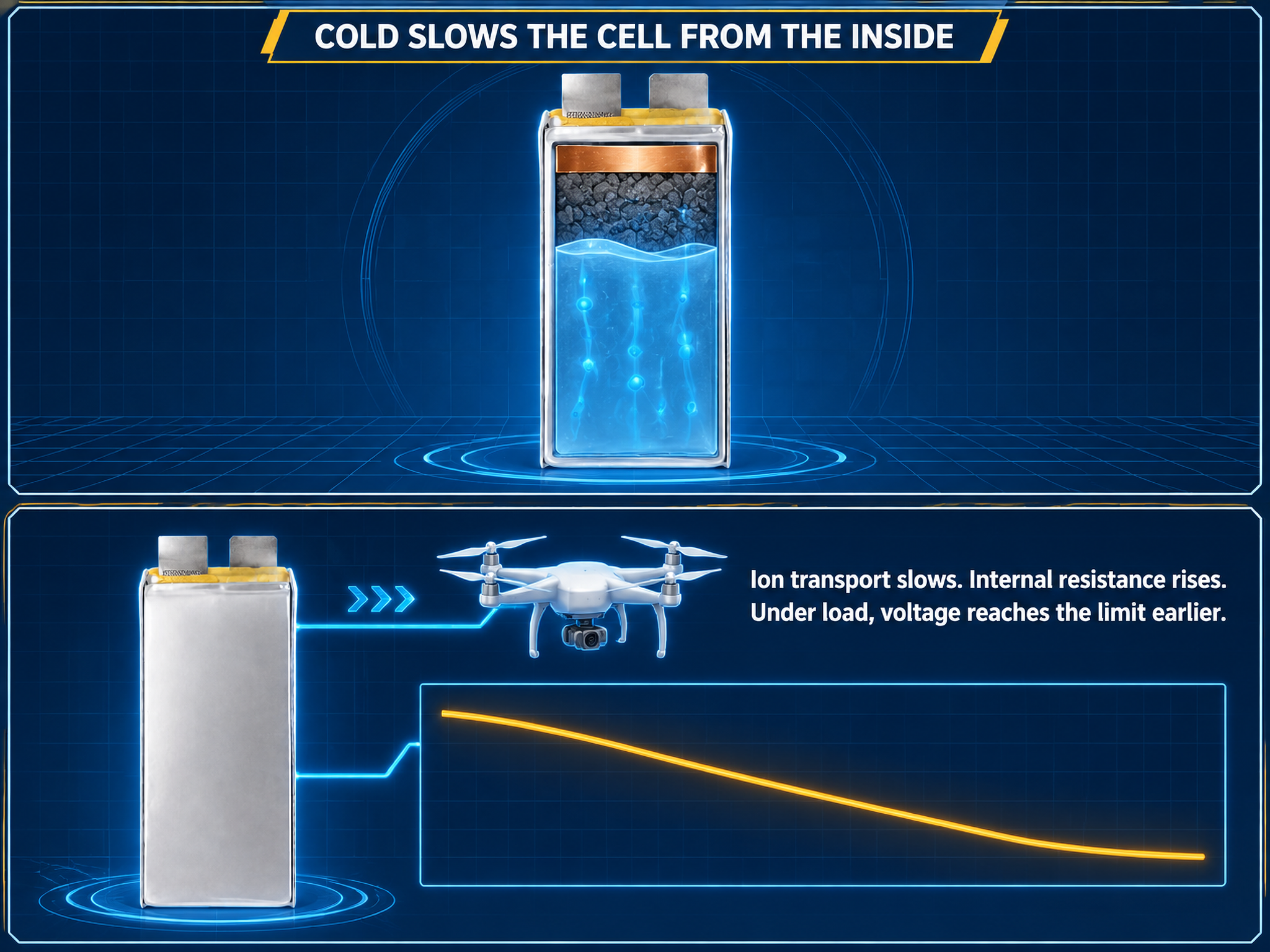
As temperature falls, ion transport through the electrolyte becomes less favorable, charge-transfer resistance increases, and lithium diffusion through the active materials slows. The result is higher internal resistance and a larger voltage drop under load. A drone may therefore reach its low-voltage threshold earlier, even when the pack still contains usable chemical energy.
The effect depends on the cell design and the operating point. A discharge curve measured at a low current and room temperature cannot predict the performance of an agricultural drone drawing several times that current in cold air. Buyers should compare curves measured at the aircraft’s actual or expected discharge rate, temperature, cutoff voltage, and state-of-charge window.
Cold also makes state-of-charge estimation more difficult. A pack can show a sharp voltage drop during a climb or gust, then recover when the load is removed. That recovery does not mean the lost flight margin has returned. For winter operations, energy reserve and measured pack behavior are more useful than a percentage displayed without temperature context.
Why charging a cold pack is a separate risk
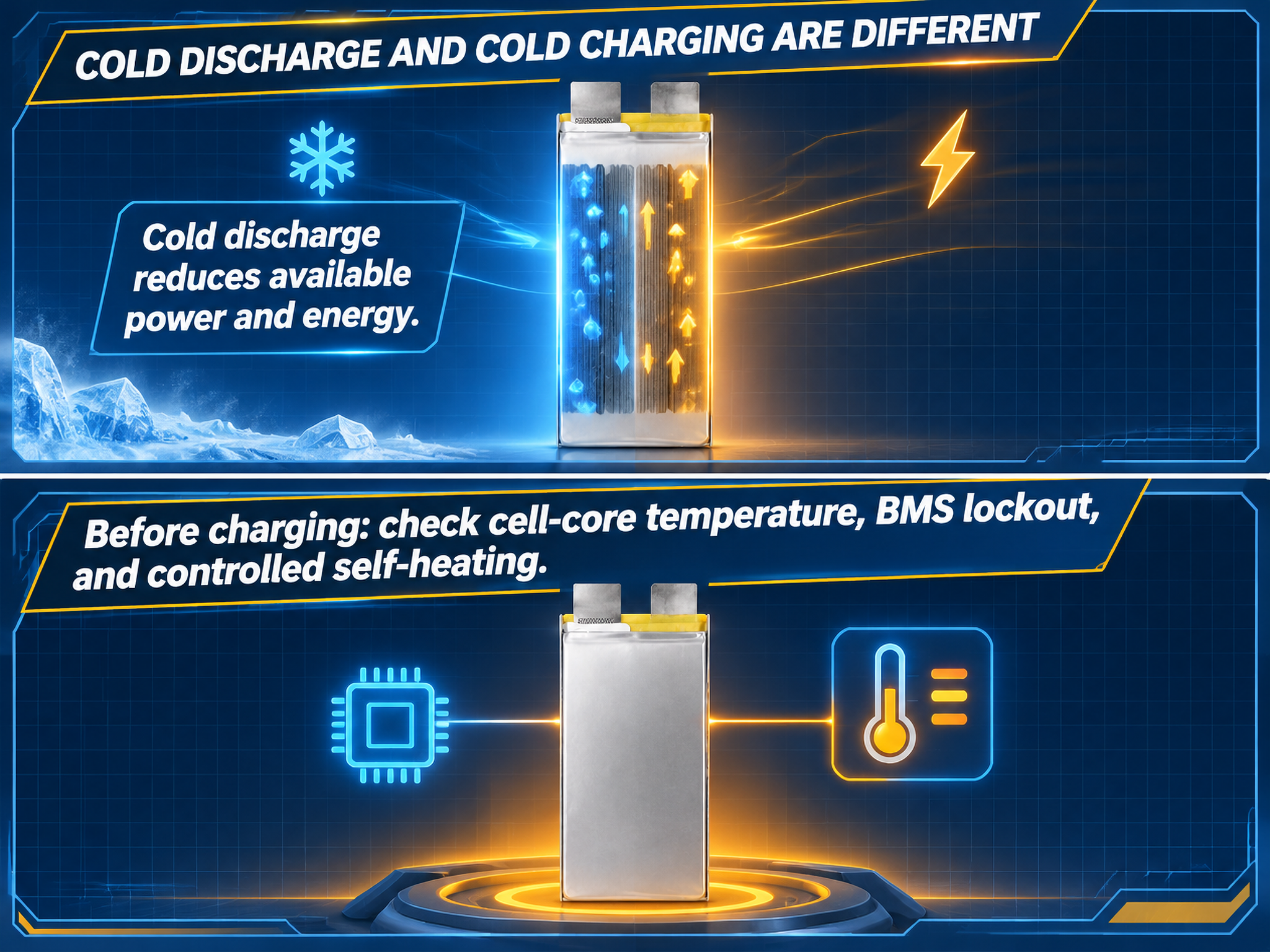
Discharging in the cold mainly reduces available power and energy. Charging a cold lithium-ion cell can create a more serious degradation mechanism: lithium plating on the graphite anode.
When the cell cannot accept lithium ions quickly enough during charging, metallic lithium can deposit on the anode surface instead of being stored in the graphite structure. This can consume active lithium, reduce usable capacity, and increase safety risk. The exact temperature limit is cell-specific; it must come from the manufacturer’s data rather than from a generic rule applied to every battery.
A practical winter charging protocol should answer four questions:
- What is the cell or pack’s permitted charging-temperature range?
- Is the temperature measured at the cell core or only at the case?
- Does the BMS inhibit charging when the pack is too cold?
- Does the pack use controlled self-heating, and what conditions must be met before charging begins?
A pack that is approved for cold-weather discharge is not automatically approved for charging at the same temperature. The charge and discharge windows must be reviewed separately.
LiFePO4 in cold-weather drone applications
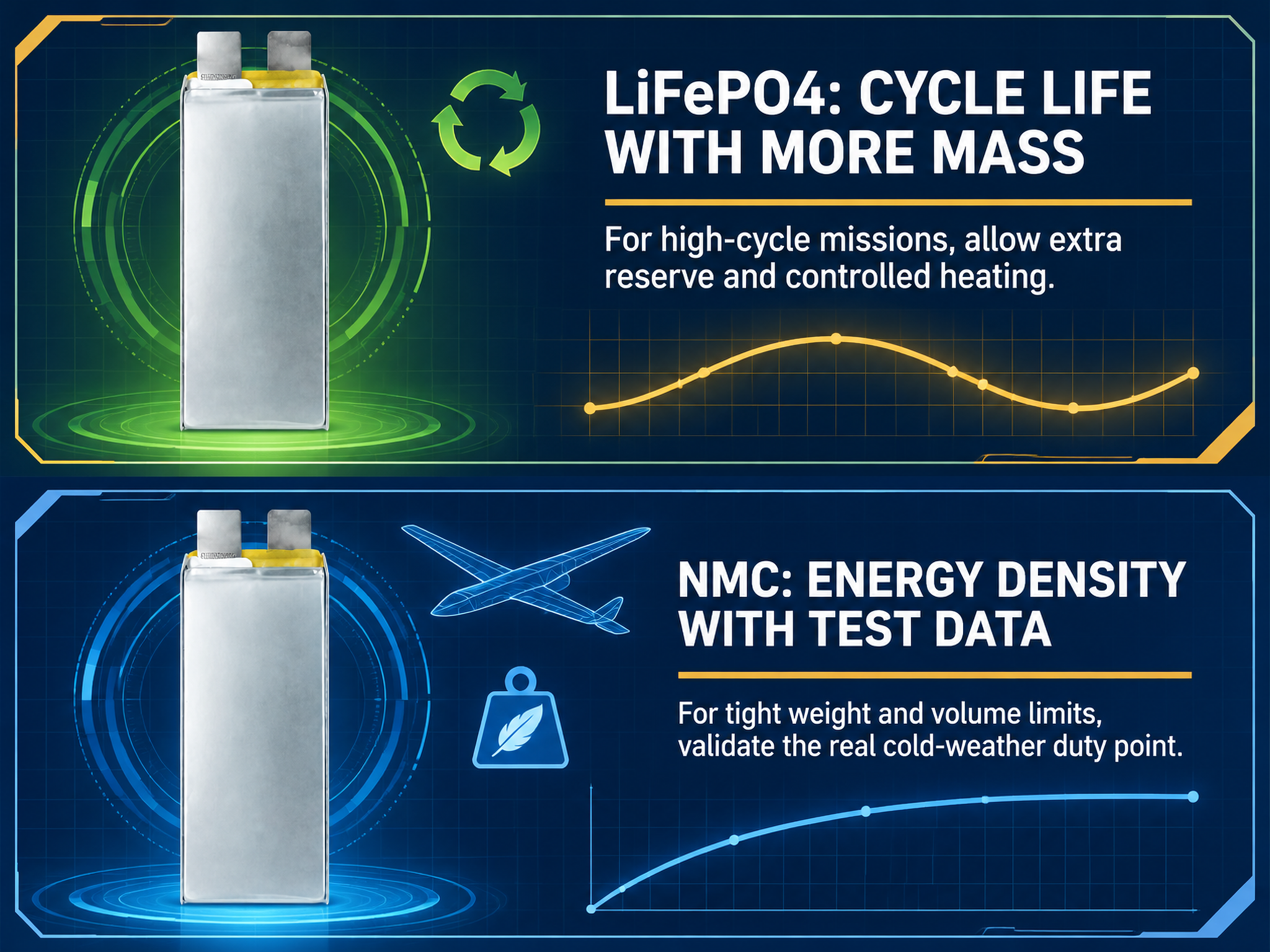
LiFePO4 is valued for its thermal and chemical stability, long cycle-life potential, and strong suitability for applications where durability and safety margins matter. Those advantages can make it attractive for ground equipment, high-cycle fleets, and aircraft where the mass penalty is acceptable.
The trade-off is that low-temperature power and charge acceptance can be challenging. The chemistry’s nominal voltage and low-temperature kinetics affect how much usable energy remains available under load. A LiFePO4 pack designed for winter use may therefore need a larger energy reserve, a controlled heating strategy, or a lower operating current than the same pack would need in mild weather.
LiFePO4 is a strong candidate when:
- the aircraft can carry the required pack mass;
- cycle life and predictable fleet operation are more important than minimum weight;
- the battery has documented low-temperature discharge data;
- the pack design includes appropriate charge-temperature protection; and
- the mission allows preheating or a conservative reserve window.
Do not choose LiFePO4 solely because it is described as safer or longer-lasting. The complete pack still needs appropriate BMS settings, mechanical protection, thermal management, and validation under the aircraft’s load profile.
NMC for cold-weather UAVs
NMC is often considered when the aircraft needs high energy density, lower pack mass, or stronger power performance within a limited volume. Those characteristics are important for industrial UAVs, long-endurance platforms, and aircraft where every kilogram affects payload or flight time.
NMC can offer a favorable cold-weather balance, but it is not immune to low-temperature limitations. Voltage sag, reduced usable energy, and charge restrictions still depend on the cell formulation, electrode design, electrolyte, current, and temperature. Two NMC cells with different construction can produce very different results in the same aircraft.
NMC is a strong candidate when:
- the aircraft has a strict mass or volume budget;
- the mission benefits from higher pack-level energy density;
- the supplier can provide discharge curves at the required cold temperature and C-rate;
- the BMS can enforce the cell’s charge and discharge limits; and
- the aircraft has sufficient reserve for cold-weather voltage sag.
The correct comparison is not “NMC versus LiFePO4” in the abstract. It is the measured performance of the proposed pack at the aircraft’s real current, temperature, cutoff voltage, and duty cycle.
LiPo for cold-weather FPV and high-power missions
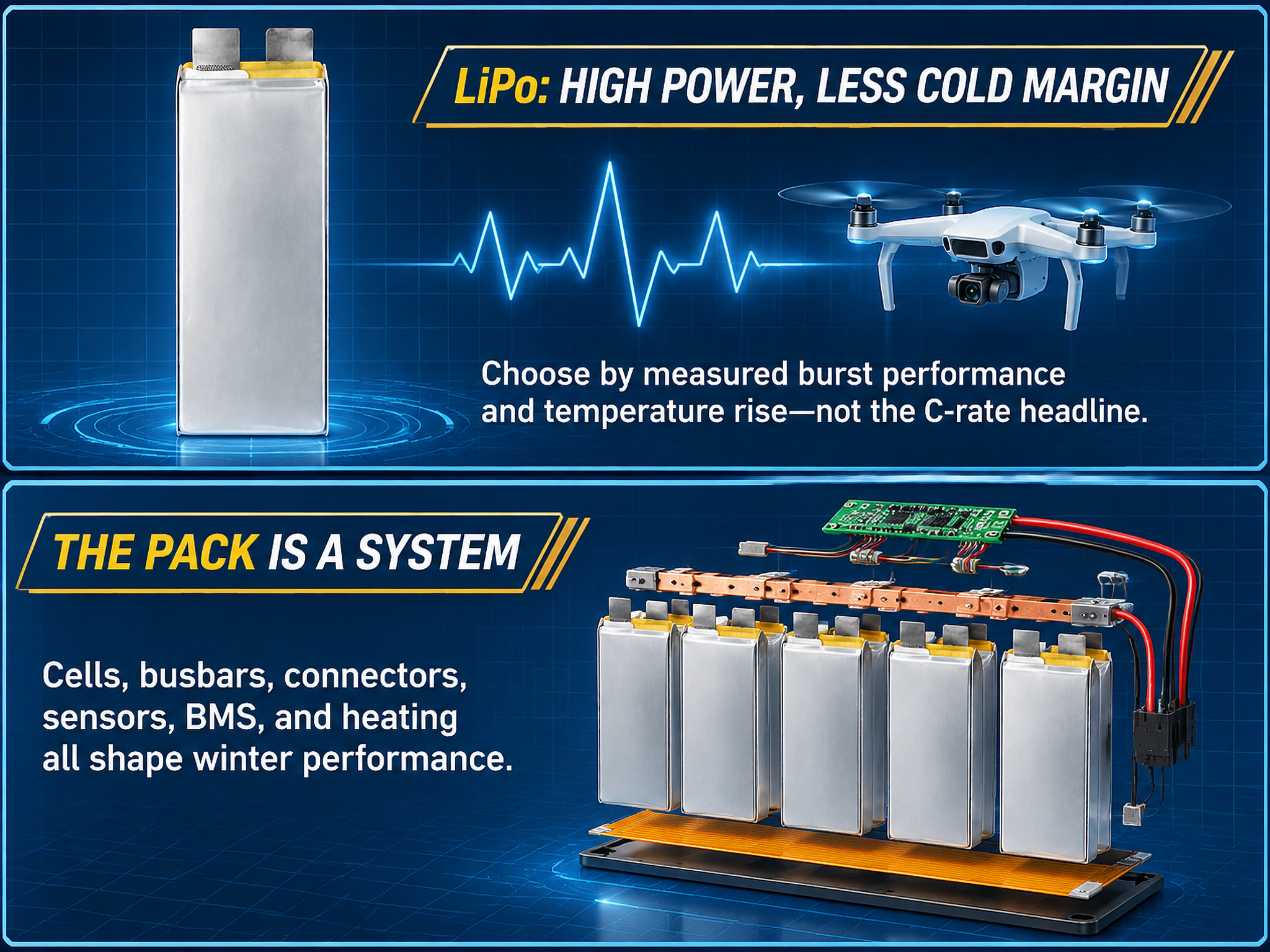
LiPo packs remain common in FPV and other high-power applications because they can deliver strong burst current in a compact format. That makes them useful when acceleration and short-duration power are more important than long calendar life or maximum cycle count.
Cold weather reduces the margin that makes a high-power LiPo pack perform well. Internal resistance rises, voltage sag becomes more pronounced, and the pack may fall below the aircraft’s usable voltage during a hard maneuver. A pack that feels strong after a warm indoor test may behave very differently when launched cold.
For cold-weather LiPo operations:
- keep packs warm until they are installed;
- use a controlled warm-up process rather than relying on a hard maneuver to heat the cells;
- monitor the first voltage dip of the flight;
- avoid charging until the pack has reached the permitted charge range; and
- inspect the pack after use for swelling, impact damage, and abnormal temperature.
LiPo is often the practical choice for short, high-power missions, but it should be selected using measured burst performance and temperature rise—not only the advertised C-rate.
The pack design matters as much as the chemistry
Cold-weather performance is a system property. The same cell chemistry can behave differently depending on the pack design.
Important design variables include:
- cell format and electrode loading;
- series and parallel configuration;
- busbar, tab, and connector resistance;
- thermal paths between cells and the pack enclosure;
- insulation and condensation control;
- BMS temperature-sensor location;
- charge and discharge protection thresholds;
- self-heating hardware and control logic; and
- telemetry available to the pilot or fleet manager.
A self-heating pack is not automatically a winter-ready pack. The heating system must warm the cell core evenly, avoid wasting excessive energy, and prevent charging or high-power discharge before the pack reaches the permitted operating range.
The BMS should also distinguish between a cold pack that needs warming and a damaged pack that should be removed from service. Temperature, voltage spread, current, and event history need to be interpreted together.
What battery buyers should request
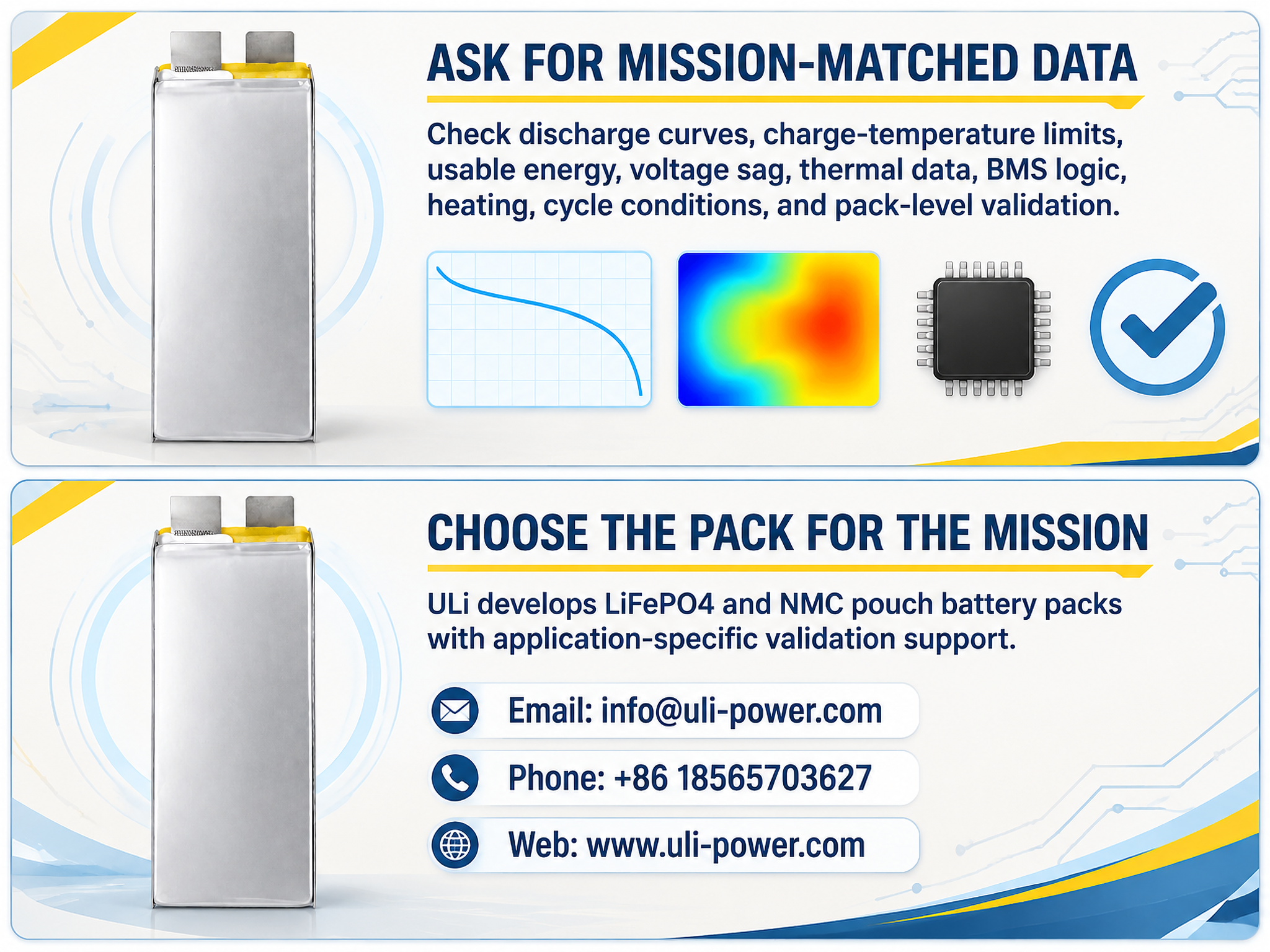
Before approving a cold-weather drone battery, ask the supplier for a data package that includes:
- Discharge curves at the intended temperature, current, and cutoff voltage.
- Charge-temperature limits for the exact cell and pack configuration.
- Usable energy, not only nominal capacity, at the aircraft’s duty cycle.
- Voltage-sag data during the expected peak and continuous load.
- Thermal data for the cells, connectors, BMS, and enclosure.
- BMS protection logic, including low-temperature charge inhibition.
- Self-heating specifications, if heating is included.
- Cycle-life conditions, including depth of discharge, temperature, charge rate, and end-of-life criterion.
- Pack-level test results, rather than data from a different cell format or a laboratory sample.
- Transport and safety documentation for the actual battery configuration.
If a supplier provides only room-temperature capacity and a headline C-rate, the winter performance of the pack is still unverified.
A practical selection framework
Use the following sequence when comparing options:
Step 1: Define the mission
Record the flight time, payload, peak current, average current, operating temperature, altitude, reserve requirement, and charging location.
Step 2: Define the acceptable trade-off
Decide whether the aircraft gives priority to minimum mass, high cycle life, burst power, thermal margin, or low total operating cost. No chemistry maximizes every variable at once.
Step 3: Compare complete packs
Evaluate the cell, BMS, connectors, enclosure, heater, telemetry, and service process together. A high-energy cell can lose its advantage if the pack requires excessive structural mass or cannot be charged safely in the field.
Step 4: Test at the real operating point
Run capacity, voltage-sag, temperature-rise, and charging tests at the temperatures and currents the aircraft will actually see. Include a cold start and a repeated sortie sequence when the battery will be used in a fleet.
Step 5: Set operating rules before delivery
Define the minimum core temperature for launch, the minimum reserve for return, the cold-charge lockout, the warm-up procedure, and the retirement triggers. These rules belong in the operating manual, not only in the engineering team’s test report.
Conclusion
LiFePO4, NMC, and LiPo can all be used in drone systems, but they solve different mission problems. LiFePO4 can suit high-cycle applications where mass is manageable. NMC can suit aircraft that need energy density and lower pack weight. LiPo can suit short, high-power missions where burst output is the priority.
In cold weather, the best battery is not the one with the most impressive headline specification. It is the pack whose measured performance, charge limits, heating strategy, BMS behavior, and reserve policy match the aircraft’s real mission.
ULi develops LiFePO4 and NMC pouch battery packs for aerial and ground platforms, with pack design, BMS, telemetry, and application-specific validation support. Share your operating temperature, current profile, payload, and daily duty cycle to start a battery selection review.
Technical references
- U.S. Department of Energy: Low Temperature Performance Characterization & Modeling
- Energy & Environmental Science: Electrolyte design principles for low-temperature lithium-ion batteries
- U.S. Department of Energy: Development of an Extreme Fast Charging Battery
SEO Keywords: cold weather drone battery, LiFePO4 vs NMC drone battery, low temperature UAV battery, LiPo battery cold weather, drone battery self heating, winter drone battery selection, low temperature lithium battery, agricultural drone battery winter, cold weather FPV battery, UAV battery discharge curve
Post time: Nov-27-2026