The first frost always finds somebody’s fleet by surprise. A pack that flew a full spray cycle in September loses a fifth of its usable minutes in November, the fuel gauge argues back, and the aircraft comes home angry. None of this is a defect — it is electrochemistry doing what electrochemistry does in the cold. What separates a fleet that winters well from one that bleeds batteries is a protocol, not luck.
This guide covers what cold actually does inside a drone battery, why charging is more dangerous than discharging, how the main chemistries behave, and the operating and storage routine that keeps a fleet flying through winter and coming back in spring.
What cold does inside the cell
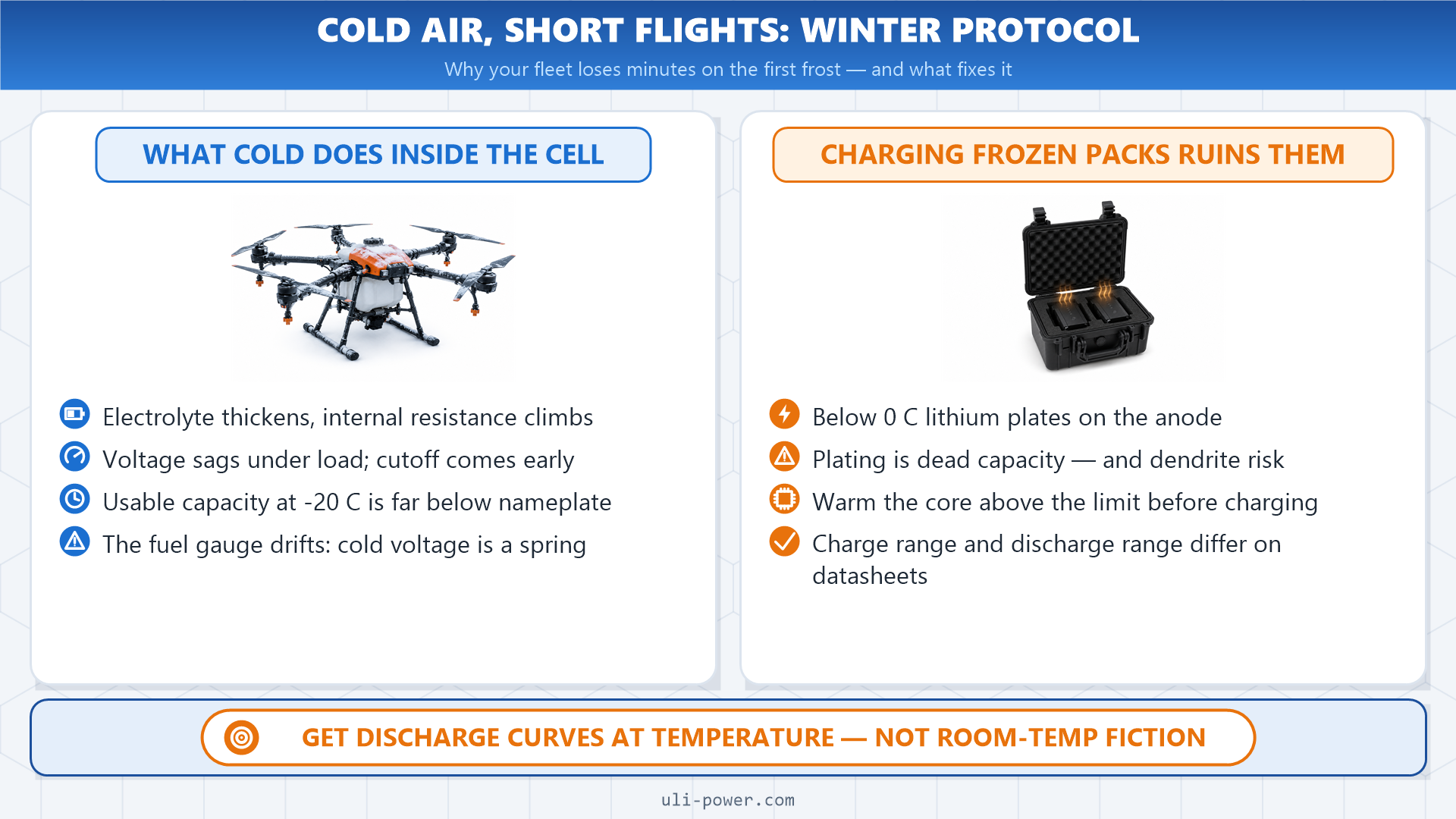
Three things happen as temperature falls. The electrolyte thickens and ionic conduction drops. The interface between electrolyte and electrodes resists charge transfer far more strongly. And lithium diffusion inside the active material slows down. Together they mean the same current draw now costs more voltage: the pack sags earlier, hits the low-voltage cutoff with plenty of lithium still in the cell, and the usable capacity measured at minus twenty is a fraction of the nameplate figure.
How big that fraction is depends on chemistry, electrode design, electrolyte formulation, temperature, and how hard the aircraft is pulling. This is exactly why winter numbers must come from the manufacturer’s discharge curves at temperature — a 0.2C curve at 25 degrees tells you nothing about a pump-loaded agricultural drone pulling 3C at minus ten.
One winter-specific trap: state-of-charge estimation drifts in the cold, and voltage recovers when the load comes off. A pack can read 40 percent, sag to land-home voltage on the first gust, then “recover” to 35 percent on the ground. The gauge is not lying; it is measuring a spring. Trust energy margin, not percentages.
Charging a cold pack is how you ruin it
Discharge in the cold is annoying; charge in the cold is destructive. Below the cell’s charge temperature limit — for most standard lithium-ion chemistries around zero degrees Celsius — lithium ions struggle to intercalate into the graphite and plate onto the anode surface instead. Plated lithium is dead capacity that never comes back, and in the worst case it grows dendrites that threaten the separator.
Two rules follow. Never charge a pack straight in from the field until its core — not its skin — has warmed above the charge limit stated in the spec sheet; some packs handle this with self-heating, most do not. And note that charge range and discharge range are different numbers on every honest datasheet: a cell rated to discharge down to minus twenty is not automatically rated to charge there.
How the chemistries behave
LiFePO4 generally suffers the most in the cold: the olivine structure’s kinetics and its low operating voltage make capacity retention and charge acceptance at sub-zero temperature the weakest of the common options unless the pack is engineered with heating. NMC retains more of its capacity at the same temperature and is the usual choice for cold-climate flight, though it still loses meaningful minutes below zero. Semi-solid and solid-electrolyte cells are marketed with wide temperature windows — treat those as claims to verify with measured data: capacity retention at minus twenty at your discharge rate, and the charge-temperature limit, in writing.
High-power maneuvers hurt more than gentle flight in cold weather. The burst that a warm pack delivers without thinking is the burst that sags a cold pack below cutoff. Warm the pack before the hard flying, not during it.
The pre-flight winter protocol
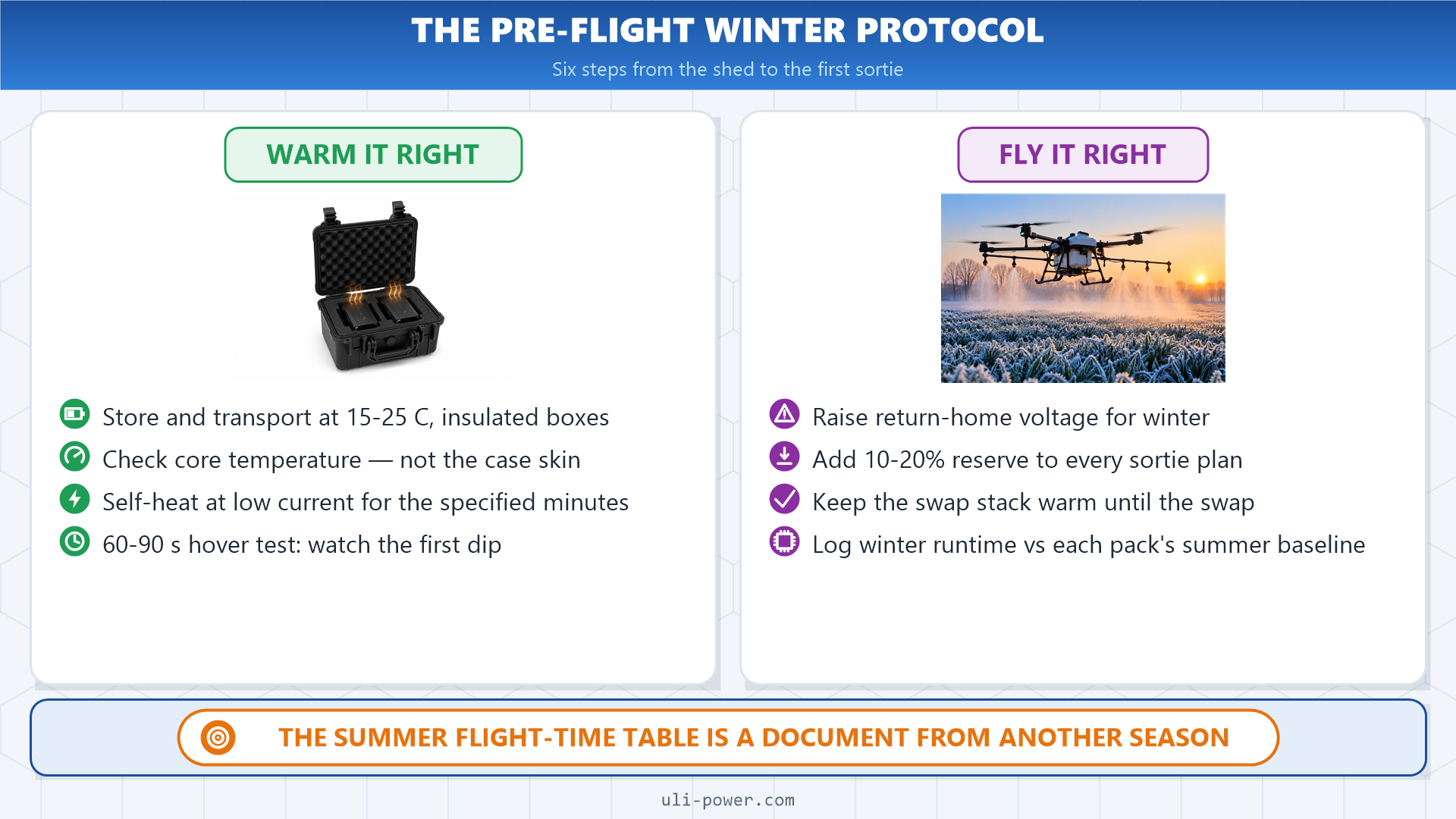
Store and transport the fleet at 15 to 25 degrees Celsius — indoors, in insulated boxes, right up to the moment of installation. Verify core temperature from the BMS or a probe, not by touching the case. Warm the pack deliberately before flight: a low-current self-heat at a fraction of its discharge rating for the time the supplier specifies, or a heated bag, beats a hover test performed on cold cells.
Then fly the aircraft’s own warm-up: sixty to ninety seconds of gentle hover at the operating site, watching the first voltage dip of the day. Raise the automatic return-home threshold — the voltage that is safe at twenty degrees is a gamble at minus ten. Add reserve to every sortie plan, and keep the swap stack warm in the cabin, not cold in the bay.
Winter operations and the off-season shutdown
Expect shorter sorties per pack and plan more swaps; the summer flight-time table is a document from another country. Log every pack’s winter runtime against its own summer baseline — the packs that fall away fastest are telling you something about their health, and cold sag accelerates the exposure of weak cells.
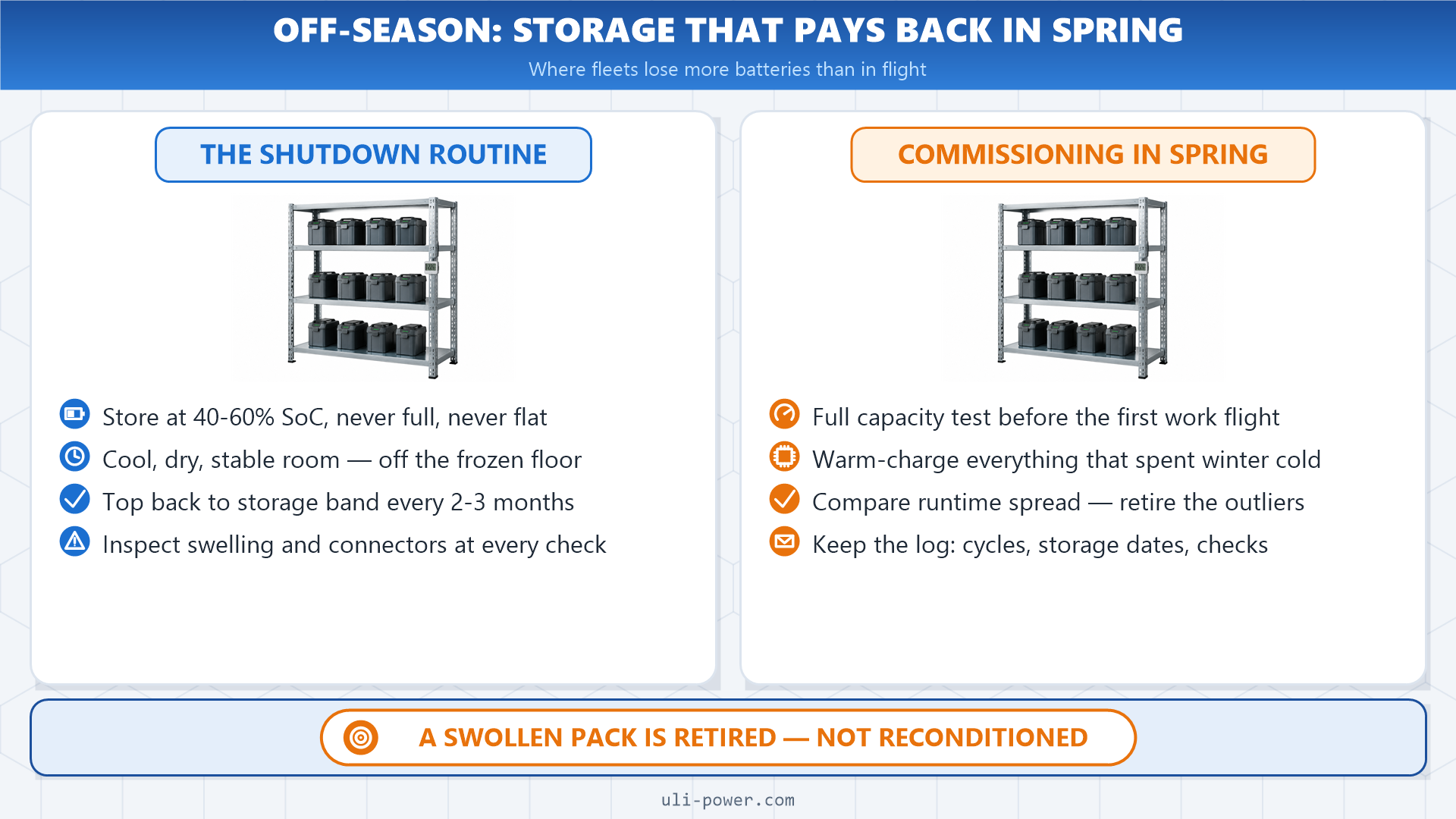
When the working season ends, put the fleet away properly: store at roughly 40 to 60 percent state of charge, in a cool, dry, temperature-stable place; never store a pack at full charge for months, and never store one flat. Check voltage and top back up to the storage band every two to three months — self-discharge does not take a holiday. Inspect cases for swelling and connectors for corrosion at every check; a puffed pack is retired, not reconditioned. Remove packs from aircraft so the airframes store without a load, and log the cycle count and storage date so spring commissioning knows where every pack stands.
We are ULi — Dongguan Youli Electronic Technology Limited. We build LiFePO4 and NMC pouch cell packs for aerial and ground platforms, including cold-climate configurations with documented discharge curves at low temperature, self-heating BMS options, and telemetry that tells you core temperature before you commit to a sortie. Send us your winter operating range and your daily duty cycle; we will size the pack and the heating with you.
Email: info@uli-power.com
Phone: +86 18565703627
Web: www.uli-power.com
Post time: Oct-27-2026