A purchasing question and a fleet question look similar and have different answers. The purchasing question is “how many watt-hours does the pack hold?” The fleet question is “what does each sortie cost me?” Two farms flying identical aircraft, buying packs that look identical on a spec sheet, can end up with a threefold difference in cost per flight — because one of them understood what happens after flight three hundred.
This article walks through the shape of battery aging, what actually kills drone battery cycle life, how to decide when a pack is retired, and a cost model you can run with your own numbers.
The shape of a fade curve
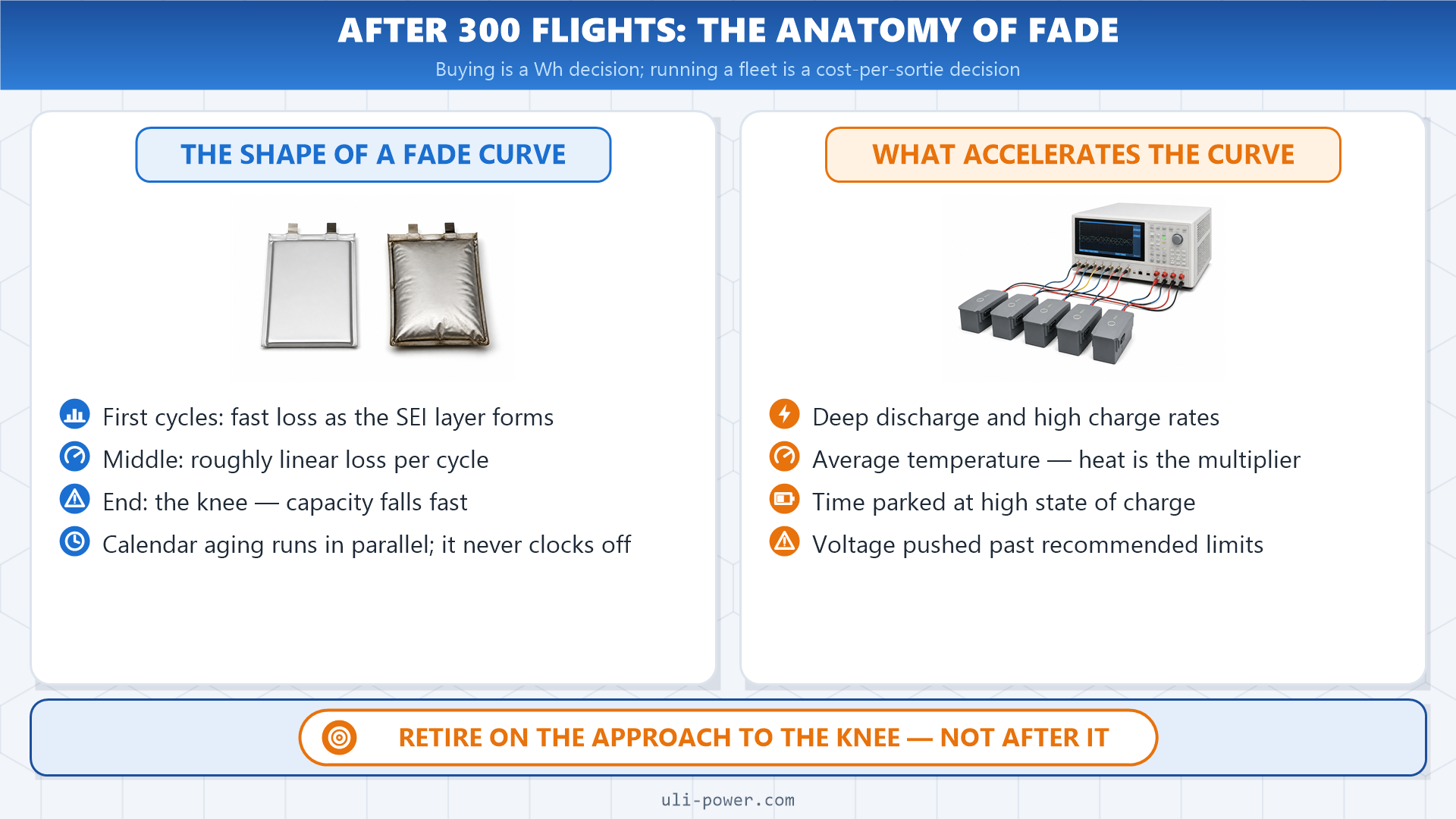
Every lithium cell ages along a recognizable curve. In the first cycles, capacity drops quickly — the solid-electrolyte interphase forms inside the cell and consumes a little cyclable lithium; a few percent of nameplate is normal and then it stabilizes. Through the long middle, loss is roughly linear with each cycle. Near the end, the curve bends over — the “knee” — and capacity falls fast. Fleet packs are retired on the approach to the knee, not after it.
Calendar aging runs in parallel and does not care whether you fly. A pack stored hot and full loses capacity even in a crate. The accelerators of both kinds of aging are the same handful: depth of discharge per cycle, average temperature, charge rate, time spent at high state of charge, and voltage pushed past the recommended limits.
What this means for drones specifically: the agricultural pack doing three deep cycles a day in a hot cabin ages on the cycle axis; the spare fleet sitting charged in the warehouse ages on the calendar axis. Both need management.
Chemistry and duty arithmetic
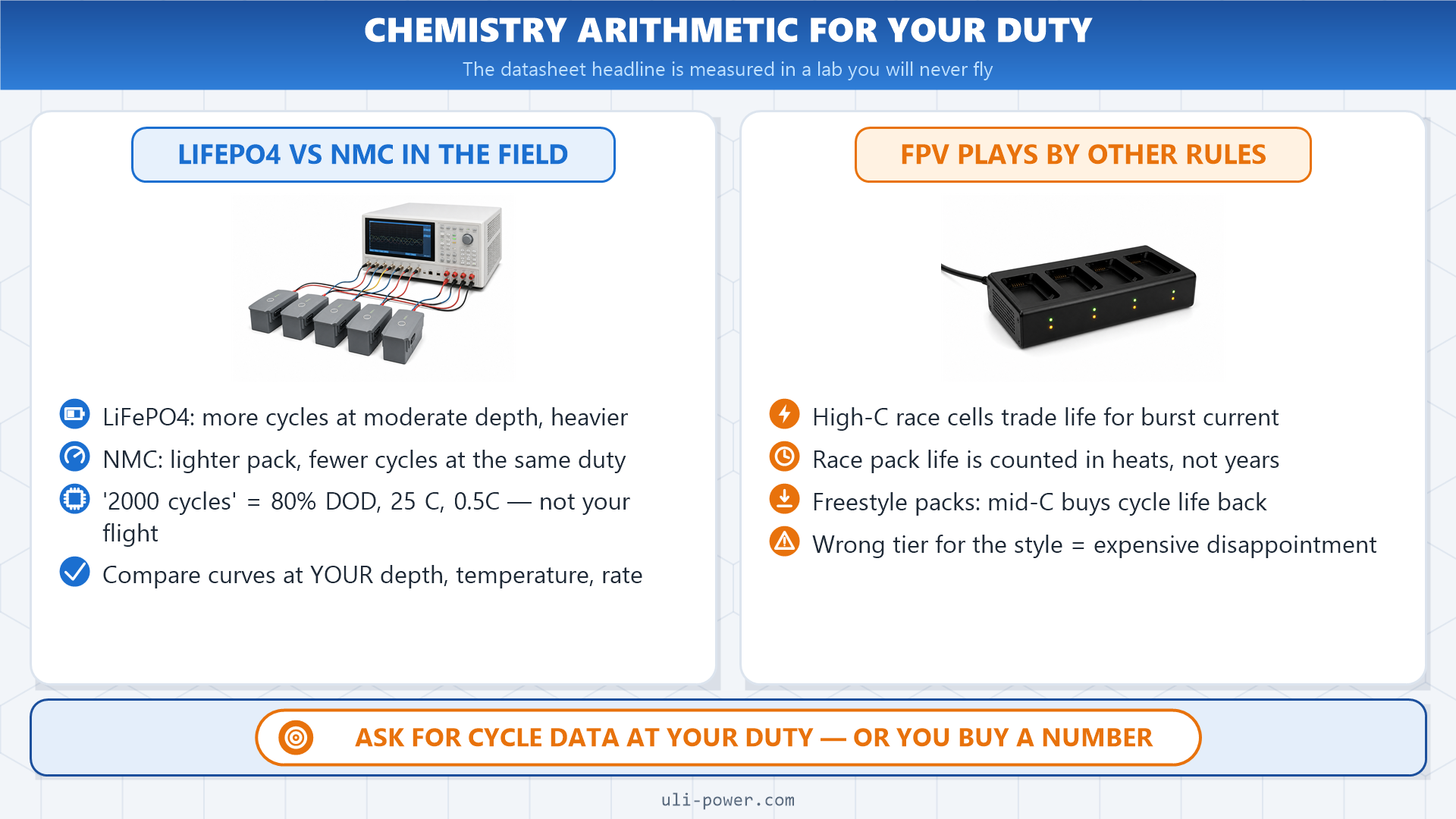
LiFePO4 typically delivers the highest cycle counts at moderate depth of discharge, at the cost of mass per watt-hour — the same energy weighs more. NMC gives you the lighter pack, with fewer cycles at the same duty, and the gap between quality tiers is large. The honest comparison is never the headline number — “2000 cycles” on a datasheet is measured at 80 percent depth, 25 degrees, half a charge rate, and a cutoff your aircraft would never accept.
Ask the supplier for the curve at your duty: cycle life at your depth of discharge, your average temperature, your charge rate. For FPV, the arithmetic is different again: high-C racing cells trade cycle life for burst current, and a race pack’s life is counted in crashes and heats, not in years. Choosing the chemistry for the mission is the first cost lever.
When to retire a pack
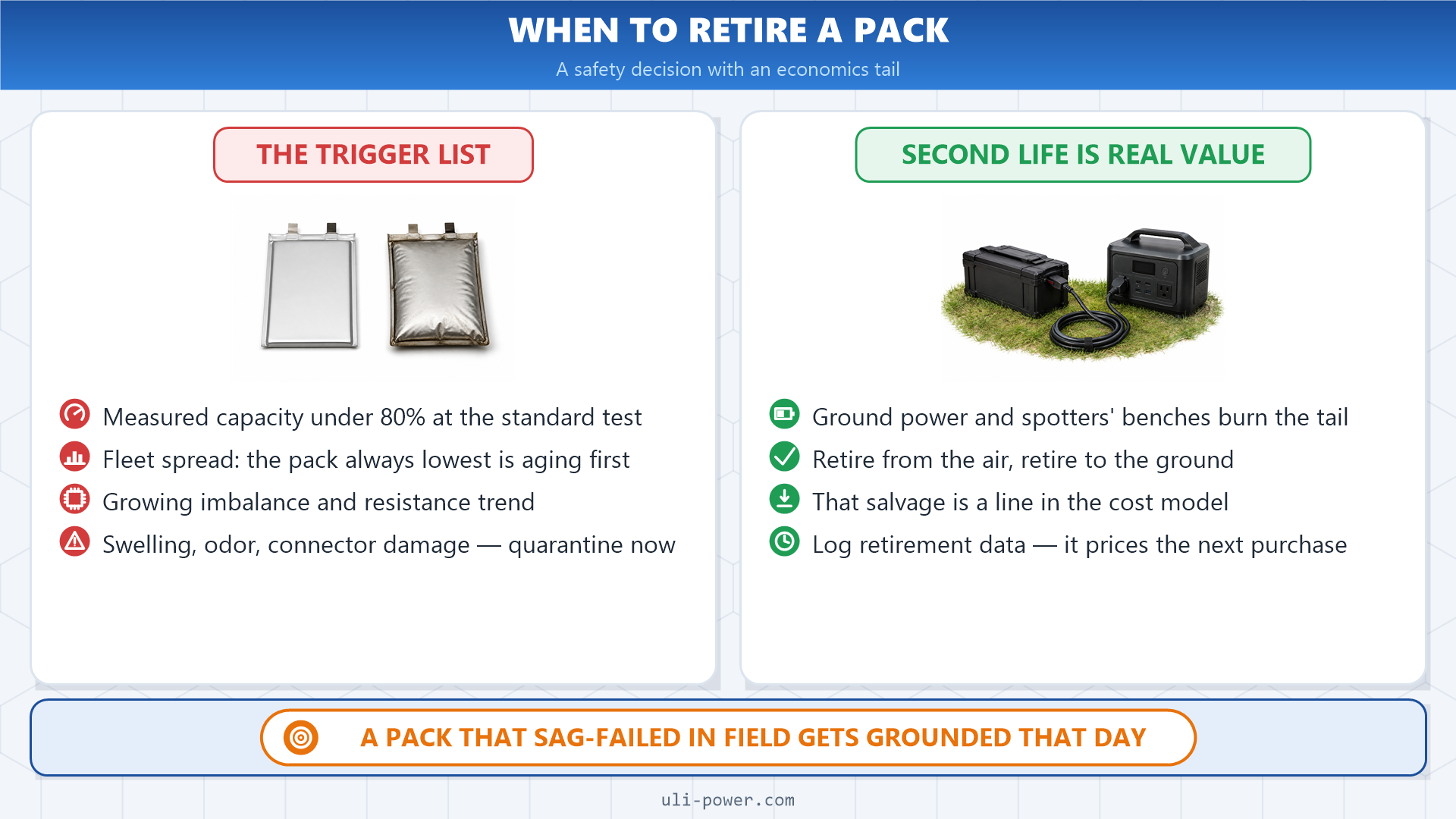
Retirement is a safety decision with an economics tail. The common triggers: measured capacity below 80 percent of nameplate at the standard test (low rate, room temperature) — though for aircraft the earlier warning is behavior, not the lab number. Watch runtime spread across the fleet: the pack that always comes back with the lowest cells is aging faster than its siblings. Watch imbalance growth between cycles, internal-resistance trend if the BMS logs it, and physical signs — swelling, electrolyte odor, connector damage, any cell that sags to cutoff under a normal load.
A pack that failed in the field gets quarantined that day, regardless of what the gauge says. And retirement is not the scrap heap: ground power, spotters’ benches, and training rigs happily burn the tail of the curve, which is exactly where the cost model below gets its last value.
The cost per flight hour model
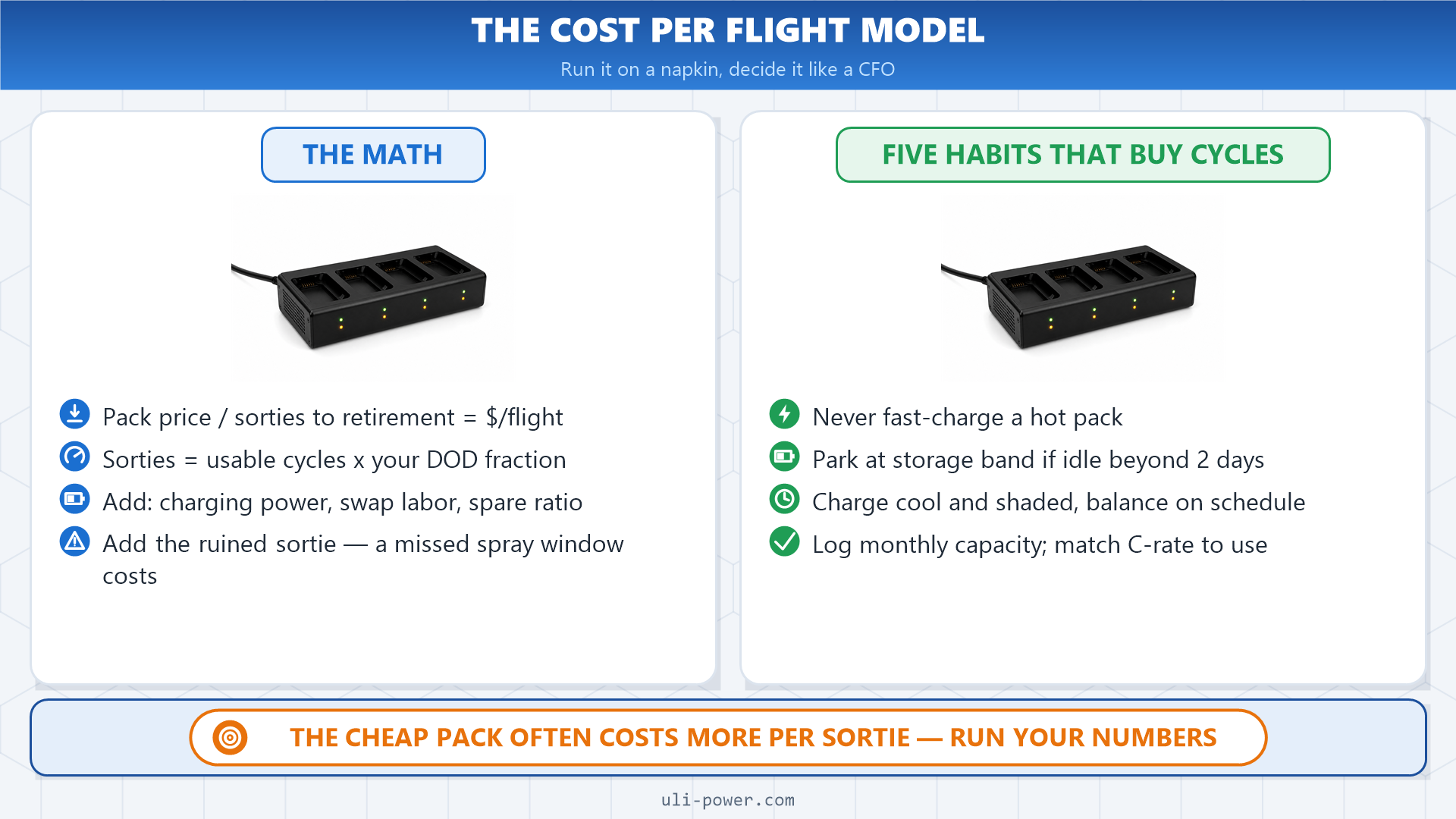
The model is simple enough to run on a napkin: pack price divided by expected sorties to retirement gives dollars per flight. Expected sorties come from cycle life at your duty multiplied by the usable share of the curve you accept — a pack retired at 80 percent gives you roughly four-fifths of its lab cycles in the air.
Now make it honest: add the electricity to charge it, the labor of swap and transport, the spare ratio your operation carries (a fleet that cannot afford downtime buys extra packs, and that capital is per-flight cost too), and the cost of a ruined sortie — one missed spray window has a real price in farming. Run the model with your numbers, not a supplier’s; the point is comparing purchase options on the same axis, and the axis is the sortie.
The result usually flips the purchase. The cheap pack with half the cycle life at your duty is not half the value — it is double the flights-of-downtime risk and often a higher cost per sortie than the premium pack.
Five habits that buy you more cycles
Charge at the rate the cell was designed for — fast-charging a warm pack is the most common cycle-life donation in the field. Do not store at full charge: if a pack will sit more than a couple of days, bring it to the storage band. Keep charge areas cool and shaded. Run a full balance charge on schedule and log monthly capacity per pack so trends appear before failures do. And match C-rate to use: a fleet that never pulls more than 2C has no business carrying 10C cells, and paying for them.
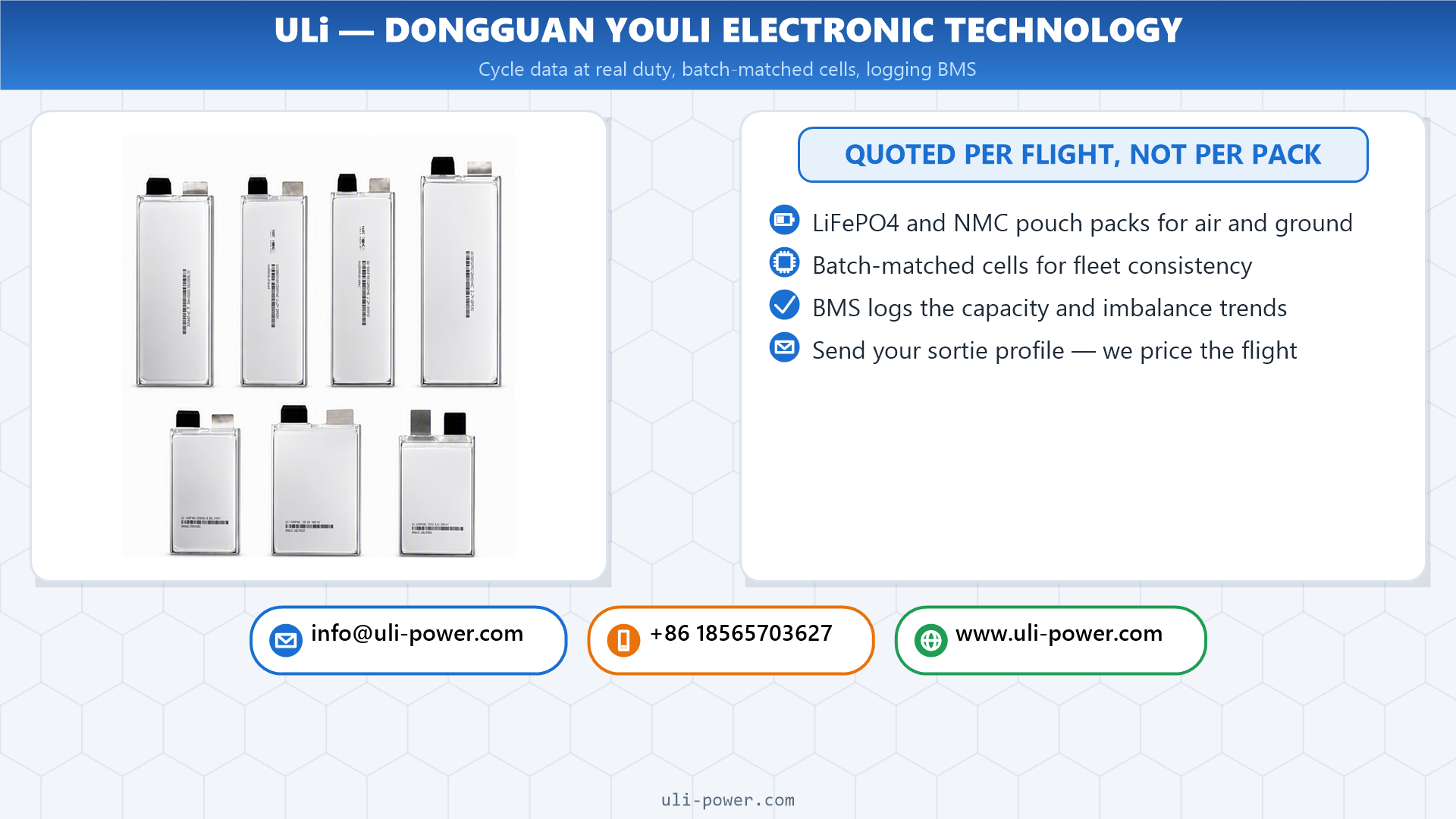
We are ULi — Dongguan Youli Electronic Technology Limited. We build LiFePO4 and NMC pouch cell packs for aerial and ground platforms with cycle data measured at representative duty, batch-matched cells for fleet consistency, and BMS telemetry that logs the capacity and imbalance trends this article asks you to track. Send us your sortie profile; we will quote the cost per flight, not just the pack.
Email: info@uli-power.com
Phone: +86 18565703627
Web: www.uli-power.com
Post time: Oct-28-2026