The global demand for LiFePO4 batteries is exploding, but so is the market for “budget-friendly” alternatives. While a low price tag is tempting, the internal components often hide a different story. To the untrained eye, two battery packs might look identical, but their performance and safety are worlds apart.
At ULi, we believe transparency is the foundation of trust. Here are 5 hidden signs of low-quality LiFePO4 batteries that many manufacturers try to hide.
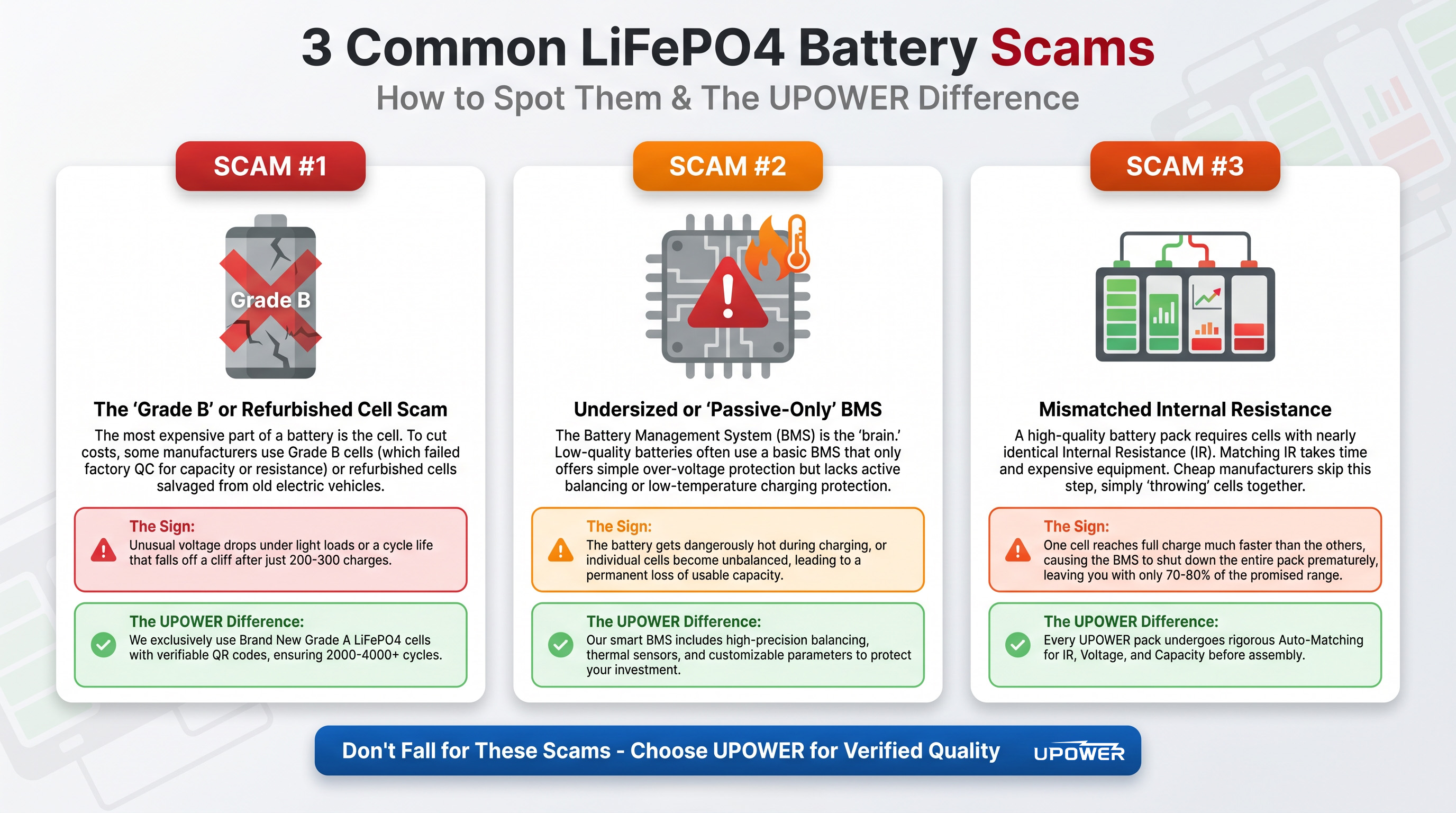
1. The “Grade B” or Refurbished Cell Scam
The most expensive part of a battery is the cell. To cut costs, some manufacturers use Grade B cells (which failed factory QC) or refurbished cells salvaged from old EVs.
- The Sign: Unusual voltage drops under light loads or a cycle life that falls off after just 200-300 charges.
- The ULi Difference: We exclusively use Brand New Grade A LiFePO4 cells with verifiable QR codes, ensuring 2000-4000+ cycles.
2. Undersized or “Passive-Only” BMS
The Battery Management System (BMS) is the “brain.” Low-quality batteries often use a basic BMS that lacks active balancing or low-temperature charging protection.
- The Sign: The battery gets dangerously hot during charging, or individual cells become unbalanced, leading to permanent capacity loss.
- The ULi Difference: Our smart BMS includes high-precision balancing, thermal sensors, and customizable parameters to protect your investment.
3. Mismatched Internal Resistance
A high-quality battery pack requires cells with nearly identical Internal Resistance (IR). Matching IR takes time and expensive equipment. Cheap manufacturers skip this step, simply “throwing” cells together.
- The Sign: One cell reaches full charge much faster than others, causing the BMS to shut down the pack prematurely, leaving you with only 70-80% of promised range.
- The ULi Difference: Every ULi pack undergoes rigorous Auto-Matching for IR, Voltage, and Capacity before assembly.
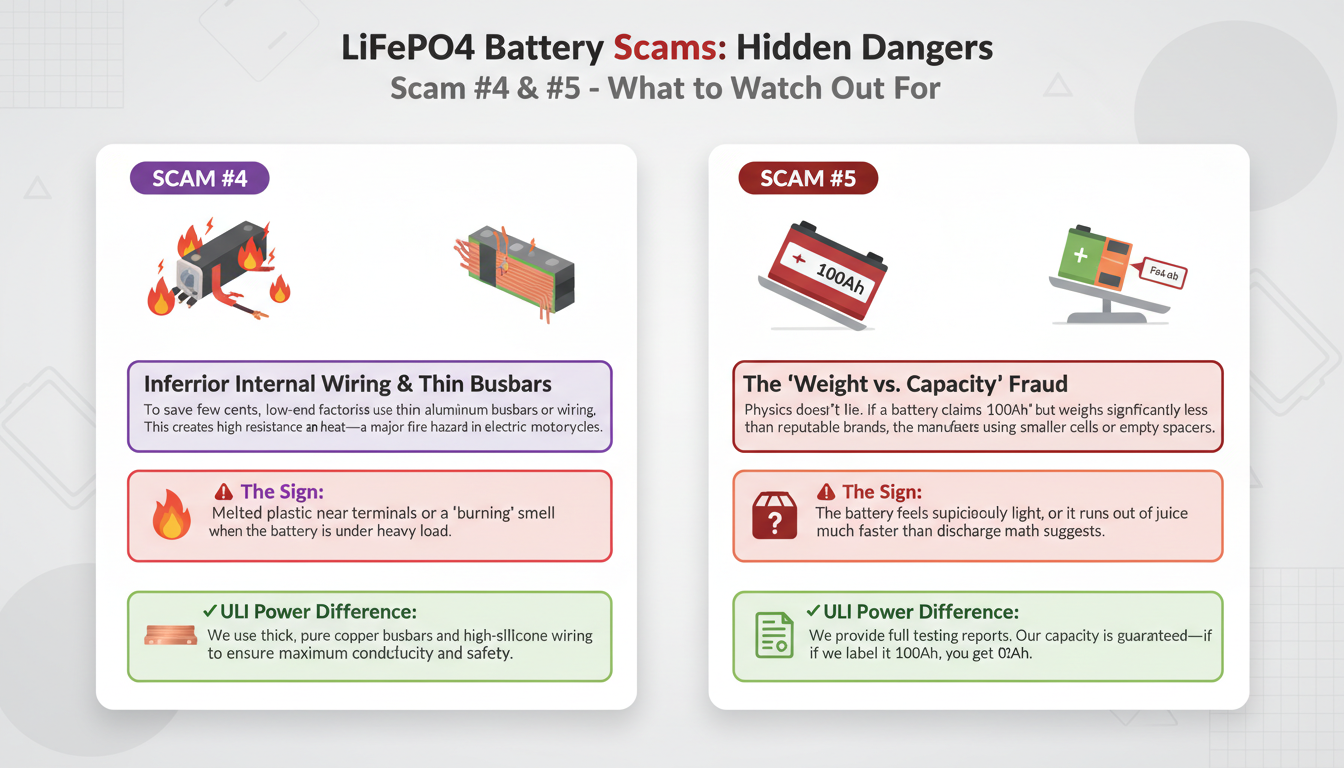
4. Inferior Internal Wiring and Thin Busbars
To save a few cents, low-end factories use thin aluminum busbars or undersized copper wiring. This creates high resistance and heat—a major fire hazard in electric motorcycles.
- The Sign: Melted plastic near terminals or a “burning” smell when the battery is under heavy load.
- The ULi Difference: We use thick, pure copper busbars and high-temp silicone wiring to ensure maximum conductivity and safety.
5. The “Weight vs. Capacity” Fraud
Physics doesn’t lie. If a battery claims “100Ah” but weighs significantly less than reputable brands, the manufacturer is likely using smaller cells or empty spacers.
- The Sign: The battery feels suspiciously light, or it runs out of juice much faster than discharge math suggests.
- The ULi Difference: We provide full testing reports. Our capacity is guaranteed—if we label it 100Ah, you get 100Ah.
Conclusion: You Get What You Pay For
Buying a low-quality battery isn’t just a waste of money—it’s a safety risk. When sourcing from China, always ask for cell grading reports, BMS specifications, and factory certifications.
Need a reliable power partner? ULi specializes in high-performance LiFePO4 solutions for electric motorcycles, home storage, and industrial needs.
Contact ULi for Professional Solutions:
- Email: info@uli-power.com
- Phone: +86 18565703627
- Web: www.uli-power.com
Post time: May-06-2026