Avoid Fines, Customs Detentions, and Rejected Submissions — Exclusively for EV Battery Manufacturers & Exporters
If you’re an EV battery manufacturer, exporter, or automaker shipping battery-powered products to the US — stop scrolling. The May 31, 2026 deadline for the SEC’s 2025 Conflict Minerals Report (CMR) is exactly 3 months away, and 90% of your compliance risk, reporting burden, and potential penalties are tied directly to your EV battery supply chain.
In 2025, 32% of EV industry submissions were either rejected by the SEC or resulted in customs detentions for incomplete battery mineral traceability, with fines reaching up to $1.2M per violation. This guide is built exclusively for EV battery stakeholders, with an actionable 90-day checklist, 2026 rule updates specific to battery materials, and the most common pitfalls to avoid.
2026 SEC Rule Updates: What EV Battery Stakeholders Need to Know
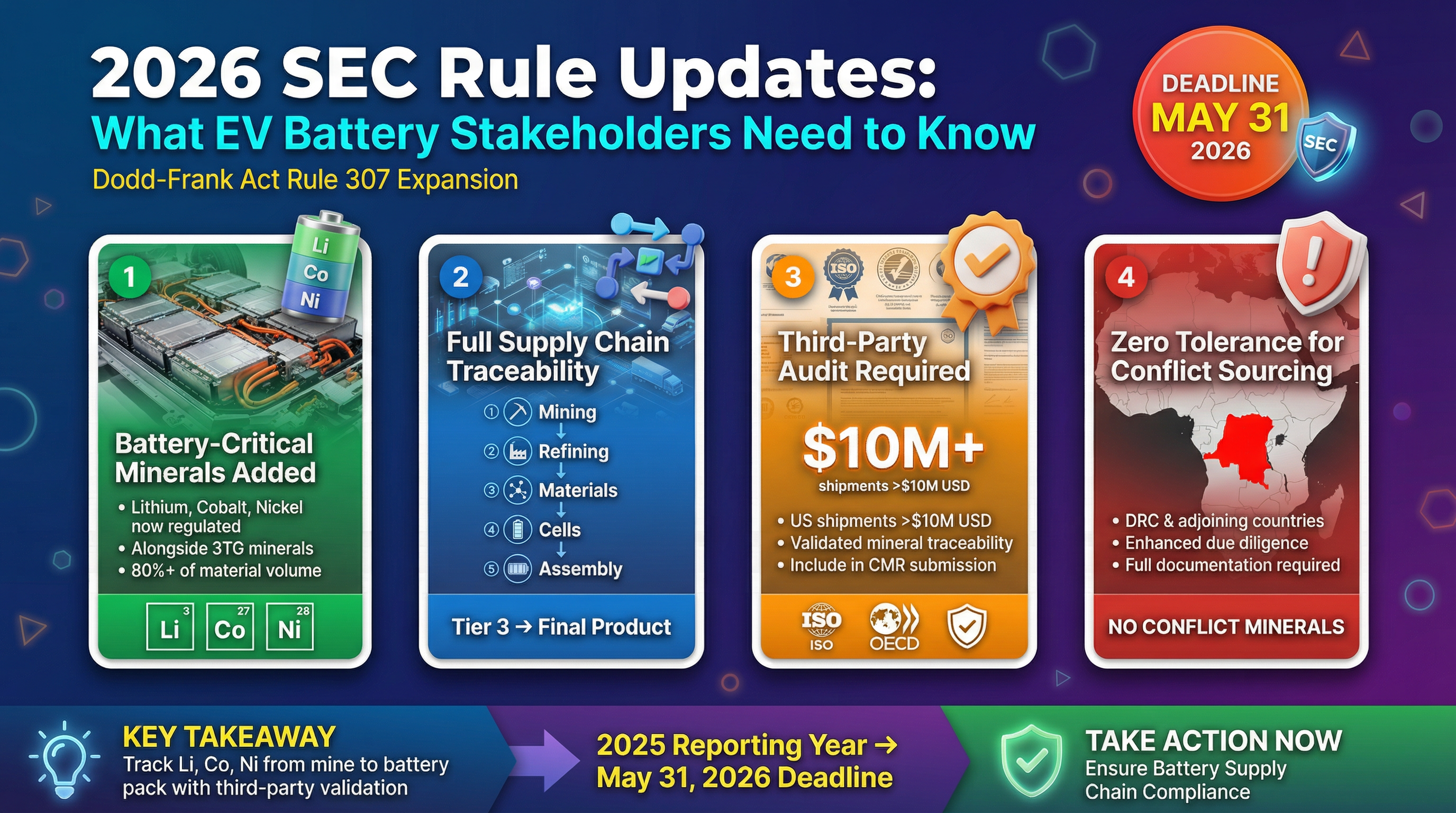
The SEC’s Dodd-Frank Act Rule 307 has expanded its scope for the 2025 reporting year (due May 31, 2026) — and the biggest changes directly impact EV battery supply chains:
- Battery-Critical Minerals Added to Mandatory Tracking: Lithium, cobalt, and nickel (the core raw materials of all EV battery chemistries, from LFP to NCM) are now regulated alongside the traditional 3TG minerals (tin, tantalum, tungsten, gold). For EV batteries, these three minerals make up 80%+ of your regulated material volume.
- Full Battery Supply Chain Traceability Mandate: You must map your battery supply chain down to the Tier 3 mining level — not just your cell supplier. This means tracking from:
○ Mining (lithium brine/hard rock, cobalt/nickel mines)
○ Refining & processing
○ Cathode/anode material manufacturing
○ EV cell production
○ Battery pack assembly
- Third-Party Audit Requirement for High-Volume Shippers: EV battery exporters with annual US shipments exceeding $10M USD must include a third-party validated audit of their battery mineral traceability in their CMR submission.
- Zero Tolerance for Conflict Zone Sourcing: Batteries containing minerals from the Democratic Republic of the Congo (DRC) and adjoining conflict-affected countries require enhanced due diligence, with full documentation to prove no funds supported armed groups.
90-Day EV Battery Conflict Minerals Prep Checklist (By Month)
This phase-based checklist is built exclusively for EV battery manufacturers and exporters, with actionable tasks to meet the May 31 deadline without last-minute delays:
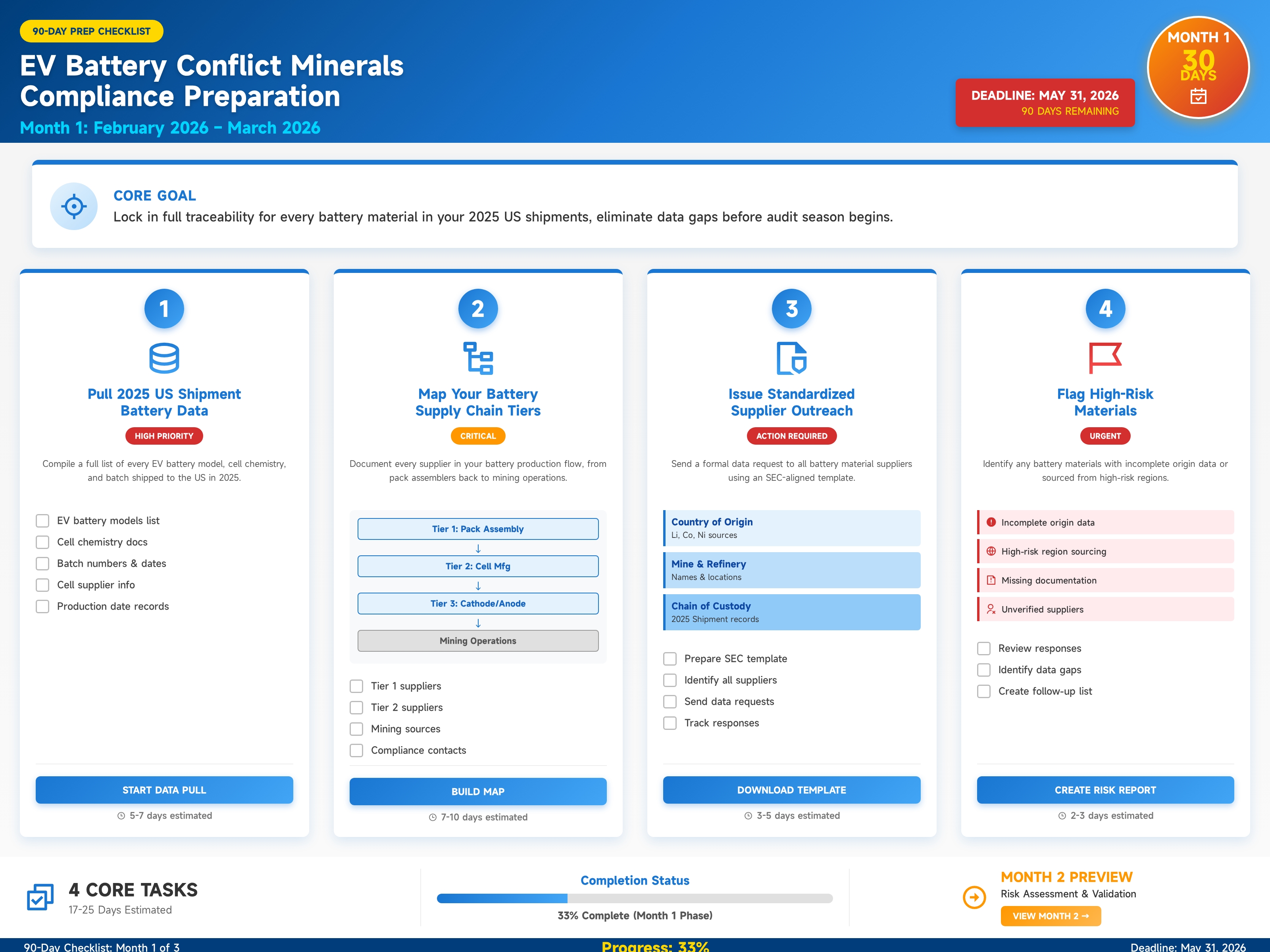
Month 1: February 2026 – March 2026 | Supply Chain Mapping & Data Collection
Core Goal: Lock in full traceability for every battery material in your 2025 US shipments, eliminate data gaps before audit season.
- Pull your 2025 US shipment battery data: Compile a full list of every EV battery model, cell chemistry, and batch shipped to the US in 2025, with corresponding cell suppliers and production dates.
- Map your battery supply chain tiers: Document every supplier in your battery production flow, from pack assemblers back to mining operations, with contact details for compliance leads at each Tier 1, 2, and 3 supplier.
- Issue standardized supplier outreach: Send a formal data request to all battery material suppliers, using an SEC-aligned template to collect:
○ Country of origin for all battery-grade lithium, cobalt, and nickel in your materials
○ Mine name, refinery location, and conflict-free status documentation
○ Full chain of custody records for 2025 shipments
- Flag high-risk materials: Identify any battery materials with incomplete origin data, or sourced from high-risk regions, for priority follow-up.
Month 2: March 2026 – April 2026 | Risk Assessment & Third-Party Validation
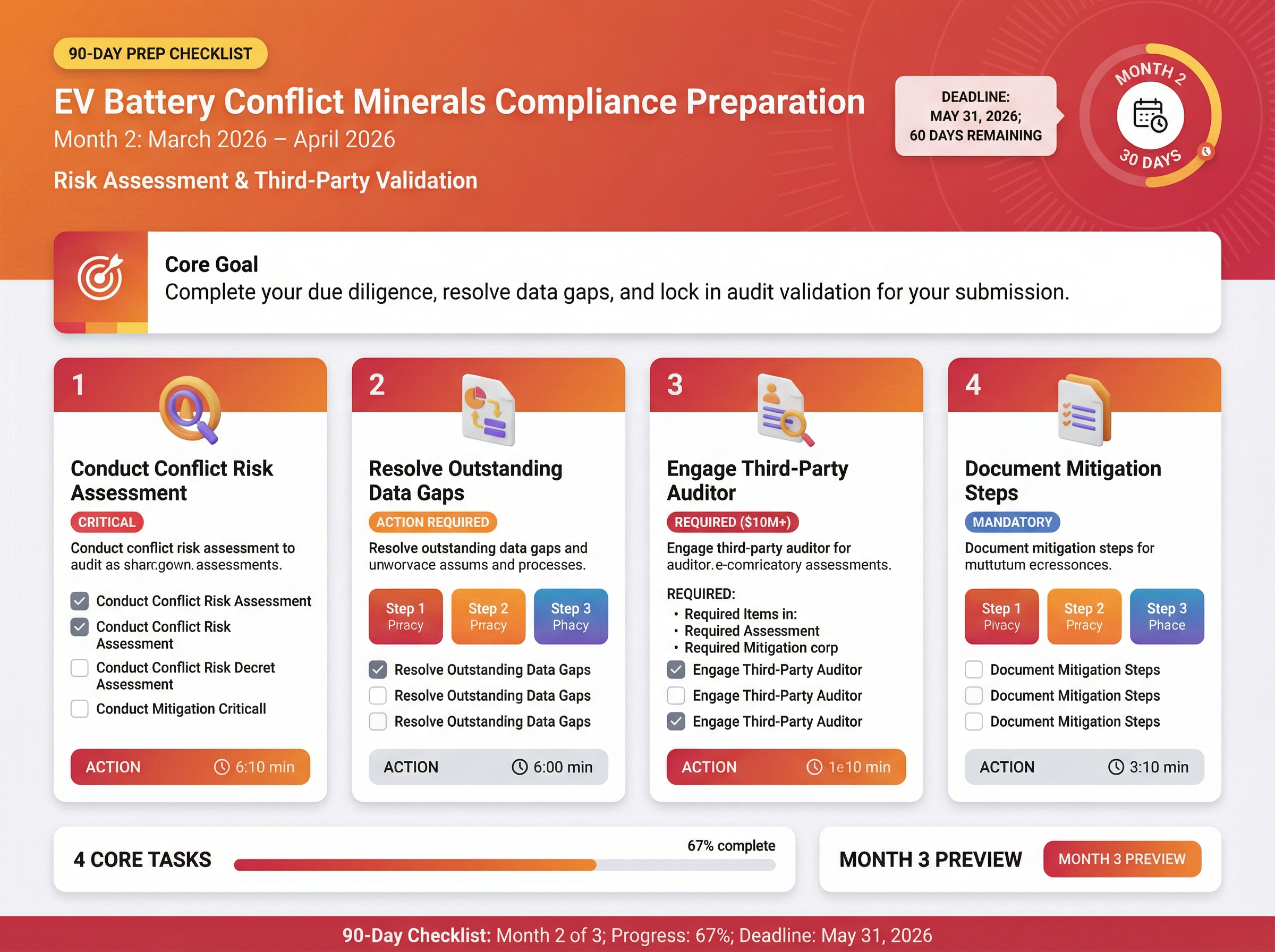
Core Goal: Complete your due diligence, resolve data gaps, and lock in audit validation for your submission.
- Conduct a conflict risk assessment: For all battery materials sourced from high-risk regions, complete a SEC-compliant due diligence review, including supplier audits and chain of custody verification.
- Resolve outstanding data gaps: Follow up with non-responsive battery suppliers, with clear deadlines for documentation submission — have backup supplier data on hand for any incomplete records.
- Engage a SEC-recognized third-party auditor: If you meet the $10M shipment threshold, contract an auditor with specific EV battery industry experience to validate your traceability data and due diligence processes.
- Document your mitigation steps: For any identified conflict risks, formalize a written mitigation plan (e.g., supplier phasedown, alternative material sourcing) to include in your CMR.
Month 3: April 2026 – May 31, 2026 | Report Finalization & SEC Submission
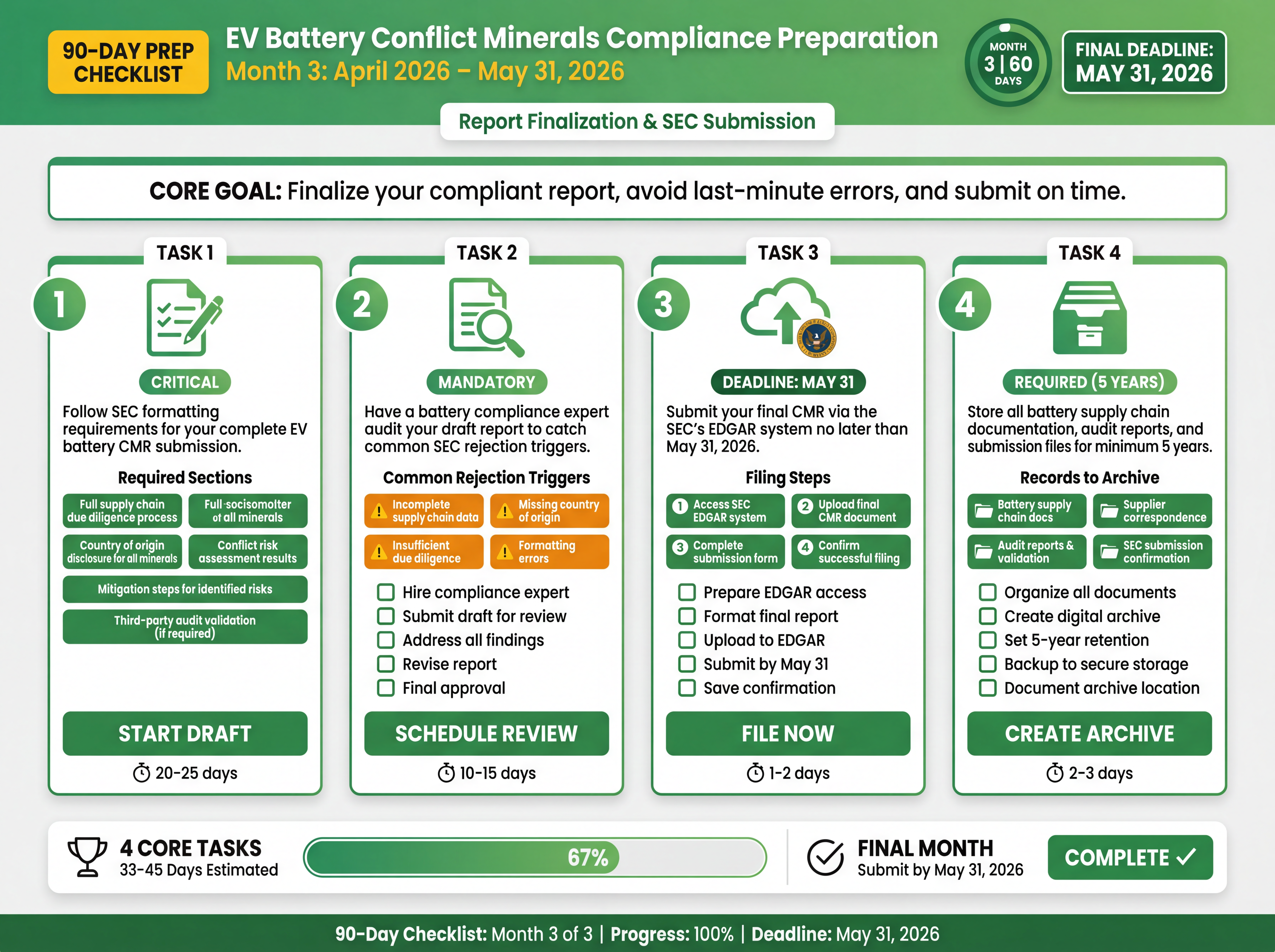
Core Goal: Finalize your compliant report, avoid last-minute errors, and submit on time.
- Draft your full Conflict Minerals Report: Follow SEC formatting requirements, including:
○ Full description of your EV battery supply chain due diligence process
○ Country of origin disclosure for all regulated battery minerals
○ Results of your conflict risk assessment
○ Mitigation steps for any identified risks
○ Third-party audit validation (if required)
- Conduct a pre-submission compliance review: Have a battery compliance expert audit your draft report to catch common SEC rejection triggers.
- File your report with the SEC: Submit your final CMR via the SEC’s EDGAR system no later than May 31, 2026.
- Archive all records: Store all battery supply chain documentation, audit reports, and submission files for a minimum of 5 years, per SEC record-keeping requirements.
5 Most Common EV Battery CMR Rejection Triggers (2025 Industry Data)
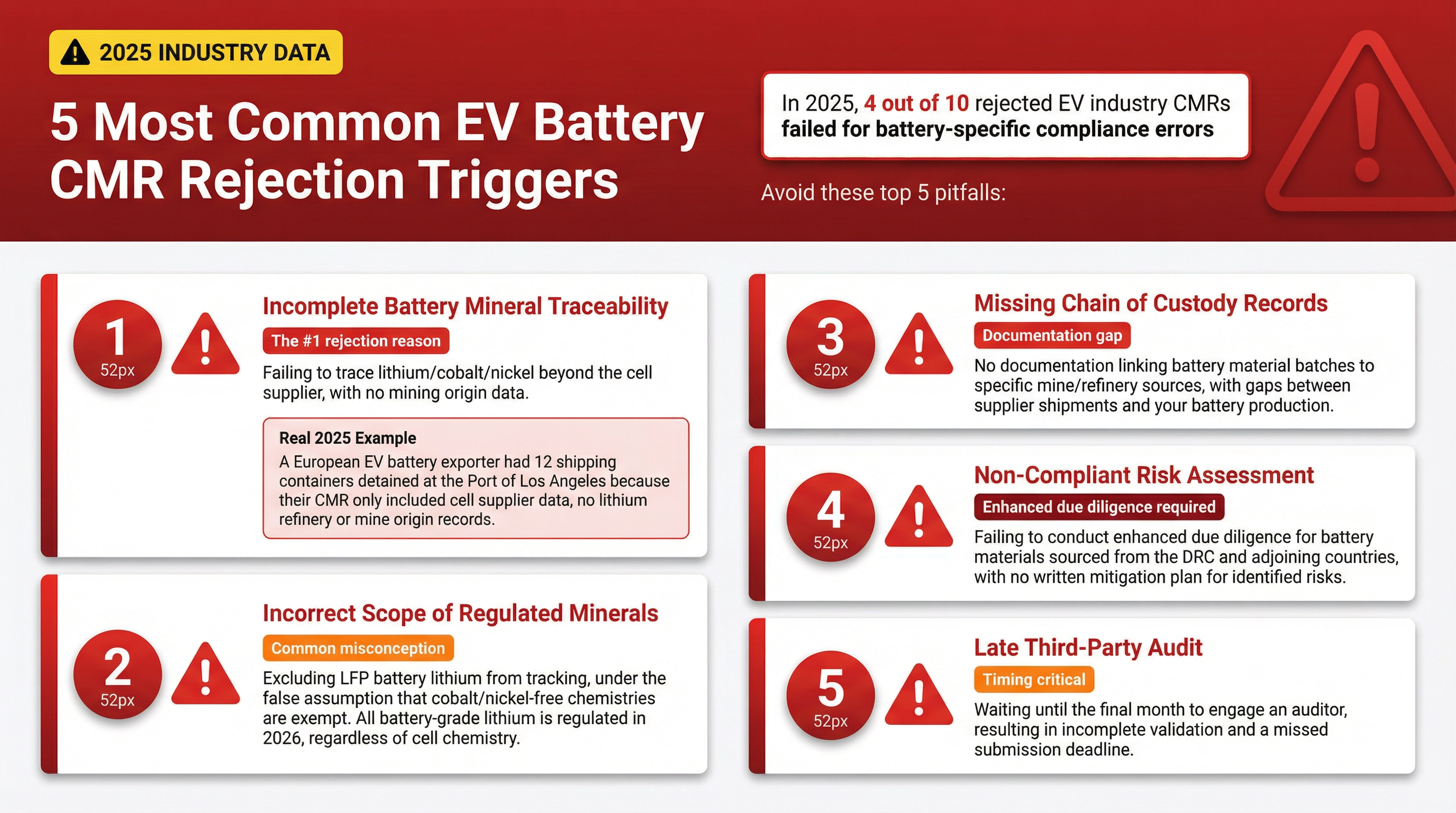
In 2025, 4 out of 10 rejected EV industry CMRs failed for battery-specific compliance errors. Avoid these top 5 pitfalls:
- Incomplete Battery Mineral Traceability: The #1 rejection reason — failing to trace lithium/cobalt/nickel beyond the cell supplier, with no mining origin data.
Real 2025 Example: A European EV battery exporter had 12 shipping containers detained at the Port of Los Angeles because their CMR only included cell supplier data, no lithium refinery or mine origin records.
- Incorrect Scope of Regulated Minerals: Excluding LFP battery lithium from tracking, under the false assumption that cobalt/nickel-free chemistries are exempt. All battery-grade lithium is regulated in 2026, regardless of cell chemistry.
- Missing Chain of Custody Records: No documentation linking battery material batches to specific mine/refinery sources, with gaps between supplier shipments and your battery production.
- Non-Compliant Risk Assessment: Failing to conduct enhanced due diligence for battery materials sourced from the DRC and adjoining countries, with no written mitigation plan for identified risks.
- Late Third-Party Audit: Waiting until the final month to engage an auditor, resulting in incomplete validation and a missed submission deadline.
ULi Power: Your EV Battery Conflict Minerals Compliance Partner
Navigating the SEC’s 2026 conflict minerals rules for EV batteries doesn’t have to be a burden. At ULi Power, we specialize in end-to-end EV battery global compliance, with a 100% success rate helping 50+ global battery manufacturers and automakers meet SEC and US market requirements.
Our exclusive EV battery conflict minerals solutions include:
- Battery Supply Chain Traceability Platform: Cloud-based system to map and track your full battery supply chain, from mining to pack assembly, with automated supplier data collection and SEC-aligned record-keeping.
- Pre-Submission Compliance Review: Expert audit of your CMR draft to catch rejection triggers, with 10+ years of EV battery SEC compliance experience.
- Third-Party Audit Coordination: Partnerships with SEC-recognized auditors specializing in EV battery materials, cutting audit timelines by 30% vs. industry averages.
- Ongoing Compliance Support: Year-round supplier outreach, documentation management, and 2027 rule updates to keep your US shipments compliant long-term.
Ready to meet the May 31 deadline without the stress of last-minute compliance gaps? Reach out to our EV battery compliance experts today for a free pre-submission review of your 2025 supply chain data.
Inquiry Email: info@uli-power.com
Contact: +86 18565703627
Website: www.uli-power.com
Post time: Feb-25-2026