For EV battery businesses and buyers operating in global markets, compliance is a “make-or-break requirement.” In 2024, regulatory standards across Europe, the US, and Southeast Asia continue to tighten—non-compliant products face consequences ranging from tens of thousands of euros/dollars in fines and cargo detention to permanent market exclusion. This guide breaks down the latest requirements for EU CE/UN38.3, US UL, and Southeast Asian local certifications, highlights risks with real-world cases, and includes an actionable compliance checklist to help you navigate regional markets smoothly.
I. Critical Warnings: Real Compliance Failures to Learn From
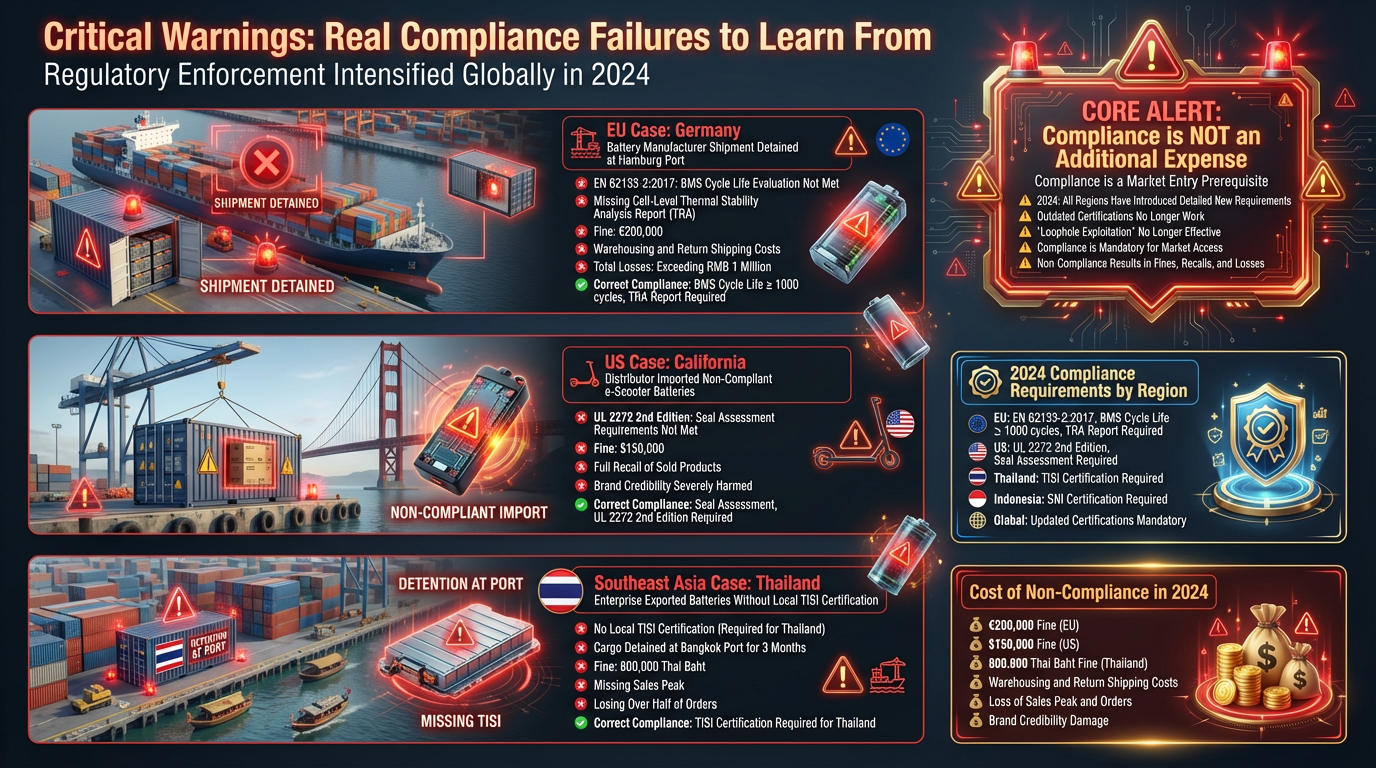
Regulatory enforcement for EV battery compliance has intensified globally in 2024. These actual scenarios serve as vital reminders for industry players:
- EU Case: A battery manufacturer’s shipment to Germany was detained at Hamburg Port for failing to meet the updated BMS cycle life evaluation in EN 62133-2:2017 and lacking a Cell-Level Thermal Stability Analysis Report (TRA). The company incurred a €200,000 fine, plus substantial warehousing and return shipping costs, resulting in total losses exceeding RMB 1 million.
- US Case: A California distributor imported e-scooter batteries that did not comply with the new seal assessment requirements in UL 2272 2nd Edition. Regulators imposed a $150,000 fine and forced a full recall of sold products, severely harming the brand’s credibility.
- Southeast Asia Case: An enterprise exported EV batteries to Thailand with only international certifications but no local TISI certification. The cargo was detained at Bangkok Port. After 3 months of supplementary certification and an 800,000 Thai baht fine, the shipment was released—missing the sales peak and losing over half its orders.
Core Alert: Compliance is not an “additional expense” but a “market entry prerequisite.” In 2024, all regions have introduced detailed new requirements—outdated certifications or “loophole exploitation” no longer work!
II. Regional Deep Dive: 2024 Latest Compliance Requirements (Must-Know for Businesses/Buyers)
Compliance priorities vary by region. Below are the key 2024 updates to target your preparations effectively:
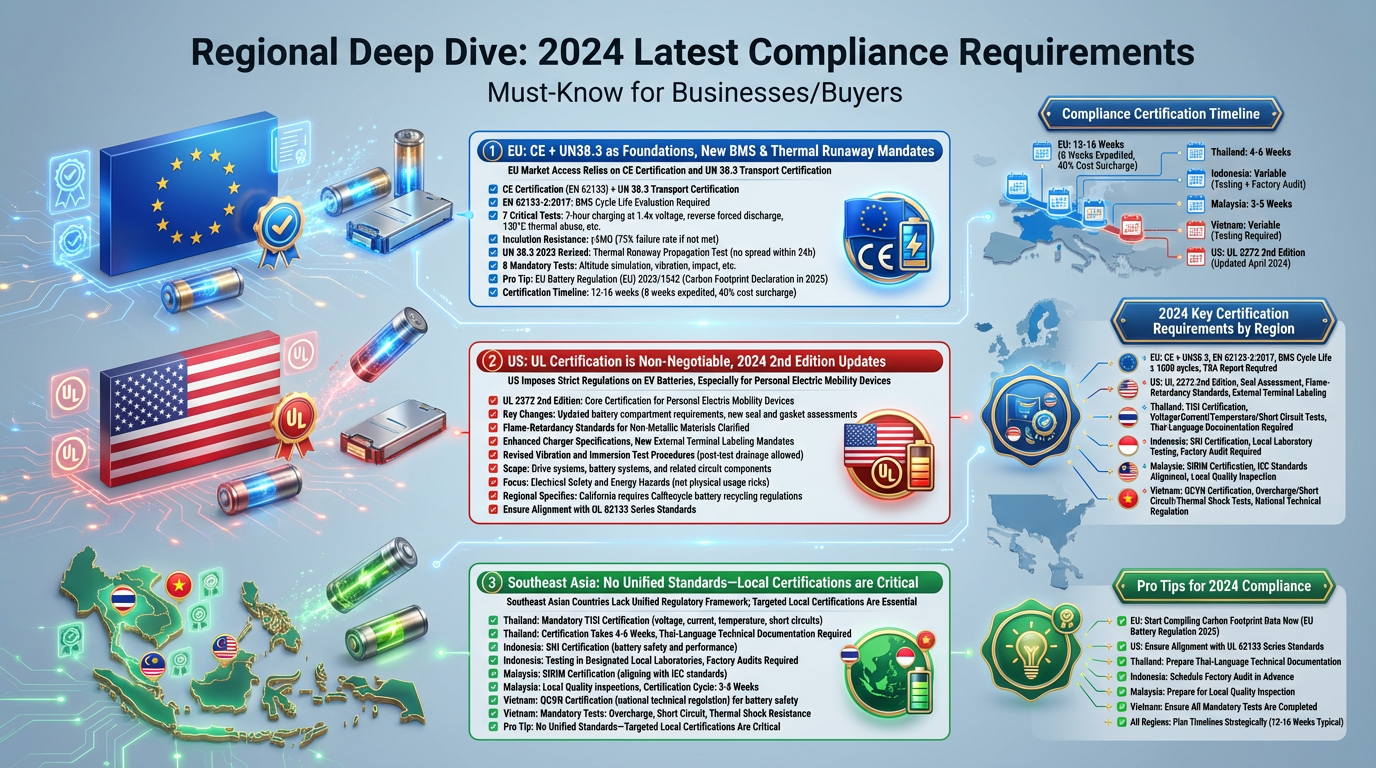
(1) EU: CE + UN38.3 as Foundations, New BMS & Thermal Runaway Mandates
EU market access relies on CE certification (including EN 62133) and UN 38.3 transport certification. 2024 updates focus heavily on BMS performance and thermal safety:
- EN 62133-2:2017 (CE Core Standard): Now mandates BMS cycle life evaluation for portable lithium-ion batteries. Products must pass 7 critical tests: 7-hour continuous charging at 1.4x rated voltage, stable reverse forced discharge, 130°C thermal abuse resistance, etc. Insulation resistance must be ≥5MΩ—failure rates reach 75% if this threshold is not met.
- UN 38.3 (Mandatory for Transport): The 2023 revised edition adds a “thermal runaway propagation test,” requiring no spread to adjacent cells within 24 hours if one cell malfunctions. It also includes 8 mandatory tests: 6-hour altitude simulation at 11.6kPa, 3-hour random vibration, 150G/6ms half-sine wave impact, etc.
- Pro Tip: The EU’s new Battery Regulation (EU) 2023/1542 will enforce carbon footprint declarations in 2025. Start compiling relevant data now to avoid last-minute disruptions. Certification typically takes 12-16 weeks (8 weeks for expedited service, with a 40% cost surcharge)—plan timelines strategically.
(2) US: UL Certification is Non-Negotiable, 2024 2nd Edition Updates
The US imposes strict regulations on EV batteries, especially for personal electric mobility devices. UL 2272 is the core certification, with key updates in its April 2024 2nd Edition:
- UL 2272 2nd Edition Key Changes: Updated battery compartment requirements, new seal and gasket assessments, clarified flame-retardancy standards for non-metallic materials, enhanced charger specifications, new external terminal labeling mandates, and revised vibration and immersion test procedures (allowing post-test drainage).
- Scope: Covers drive systems, battery systems, and related circuit components for personal electric mobility devices (e.g., e-scooters). Focuses on electrical safety and energy hazards, not physical usage risks.
- Regional Specifics: California requires additional compliance with CalRecycle battery recycling regulations. Ensure products align with referenced standards in the UL 62133 series to avoid incomplete certification.
(3) Southeast Asia: No Unified Standards—Local Certifications are Critical
Southeast Asian countries lack a unified regulatory framework; targeted local certifications are essential for market access:
- Thailand: Mandatory TISI certification, requiring safety tests for voltage, current, temperature, and short circuits. Certification takes 4-6 weeks, with Thai-language technical documentation required.
- Indonesia: SNI certification is core, covering battery safety and performance. Testing must be conducted in designated local laboratories, with factory audits required.
- Malaysia: SIRIM certification, aligning with relevant IEC standards. Products must pass local quality inspections, with a typical certification cycle of 3-5 weeks.
- Vietnam: QCVN certification (national technical regulation) for battery safety. Mandatory tests include overcharge, short circuit, and thermal shock resistance.
III. Actionable Compliance Checklist (For Businesses & Buyers)
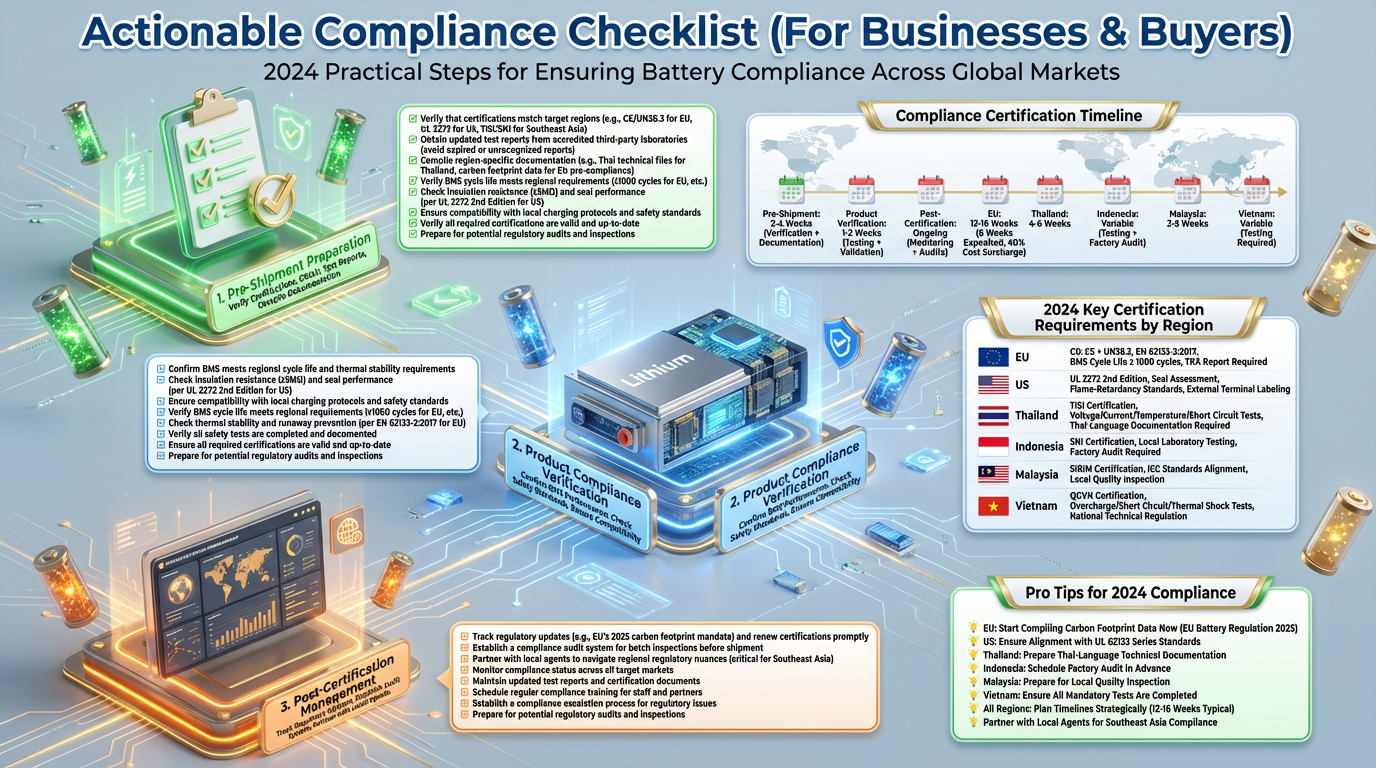
1. Pre-Shipment Preparation
- Verify that certifications match target regions (e.g., CE/UN38.3 for EU, UL 2272 for US, TISI/SNI for Southeast Asia).
- Obtain updated test reports from accredited third-party laboratories (avoid expired or unrecognized reports).
- Compile region-specific documentation (e.g., Thai technical files for Thailand, carbon footprint data for EU pre-compliance).
2. Product Compliance Verification
- Confirm BMS meets regional cycle life and thermal stability requirements.
- Check insulation resistance (≥5MΩ) and seal performance (per UL 2272 2nd Edition for US).
- Ensure compatibility with local charging protocols and safety standards.
3. Post-Certification Management
- Track regulatory updates (e.g., EU’s 2025 carbon footprint mandate) and renew certifications promptly.
- Establish a compliance audit system for batch inspections before shipment.
- Partner with local agents to navigate regional regulatory nuances (critical for Southeast Asia).
IV. ULi Power: Your Trusted Compliance Partner for Global Markets
ULi Power specializes in global-ready EV battery solutions, with products fully compliant with EU CE/UN38.3, US UL 2272, and Southeast Asian local certifications (TISI/SNI/SIRIM/QCVN). Our core advantages include:
- Regional Expertise: Dedicated teams monitor 2024 regulatory updates to ensure products meet the latest requirements.
- Accredited Testing: All products undergo third-party testing by recognized laboratories, with complete documentation provided.
- End-to-End Support: From pre-shipment compliance checks to local certification assistance, we simplify market entry.
Contact Us for Compliance Support
Whether you’re targeting the EU, US, or Southeast Asia, ULi Power can tailor battery solutions to meet regional regulatory demands. Reach out today to avoid compliance pitfalls and accelerate your market expansion.
Inquiry Email: info@uli-power.com
Contact: +86 18565703627
Website: www.uli-power.com
Post time: Jan-22-2026